






ROBERTS, Herbert Cunningham
| Service Number: | 406368 |
|---|---|
| Enlisted: | 11 November 1940 |
| Last Rank: | Flight Lieutenant |
| Last Unit: | No. 43 Squadron (RAAF) |
| Born: | Bunbury, Western Australia, Australia, 7 November 1912 |
| Home Town: | Bunbury, Bunbury, Western Australia |
| Schooling: | Bunbury High School, Western Australia, Australia |
| Occupation: | Bank Officer |
| Died: | Flying Battle, Philippines, 14 December 1944, aged 32 years |
| Cemetery: |
No known grave - "Known Unto God" Labuan Memorial, Labuan, Malaysia Panel 32 |
| Memorials: | Australian War Memorial Roll of Honour, Capel War Memorial, Fremantle Commonwealth Bank of Australia West Australian Staff WW2 Honour Roll, Kings Park Western Australia State War Memorial |
World War 2 Service
| 3 Sep 1939: | Involvement Flight Lieutenant, 406368 | |
|---|---|---|
| 11 Nov 1940: | Enlisted Royal Australian Air Force, Flight Lieutenant, 406368 | |
| 14 Dec 1944: | Involvement Royal Australian Air Force, Flight Lieutenant, No. 43 Squadron (RAAF) |
Help us honour Herbert Cunningham Roberts's service by contributing information, stories, and images so that they can be preserved for future generations.
Add my storyBiography contributed by Geoff Tilley
Herbert Cunningham Roberts was born in November 1912 at Bunbury to parents Herbert Henry Roberts and Rose Campbell Forrest, who were married in 1898 at Busselton.
Herbert was the youngest of four siblings, with two brothers and a sister, conducting his schooling at Bunbury.
On leaving school, Herbert worked with the Commonwealth Bank as a bank officer.
In October 1939 Herbert married Doryne Leonora Smith in Claremont, living in the Nedlands area. A daughter was born in December 1943.
Herbert enlisted into the Royal Australian Air Force (R.A.A.F.) in November 1940 at Perth, assigned to trainee aircrew.
On receiving his pilot wings, Herbert was fast track to become a flying instructor.
Throughout 1941 to mid 1943, he served as a flying instructor at Amberley, Queensland, and Mallala South Australia.
He was then transferred to maritime reconnaissance training at Bairnsdale, Victoria and Catalina conversion training at Rathmines, New South Wales.
At the completion of his Catalina training, he was posted as a co-pilot to No 43 Squadron, based at Karumba, Queensland in November 1943.
He underwent further conversion training at Rathmines, where he was reposted in July 1944 back to 43 Squadron as a Catalina Captain.
By this time the squadron was now based at Darwin continuing operational service, assigned to Catalina A24-64, nicked name The Dabster by its crew.
The Catalina’s where also known as the Black Cats.
The Black cats flew missions which included long range mine laying, reconnaissance, and rescue operations. The majority of their flying operations were conducted in secret, mine laying Japanese Imperial Navy sea routes throughout the South China and Philippines Sea.
It was on the night of 14 December 1944 that Herbert in command of Catalina A24-64 was to conduct another long range mine laying operation to mine the Balabac Strait and the mouth of Manila Bay Philippines, in an attempt to disrupt the Japanese naval force from attacking allied forces on the Island on Mindoro.
The target area for the Catalina’s was known to be well defended by Japanese anti-aircraft gun emplacements in particular to the entrance of Manila Bay.
Herbert’s Catalina and remainder of his crew never returned from this mission, vanished without trace, with all the crew listed as missing in action.
It was later reported that other Catalina crews had observed an explosion in the position of the target area, indicating The Dabster had been hit by anti-aircraft fire, with its crew lost at sea.
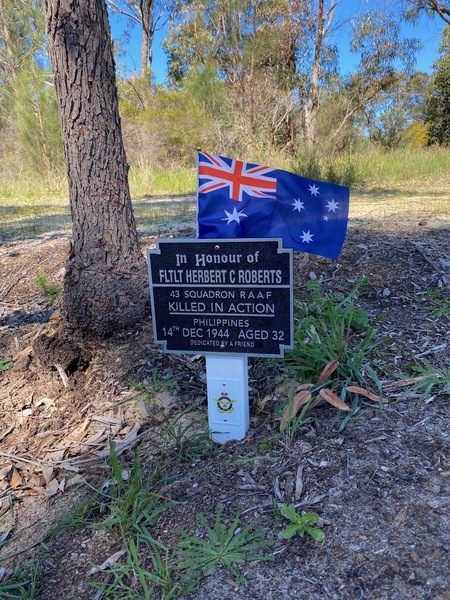
Flight Lieutenant Herbert Cunningham Roberts, service number 406368, of No 43 Squadron R.A.A.F. was killed in action during a mine laying operation in Manila Bay, Philippines aboard Catalina A24-64 on the night of 14 December 1944. He was 32 years of age.
His body has never been recovered, along with his crew and they are commemorated on the Labuan Memorial, Malaysia.
It was in March 2019 the R.A.A.F. were conducting a reconnaissance mission in the area of Manila Bay, when wreckage of A24-64, the Dabster was discovered southeast of Cape Calavite on Mindoro Island.
This was discovered to be the route of the Dabster to its target to mine the shipping lanes in Manila Harbour.
It is understood that several artefacts at the location came to light in 2014, consisting of a small metal tube with the aircraft’s manufacturers logo, a brass crown identified as RAAF cap badge and .303 ammunition.
Subsequent visits to the area where further items have been located, unique to the Black Cat Catalina flying boats that were flown by Australian crews.
A recovery mission had been planned to visit the crash site in 2020 in an attempt to confirm if the crash site is the Dabster with its missing crew.
Herbert along with his crew are remembered with honour.
His Kings Park Honour plaque is co-located with Sergeant Harold Stanley Goodchild of Mukinbudin who was an air gunner of The Dabster.




Click images to start slideshow.