








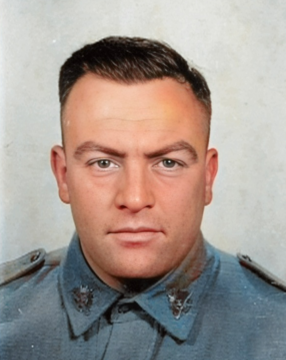
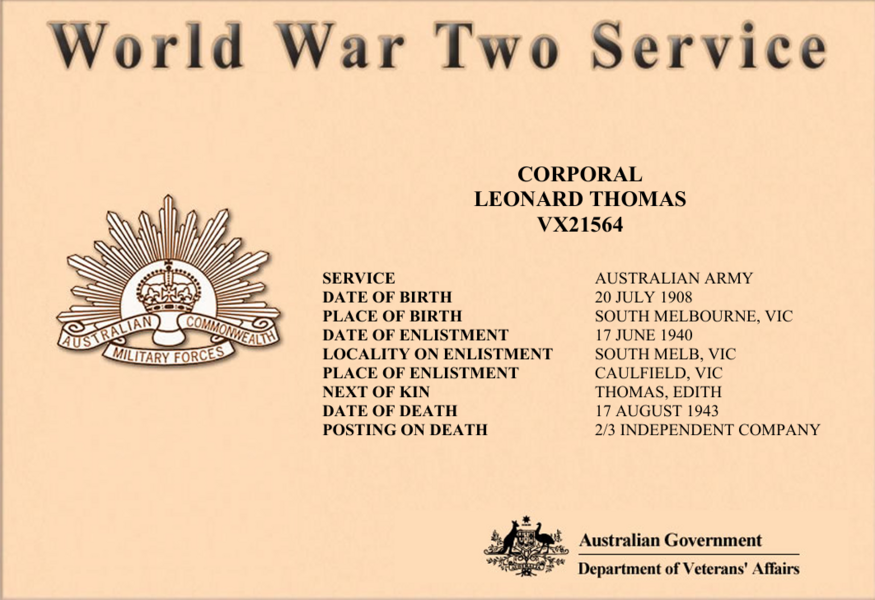
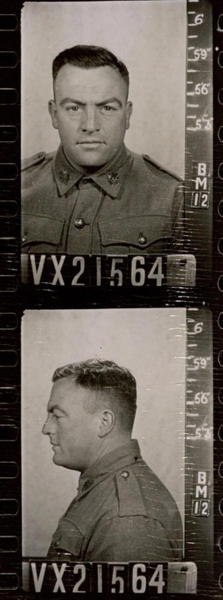
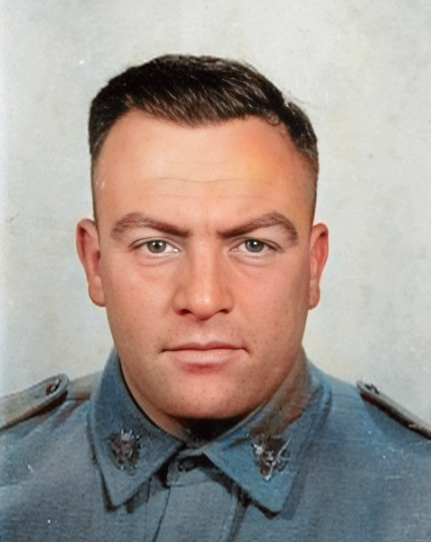
THOMAS, Leonard
| Service Number: | VX21564 |
|---|---|
| Enlisted: | 17 June 1940 |
| Last Rank: | Corporal |
| Last Unit: | 2nd/3rd Independent Company / Commando Squadron |
| Born: | South Melbourne, Victoria, Australia,, 20 July 1908 |
| Home Town: | South Melbourne, Port Phillip, Victoria |
| Schooling: | Not yet discovered |
| Occupation: | Custom's Agent |
| Died: | Killed in Action, New Guinea, 17 August 1943, aged 35 years |
| Cemetery: |
Lae War Cemetery CWGC Grave Reference: Plot P. Row D. Grave 11. Inscription: "WELL DONE "LEN"" |
| Memorials: | Albert Park South Melbourne & Sydney Swans Football Club Honour Roll, Australian Commando Memorial, Australian War Memorial Roll of Honour, Melbourne Cricket Club WW2 Honour Roll |
World War 2 Service
| 3 Sep 1939: | Involvement Corporal, VX21564 | |
|---|---|---|
| 17 Jun 1940: | Enlisted Australian Military Forces (WW2) , Corporal, VX21564 | |
| 23 Sep 1942: | Involvement Australian Military Forces (WW2) , Corporal, 2nd/3rd Independent Company / Commando Squadron, Posted to 2/3rd Independent Company on 23rd September 1942. Killed in action 17th August 1942, New Guinea. |
Help us honour Leonard Thomas's service by contributing information, stories, and images so that they can be preserved for future generations.
Add my storyBiography contributed by Faithe Jones
Son of William David and Ethel Jemima Thomas; husband of Edith Mary Thomas, of South Melbourne, Victoria.
WELL DONE "LEN"
Biography contributed by Rod Hutchings
The Biography of Private Leonard Thomas
The roar of 70,000 at the MCG fades into a single whistle. Len Thomas stands in the centre square.
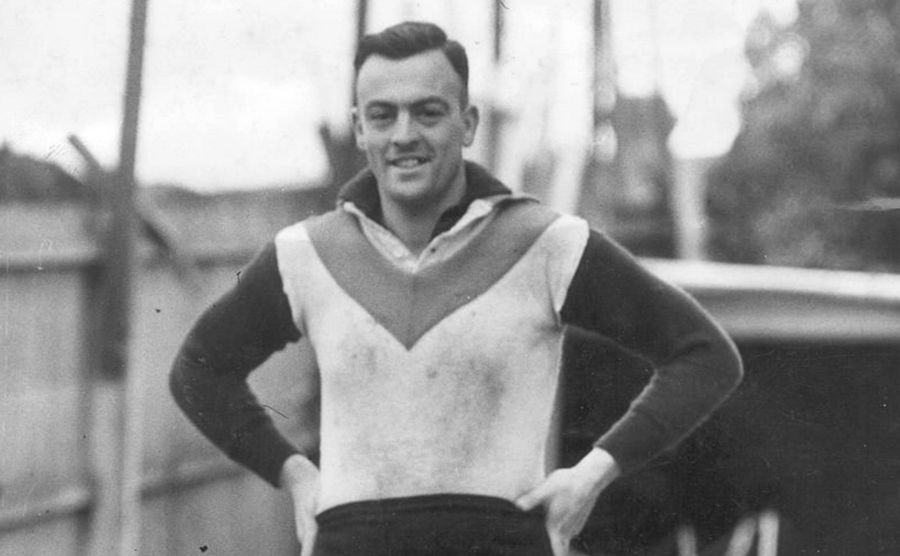
It is 30 September 1933. Thomas is a 25-year-old centreman for the South Melbourne Football Club, a local man who was born in the shadows of the Lake Oval. By the end of the afternoon, he will be a premiership player, matching the feat his father, William "Sonna" Thomas, achieved in 1909. To this day, Len and Bill remain the only father-son premiership combination in the club's history.
Leonard Thomas was more than a professional athlete; he was a man defined by the salt air of the Port Melbourne docks and the quiet responsibilities of a father. A Customs Agent by trade, he lived with his wife, Edith, and their children, Barry and Lynette, first at 36 Bedford Street and later at 5 Mountain Street. His devotion to his family was such that in 1934, he moved them to Horsham for a season simply because Edith required a change in climate for her health.
On the field, he was a giant of the game. He played 209 VFL games across 14 seasons, captaining three separate clubs: South Melbourne, Hawthorn, and North Melbourne. He was a dual Club Champion (1931, 1938) and remains 37th on the Swans' all-time games list. Yet, in June 1940, at age 32 and three games short of the 200-game milestone for South Melbourne, he walked away from his coaching career to enlist. His reasoning was as plain as his play: "Well, a fellow just can't be out of a thing like this".
Thomas initially served as a Corporal in the Middle East with the 2/11th Army Field Regiment. He was an experienced leader, reaching the rank of Bombardier. However, after returning to Australia, he sought a more specialized and direct combat role. In September 1941, he took the extraordinary step of reverting from Corporal to Private so he could volunteer for the elite 2/3rd Independent Company, the precursors to modern commandos. This sacrifice of status and pay for the chance to serve at the highest risk remains one of the most selfless acts in Australian wartime sport.
By early 1943, Private Thomas was hacking through the thick lawyer vine of New Guinea. The 2/3rd was tasked with acting as a "magnet," conducting aggressive patrols to draw Japanese forces away from the main Allied target at Lae. It was a war of jagged ridges and swollen rivers, where the environment was as lethal as the enemy.
On 17 August 1943, during an engagement near the Francisco River, Thomas was wounded in the leg. In the dense jungle, such a wound was grave. He was being treated at a forward medical post when the position was overrun during a localized Japanese counter-attack. Thomas was killed in the action. At 35, he was the most experienced professional footballer killed in the Second World War.
Today, Len Thomas rests at the Lae War Cemetery in Papua New Guinea. His name is recorded on the bronze tablets of the Lae Memorial, far from the roar of the MCG.
The war did not end for the Thomas family with the telegram. It continued in the quiet work of his son, Barry, who carried his grandfather's "Sonna" nickname, as he spent years ensuring his father's service was fully recognized. Len Thomas is remembered at the Swans not just for the goals he kicked or the 136 games he played in the number 12 jumper, but for the stripes he gave up and the duty he performed.
Lest we forget
Rod Hutchings
Director, Virtual War Memorial Australia


Click images to start slideshow.