








PARSONS, Cecil John
| Service Number: | 5813 |
|---|---|
| Enlisted: | 16 January 1916 |
| Last Rank: | Private |
| Last Unit: | 9th Infantry Battalion |
| Born: | Esk, Queensland, Australia, date not yet discovered |
| Home Town: | Esk, Somerset, Queensland |
| Schooling: | Not yet discovered |
| Occupation: | Dairying and Farming |
| Died: | Killed in Action, Broodseinde Ridge, Belgium, 4 October 1917, age not yet discovered |
| Cemetery: |
No known grave - "Known Unto God" Menin Gate Memorial, Ypres, Flanders, Belgium |
| Memorials: | Australian War Memorial Roll of Honour, Esk War Memorial, Toogoolawah War Memorial, Ypres (Menin Gate) Memorial |
World War 1 Service
| 16 Jan 1916: | Enlisted AIF WW1, Private, 5813, 9th Infantry Battalion | |
|---|---|---|
| 4 May 1916: | Involvement Private, 5813, 9th Infantry Battalion, Third Ypres, --- :embarkation_roll: roll_number: '9' embarkation_place: Brisbane embarkation_ship: HMAT Seang Choon embarkation_ship_number: A49 public_note: '' | |
| 4 May 1916: | Embarked Private, 5813, 9th Infantry Battalion, HMAT Seang Choon, Brisbane |
Help us honour Cecil John Parsons's service by contributing information, stories, and images so that they can be preserved for future generations.
Add my storyBiography contributed by Ian Lang
# 5813 PARSONS Cecil (Charlie) John 9th Battalion
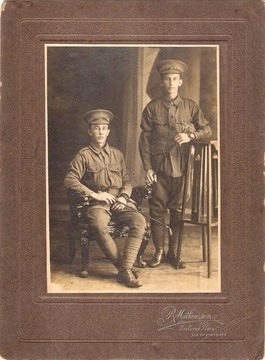
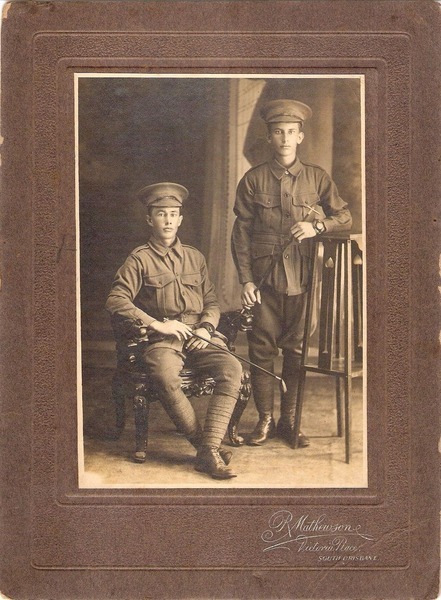
Cecil Parsons, who preferred to be known as Charlie according to his army mates, was born at Esk. He was eldest of two sons born to John and Sarah Parsons of Ottaba, a farming community halfway between Esk and Toogoolawah on the Brisbane Valley Rail Line. The Parsons family ran a dairy farm, Newton Farm, and Charlie along with his younger brother, Sydney, worked on the family farm after leaving school.
On 12th January 1916, Charlie and Sydney travelled by train to Brisbane where they attended the Adelaide Street recruiting office. Charlie stated his age as 21 and occupation labourer. Sydney was 19. Both boys named their father, John Parsons of Ottaba near Esk, as next of kin. The brothers reported to Enoggera camp where they were placed in a depot battalion before being assigned to the 18th reinforcements of the 9th Battalion. On 4th May 1917, the reinforcements embarked on the “Seang Choon” at Pikenba wharf. The embarkation roll shows Sydney and Charlie with successive regimental numbers. Each had allocated 3/- of the daily pay of 5/- to be deducted and placed in a bank account. The “Seang Choon” made its way to Suez where the reinforcements proceeded to the AIF camp at Serapeum on the Suez Canal.
The entire AIF (then 4 divisions strong) was at full strength and being shipped to the Western Front in France. There was no immediate need for reinforcements. Charlie and Sydney embarked in Alexandria on 29th July 1916 and were transported to England, arriving at the 3rd Brigade Training Battalion at Perham Downs in Wiltshire two weeks later. On 13th October, Charlie reported to the Army hospital at Buford with a case of VD. He spent 40 days in isolation. Once returned to the training battalion, Charlie proceeded to Folkstone where he boarded a ferry for the night crossing of the English Channel, arriving at the Australian Infantry Depot at Etaples on 18th December. It was at this time that Charlie’s and Syd’s paths diverged as Syd was transferred to another battalion. They probably never saw each other again.
Charlie reported to the 9th Battalion on Christmas Day. The 9th, part of the 3rd Brigade of the 1st Division, was the first Queensland Battalion raised at the beginning of the war. The battalion was in the first wave of troops ashore at Gallipoli and had gained a reputation for its ability to handle tough conditions at Pozieres in July 1916. Charlie had barely time to complete his induction before he reported sick to a field ambulance with a recurrence of gonorrhoea. After a brief stay in a dermatological ward at Rouen, Charlie returned to his battalion on 17th January 1917. The winter of 1916/17 was the harshest experienced in France in almost half a century and the Australians who had come from a far warmer climate in Australia and Egypt suffered greatly with influenza, bronchitis and trench feet. Charlie was fortunate to have seen the winter out without any serious illness or injury.
During the winter of 1916/17, the German army had secretly constructed a series of heavily defended positions, named the Hindenburg Line by the British, to which the German forces on the Somme withdrew in the spring of 1917. The British forces in that sector, and to which the AIF was attached, cautiously followed. Charlie and his companions saw action at Lagnicourt, Bapaume and Bullecourt during April and May 1917. The Hindenburg defences defeated all attempts to breech the line and most of the British forces, including the Australians, were moved north to rest and training around Hazebrouck.
During June and July 1917, the 9th Battalion engaged in training for the next series of major battles in Belgian Flanders. There were brigade and divisional sports and competitions. In early September, the men of the 1st and 2nd Divisions of the AIF moved closer to the line at Ypres in preparation for an assault on the Westhoek Ridge and Gheluvelt Plateau.
Westhoek Ridge marked the high ground that overlooked the main route east from Ypres to Broodseinde Ridge and Passchendaele; the Menin Road. A detailed model of the ground had been constructed with planks suspended over the sand so that officers and NCOs could familiarize themselves with the battlefield and the objectives they were expected to take. The 9th Battalion, in conjunction with the other three battalions of the 3rd Brigade were in position at the jumping off tapes by midnight of the 19th September and at 5:40am on the 20th, a massive artillery barrage crashed down on the German positions. As the barrage crept forward, the infantry kept pace, dealing with isolated pill boxes and gun emplacements whose occupants quickly surrendered. The Battle of Menin Road was, by the terms of the time, a great success. The battalions of the two AIF divisions that had taken part at Menin Road were relieved and two other divisions took advantage of the result to push the line even further into Polygon Wood and the approaches to the high ground of Broodseinde Ridge and the villages of Zonnebeke and Passchendaele.
On 4th October, twelve British Divisions (which included three AIF Divisions and the NZ Division) attacked Broodseinde Ridge along a thirteen kilometre front. As the 9th Battalion men rose up to follow the creeping barrage up the slope towards Zonnebeke, they encountered German infantry advancing up the reverse slope. Both the British and the Germans had made plans to attack on the same day, and at the same time. The Australians got the better of the encounter.
A witness writing to the Red Cross Wounded and Missing Enquiry Service stated that Charlie was killed instantly on 4th October 1917 while part of a reconnaissance party between Westhoek Ridge and Broodseinde Ridge. The officer in charge of the party was severely wounded. There was no report of a burial. A court of inquiry in 1918 concluded that, in the absence of anything to the contrary, Cecil John Parsons had been killed in action at Broodseinde Ridge on 4th October 1917.
In due course, Sarah Parsons was granted a pension of 30 shillings a fortnight. Charlie’s remains were never located. He is one of 56,000 soldiers from Britain and the Dominions, including 6,178 Australians, who served in the Ypres campaign and who have no known grave. Their names are inscribed on the Portland Stone Tablets under the arches of the Menin Gate Memorial to the Missing in the city of Ypres (now Ieper).
Since the 1930s, with a brief interval during the German occupation in the Second World War, the city has conducted a ceremony at the Memorial at dusk each evening to commemorate those who died in the Ypres campaign. The ceremony concludes with the laying of wreaths, the recitation of the ode, and the playing of the Last Post by the city’s bugle corps. During spring and summer, the Menin Gate service draws huge crowds of British, Canadian and Australian tourists.
The commemoration of the Menin Gate Memorial on 24 July 1927 so moved the Australian war artist Will Longstaff that he painted 'The Menin Gate at Midnight', which portrays a ghostly army of the dead marching past the Menin Gate. The painting, which now hangs in the Australian War Memorial, Canberra, toured Australia during the 1920s and 30s and drew huge crowds.
Charle’s brother Sydney survived the war and returned to dairying at Ottaba.
Click images to start slideshow.