







RANDALL, Henry Richard
| Service Number: | 1603 |
|---|---|
| Enlisted: | 6 July 1918 |
| Last Rank: | Private |
| Last Unit: | Australian Naval and Military Expeditionary Force |
| Born: | Arundel, England, December 1880 |
| Home Town: | Brisbane, Queensland |
| Schooling: | Not yet discovered |
| Occupation: | Dairy farmer |
| Died: | Heart Attack, Brisbane, Queensland, Australia, 15 November 1944 |
| Cemetery: |
Lutwyche Cemetery, Brisbane, Qld ANZ 7, Section 85, No 29. |
| Memorials: |
World War 1 Service
| 6 Jul 1918: | Enlisted AIF WW1, Private, 1603, Australian Naval and Military Expeditionary Force | |
|---|---|---|
| 18 Dec 1918: | Involvement Private, 1603, Australian Naval and Military Expeditionary Force, --- :embarkation_roll: roll_number: '21' embarkation_place: Sydney embarkation_ship: SS Melusia embarkation_ship_number: '' public_note: '' | |
| 18 Dec 1918: | Embarked Private, 1603, Australian Naval and Military Expeditionary Force, SS Melusia, Sydney | |
| 11 Mar 1920: | Discharged AIF WW1, Private, 1603, Australian Naval and Military Expeditionary Force, 1st MD, Medically discharged malaria plus a tumor in his throat |
Help us honour Henry Richard Randall's service by contributing information, stories, and images so that they can be preserved for future generations.
Add my storyBiography contributed by Evan Evans
From Australian Remembrance Army
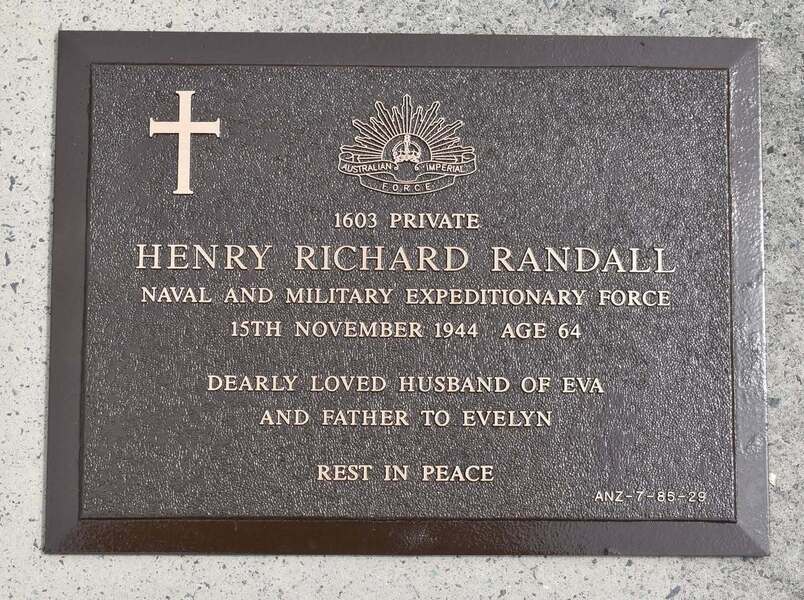
Private Henry Richard “Harry” Randall (Service No. 1603), an Australian World War One veteran, is among almost 800 previously unmarked WWI veterans’ graves in Lutwyche Cemetery we have now marked with a plaque recognising their service for Australia.
We unveiled his plaque in Lutwyche Cemetery on 15 April 2023, along with a further 246 plaques on the previously unmarked graves of Australian World War One veterans:
See Australian Remembrance Army Facebook page
The following account of Harry’s service and family life has been written by his granddaughter, Sylvia Hodgson:
"Henry Richard Randall, known as Harry, with wife Eva and 3-year-old daughter Evelyn, emigrated to Australia from England in 1911. Almost from the beginning of WWI, Harry being a patriotic Englishman had tried to enlist. He had poor eyesight in his right eye from an injury sustained while working training horses in London, and every time he tried to enlist was rejected. According to Evelyn he tried about 15 times before moving to Brisbane from the Northern Rivers area of New South Wales in 1918.
In Brisbane, Harry tried enlisting again and finally was accepted into the Army Medical Corp. After three months training at Enoggera he was due to sail to England but put on reserve. The ship on which he would have sailed was torpedoed and all lost and by the time the next ship arrived peace was declared.
However, the Government called for volunteers to go to the previously German-held territories of New Britain and New Ireland as occupational forces. Harry volunteered and was sent to Rabaul just prior to Christmas 1918 for a two-year term. He became very ill with malaria plus a tumor in his throat and was sent home for an operation at the Enoggera Army Hospital after one year.
On recovery by the end of 1920, Harry accepted a Soldier Settlement block at the Highlands and with Eva and Evelyn, moved from the comfort of a house in Brisbane to a tent and slab hut for the first three months. Then the Government provided timber and roofing iron and a house was constructed. Until the late 80s, every time she visited Jolly’s Lookout on the way to Mt Glorious, Evelyn loved to stand at the lookout and point out their house immediately below.
Life at the Highlands, now known as Highvale, was no bed of roses. Harry was a dairy farmer, and he considered the land poor because his block had previously run sheep, making it unsuitable for dairying. He was used to the fertile black loam of the Tweed Valley with lush green paspalum on which his cows had thrived. At the Highlands it was a dryer climate, the grass poor and his cows struggled. He no longer had a prize-winning herd of milkers.
In 1921 Evelyn commenced school at the Highlands, a one teacher school with about 45 children. Their teacher was Mr Taylor and Evelyn found it difficult at first. She had missed almost 12 months of schooling, due to Spanish flu quarantine during 1919 while visiting friends in Murwillumbah, then moving schools twice in Brisbane.
Harry had not been told when school actually commenced, so she arrived on the second day. Evelyn later said she “started on the wrong foot”, but by the time she left the Highlands School was second in the class.
There was no township at the Highlands, and the school was situated in the middle of the farms. Patey’s farm had a little shop selling basic items from under the farmhouse and Samford, 6 miles away, was the closest settlement.
After 2 years Mr Taylor married in October 1922 and transferred to another school because the Department could not provide a house for a married teacher. Sadly, Evelyn’s education came to a halt soon after.
A new teacher, Miss Anderson, arrived for the final two months of the year, and told Evelyn she already knew everything she could teach her. Another new teacher arrived at the beginning of 1923 and most older students left, with the boys being told they should be “helping their fathers on the farm”.
Mother Eva would not allow Evelyn to ride her horse the six miles to Samford, so she missed the opportunity to complete the Scholarship examination, which would have allowed better employment opportunities once she came to Brisbane.
From about March 1923, Harry worked for another of the Soldier Settlers on his Banana Farm nearer to the foot of the mountain as the dairying was not prospering. Nearly all the cows supplied by the Government had died. Evelyn’s comment was that public servants with a desk job in Brisbane didn’t know much about purchasing a good dairy herd!
Harry’s wife Eva persisted at the Highlands for another two years, until March 1925, when she returned to Brisbane to work as a housekeeper, saying she’d “had enough of bananas and would go mad”.
Evelyn stayed on to look after her father for another year then came to Brisbane also. Harry eventually walked off his property, as did most of the other settlers. All the banana farmers were eventually wiped out by the Bunchy Top disease, making the Highlands settlement a dismal failure.
Harry came to Brisbane and found employment at Ardoyne Army Hospital, Corinda, for several years as an odd job man, also looking after their dairy cows. Other work followed - planting pine saplings at Beerburrum and helping a market gardener on Russell Island, until eventually, in 1936 he obtained a secure job at the Anglican Church Grammar School (Churchie).
The school had a dairy herd of black and white cows, the milk being used in the kitchen and for the boarders. The wheel had turned full circle - he was back working with his beloved dairy cattle."
Harry died on 15 November 1944 from a heart attack. He was only 64, his dreams never really fulfilled, his marriage not surviving the hardship and struggles, but he had persisted, finally serving in the Army following World War I, if only for a short time.
He was buried in an ‘unmarked’ grave in the Anzac section at Lutwyche cemetery, ANZ 7, Section 85, No 29.
After decades without recognition, his grave now bears a plaque commemorating his service to Australia—ensuring that his name endures among those honoured for their duty and sacrifice. His identity and dignity have now been restored.
We have remembered him.
Lest We Forget
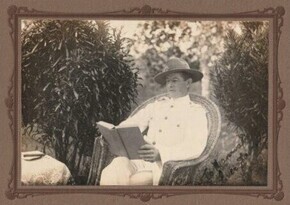
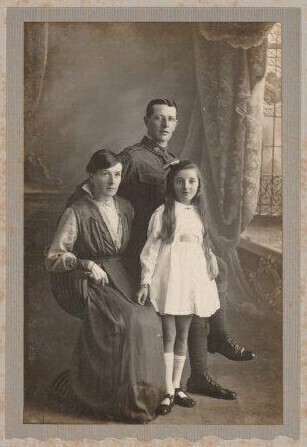
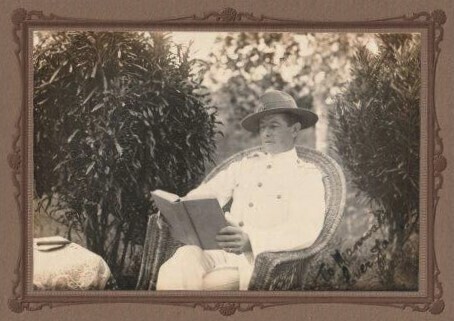
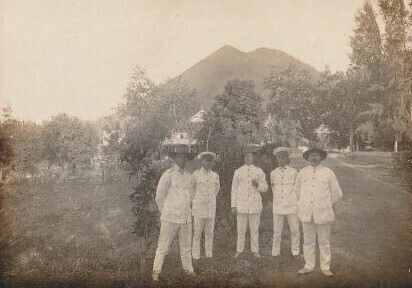
Click images to start slideshow.