






MOORE, William James
| Service Numbers: | 751, Q142208 |
|---|---|
| Enlisted: | 12 March 1917, 4 years in AIC and RAA |
| Last Rank: | Private |
| Last Unit: | 1 Garrison Battalion (QLD) |
| Born: | Bronte, New South Wales, Australia, 13 August 1887 |
| Home Town: | Lake Bathurst, Goulburn Mulwaree, New South Wales |
| Schooling: | Not yet discovered |
| Occupation: | Labourer |
| Died: | Brisbane, Queensland, Australia, 13 November 1950, aged 63 years, cause of death not yet discovered |
| Cemetery: |
Lutwyche Cemetery, Brisbane, Qld Anzac Portion 8 |
| Memorials: |
World War 1 Service
| 12 Mar 1917: | Enlisted AIF WW1, Private, 751, 11th Machine Gun Company, 4 years in AIC and RAA | |
|---|---|---|
| 24 Dec 1919: | Discharged AIF WW1, Private, 751, 3rd Machine Gun Battalion, 1st MD |
World War 2 Service
| 30 Jun 1942: | Involvement Private, Q142208 | |
|---|---|---|
| 30 Jun 1942: | Enlisted Australian Military Forces (WW2) , Private, Q142208, 1 Garrison Battalion (QLD) | |
| 30 Jun 1942: | Enlisted | |
| 15 May 1944: | Discharged Australian Military Forces (WW2) , Private, Q142208, 1 Garrison Battalion (QLD) | |
| 15 May 1944: | Discharged |
Help us honour William James Moore's service by contributing information, stories, and images so that they can be preserved for future generations.
Add my storyBiography contributed by Evan Evans
From Australian Remembrance Army
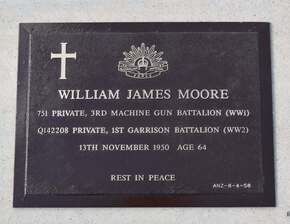
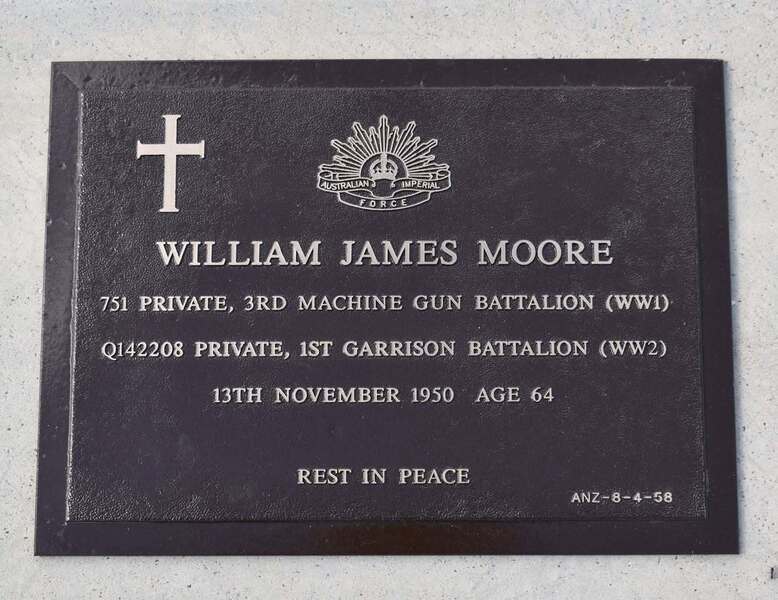
Private William James Moore, an Australian veteran of both World Wars, is among almost 800 previously unmarked WWI veterans’ graves in Lutwyche Cemetery we have now marked with plaques in recognition of their service for Australia.
We unveiled his plaque in Lutwyche Cemetery on 23 September 2023, along with a further 300 plaques on the previously unmarked graves of Australian World War One veterans in Anzac Portion 8:
See Australian Remembrance Army Facebook page
WWI service:
751, Private, 3rd Machine Gun Battalion
WWII service:
Q142208, Private, 1st Garrison Battalion
William James Moore was born on 13 August 1886 in Bronte, New South Wales, to George Edward Moore and Sophia Mary Moore (née Talbot). He enlisted in the Australian Imperial Force at Brisbane on 12 March 1917 as a 29-year-old single labourer. On 26 November 1917, he embarked for overseas service with the 11th Machine Gun Company aboard SS Indarra from Melbourne. He disembarked at Suez the following month and, in January 1918, proceeded to England for further training. In June 1918, he was sent to France, where he was taken on strength with the 3rd Machine Gun Battalion. In November 1918, he was diagnosed with defective vision.
From April 1919, for a period of four months, he was attached to the Australian Burial Corps (formally referred to as the Graves Registration Detachment). This specialised unit was established toward the end of the First World War to manage the recovery and commemoration of fallen soldiers. Its duties included locating, identifying, and reburying Australian war dead from the battlefields of the Western Front. The unit was headquartered in and around Villers-Bretonneux, France, an area of major Australian military significance. Based there, the unit undertook the important but often grim task of centralising bodies from battlefield graves into organised military cemeteries. While battlefield burials occurred throughout the war, formal Burial Corps operations intensified during the post-armistice period of 1919, focusing on the consolidation of isolated field graves into permanent military cemeteries maintained by the Imperial War Graves Commission (now the Commonwealth War Graves Commission).
William James Moore returned to Australia in November 1919 and was discharged from the Australian Imperial Force the following month.
During the Second World War, he again enlisted for service, joining the Australian Military Forces at Brisbane on 25 June 1942. He served on home service in Australia for a total of 686 days.
Private William James Moore died on 13 November 1950, aged 64, and was buried in Anzac Portion 8, Lutwyche Cemetery, Brisbane. He was a single man who had no known children.
After decades without recognition at his place of burial, his grave now bears a plaque commemorating his service to Australia — ensuring his name endures among those remembered for their duty and sacrifice. His identity and dignity have now been restored.
We have remembered him.
Lest We Forget.
Click images to start slideshow.