



CHURCH, Alfred Ernest
| Service Number: | 3377 |
|---|---|
| Enlisted: | 17 November 1916 |
| Last Rank: | Private |
| Last Unit: | 48th Infantry Battalion |
| Born: | Uraidla, South Australia, 29 July 1899 |
| Home Town: | Uraidla, Adelaide Hills, South Australia |
| Schooling: | Uraidla Public School, South Australia |
| Occupation: | Butcher |
| Died: | Killed in Action, France, 27 March 1918, aged 18 years |
| Cemetery: |
Ribemont Communal Cemetery Extension, Somme Plot I, Row L, Grave No 4 |
| Memorials: | Australian War Memorial Roll of Honour, Summertown Cemetery Memorial Arch Gates, The South Australian National War Memorial, Uraidla & Districts Roll of Honour 2, Uraidla War Memorial |
World War 1 Service
| 17 Nov 1916: | Enlisted AIF WW1, Private, 3377, 48th Infantry Battalion | |
|---|---|---|
| 10 Feb 1917: | Embarked AIF WW1, Private, 3377, 48th Infantry Battalion, HMAT Seang Bee |
Help us honour Alfred Ernest CHURCH's service by contributing information, stories, and images so that they can be preserved for future generations.
Add my storyBiography contributed by Westminster School
Alfred Ernest Church was born on the 29 of July, 1899. His birth place was Uraidla, South Australia. Uraidla is a suburb in the Adelaide Hills, he also grew up in Uraidla. Alfred Ernest Church went to Uraidla Public School, South Australia. He became a butcher after leaving school and Alfred went to World War 1 when he was only 18. Alfred had a mother, father and a brother. His parents’ names were Julia and Henry Joseph Church. His brother’s name was Frederick Thomas Robert Church who was also in World War 1 and died one year before Alfred. Alfred was in the 48th Battalion, but in the 9th reinforcement.
Alfred was killed in action on the 27th of March, 1918 aged 18 years. Julian and Henry Church had lost both sons to World War 1. He was then placed to rest in the Ribemont Communal Cemetery in France and is on the Albert Awn Roll Honour, France.
Albert fought proud and strongly for his country Australia on the Western Front.
Alfred received the Victory Medal which was awarded to soldiers who were in World War 1 between 5 August 1914 and 11 November 1918 and was also awarded the British War Medal for participation in the War while deployed overseas.
Biography contributed by Evan Evans
From Francois Somme
Pte 3377 Alfred Ernest Church
48th Australian Infantry Battalion,
12th Brigade, 4th Australian Division AIF
More than a hundred years ago on the battlefields of the Somme, a whole generation of young men fought and fell. In the face of adversity, darkness and madness, all stood tall and ready to fight to make prevail peace. Among them, thousands of young Australians whom we call with the deepest affection and respect "Diggers", our adopted sons who came from the other side of the world to save our country and side by side.
In Pozieres, in Villers-Bretonneux and Amiens, fought in the finest spirit of camaraderie and fraternity, a spirit which was born in 1915 on the blood-red sands of Gallipoli and which, in Fromelles and then in the Somme, guided them to surpass themselves to allow us today to live in peace and freedom. Brave among the brave, they fought like lions never backing down, they fought together with pride because they knew they fought the good fight and among the poppies, charged bayonets forward under the fire of machine guns and shells that rained down all around them in the fury and chaos of a world at war that turned once peaceful landscapes into abominable quagmires over which so much blood and tears were shed but despite the horrors they went through, despite the hardships, sufferings and fears,the Australians, alongside their brothers in arms, until the end, stood admirable in bravery but they were thousands who fell, who paid the supreme sacrifice on these sacred fields of northern France on which, solemn and silent, proud and young forever, they stand behind their white graves over which I will always watch with the deepest love and the highest respect to honor their memory, to tell who they were and what they did for us who owe them so much so that their faces and their names live forever.
Today, it is with the utmost respect and with the deepest gratitude that I would like to honor the memory of one of these young men, one of my boys of the Somme who gave his today for our tomorrow.I would like to pay a very respectful tribute to Private number 3377 Alfred Ernest Church who fought in the 48th Australian Infantry Battalion, 12th Brigade, 4th Australian Division, and who was killed in action 108 years ago, on March 27, 1918 at the age of 18 on the Somme front.
Alfred Ernest Church was born on July 29, 1899 in Uraidla, South Australia, and was the son of Henry Joseph Church and Julia Church (née Simmons), of 21 7th Street, Port Pirie, South Australia. He was educated at Uraidla Public School then, after graduation, served for four years in the Senior Cadets, 79th Infantry Battalion and worked as a butcher.
Young but determined to do his duty for his country, Alfred enlisted on November 7, 1916 in Adelaide, South Australia, in the 48th Australian Infantry Battalion, 9th Reinforcement. The 48th Battalion was raised in early 1916 in Egypt as part of the process that was known as "doubling the AIF" to create the 4th and 5th Divisions and was under the command of Lieutenant Colonel Raymond Leane.Several of Leane's relatives, including his brother, Benjamin, who served as adjutant, and three of his nephews,Allan, Reuben, and Geoffrey,and a few others, also served in the 48th. As a result, the battalion was nicknamed the "Joan of Arc Battalion", in reference to a quip that the battalion was "made of (all) Leanes" that is, a pun on Joan's own nickname, "The Maid of Orleans."
After a training period of three months, Alfred embarked with his unit from Adelaide, on board HMAT Seang Bee on February 10, 1917 and sailed for England and arrived on May 2 in Devonport then he marched to join the 12th Training Battalion in Codford, south of Salisbury Plain where he completed a period of training under realistic war conditions. Two months later, on July 16, ready to join the battlefields, he proceeded overseas from Southampton to France.
On July 17, 1917, Alfred arrived in France and was disembarked at Le Havre where he joined the 4th Australian Divisional Base Depot then marched out to unit on August 2 and taken on strength in the 48th Battalion the next day at Doulieu. On August 8, Alfred and his unit marched to the front line at Kemmel, Belgium and occupied a position known as "Cabin Hill" where they fought until August 20, when they were relieved and marched to "Hill Side Camp", a few kilometers behind the trenches of Kemmel then moved to Zuytpeene, in the north of France where they were mainly employed in working parties until the end of the month.
On September 3, 1917, Alfred and the 48th Battalion moved to Nieppe where they underwent a period of training including trench attack practices and anti-gas exercises but also had sports exercises to keep the morale and cohesion of the battalion high. .A little over two weeks later, on September 20, they left Nieppe and marched for Bavinchove, for Steenvoorde on September 21, Reninghelst on September 23 and arrived in Ypres on September 26 then on October 12, were involved in one of the deadliest battles to have taken place in the Ypres Salient was the Battle of Passchendaele.
By 5 October 1917, the British attempt to push back the German line east of Ypres in a series of "bite and hold" operations had met with some success. However, this had come at a great cost. While the weather held, the British had been able to bring up supplies and the all-important artillery. Artillery was the essential ingredient of the "bite and hold" tactics for if the "creeping barrages" could not protect the advancing British infantry they would be at the mercy of the enemy machine gunners. After 4 October 1917 the rain poured down and the battlefield, and all the approaches to it, became a sea of mud. To successfully bring up heavy war equipment under these conditions proved impossible. However, Field Marshal Sir Douglas Haig, the British commander-in-chief ordered the battle to continue.
On 9 October 1917, British divisions, with the Australians in support, attacked in terrible conditions towards Passchendaele village. In the mud and rain the effort proved futile but the high command thought that enough ground had been gained to order a fresh assault on 12 October. Spearheading this attack were the Australian Third Division and the New Zealand Division, with the Australian Fourth Division in support. As predicted, the shells of the support bombardment mostly exploded harmlessly in the mud and little cover was available from that source. Men had to press forward in the quagmire against the German pillboxes armed only with grenades, rifles and light machine guns.
A few Australians reached the edge of Passchendaele. However, they were not strong enough to hold the ground and were eventually forced to fall back and give up their gains. Australian losses for 12 October were 3,000 casualties for the Third Division and 1,000 for the Fourth Division for no gain. The Canadian Corps moved into the battle area on 18 October to replace the exhausted Australians. The Canadians, in five attacks between 26 October and 10 November, captured Passchendaele, and with their success the Third Battle of Ypres ended.October 12, 1917 was a black day for the 48th Australian Infantry Battalion which had to withdraw from Passchendaele but on neither occasion did the battalion fail for want of courage or skill among its own troops.
On October 15, 1917, exhausted and almost annihilated, the 48th Battalion moved back to Ypres then Zonnebeke for reorganization and received reinforcements. A few days later, on October 25, they marched for Halifax Camp at Brandhoek and on October 27, moved into billets to Cuhem, in the north of France, where they underwent light training, including musketry exercises, marches, bayonet fights, and also organized football matches, rare moments of calm in a ruthless war.
On November 17, 1917, Alfred and the men of the 48th Battalion left Cuhem and marched for Maintenay, in the Pas-De-Calais where alternate periods of rest and sports exercises then on December 1, moved to the village of Friancourt and on December 6, were sent by motorized bus to the Somme, near Peronne where they remained until January 9, 1918.
On January 9, 1918, the 48th Battalion left Peronne and marched through Bailleul, Berthen, Elzenwalle, and again arrived in the Ypres salient, in the Hollebeke sector which was described in the battalion's war diary as "the quietest sector we have been in". Indeed, they suffered almost no enemy artillery fire, nor raids, nor enemy attacks and later, always in the war diary of the battalion was written "The men are beginning to wonder what has happened that the 4th Division should get such a quiet sector" and in the days that followed, several patrols were carried out to intercept possible enemy positions but without success then on January 20, the 48th Battalion was relieved by the 13th Australian Infantry Battalion and marched to Curragh Camp, near La Clytte, which they endeavored to fortify for fear of enemy shells, then, following intense rains, had to drain the water which had invaded the camp and improved the sanitary conditions in which they lived during their stay here and during the day of January 30, had hot baths, which raised the morale of the men who had suffered terribly and it was written in the war diary of the battalion "The camp has been turned from a swamp into a place of comfort".
On February 6, 1918, Alfred and his comrades left Curragh Camp with an effective force of 638 men and marched to "Crater Dugouts", near the Ypres Canal, where they were employed in working parties and received dry new uniforms as well as rum and cocoa. A little over a week later, on February 13, they moved back into the Hollebeke sector and reinforced their trenches with numerous strongpoints defended by machine guns but once again the sector was very calm and the only enemy activity they observed was that of airplanes which flew over the Australian lines and some artillery fire which caused only light damage and it is written in the battalion's war diary that "the lines of trenches are so fortified in this sector that no large-scale enemy attack and no raids would be possible without catastrophic losses" and "our patrols continued actively always on the lookout to capture a live Boche but without success". After this period on the front line, the 48th Battalion was relieved and marched to Murrumbidgee Camp, near Hollebeke then moved back to La Clytte on 24 February and to Meteren on 28 February and where they stayed until March 25.
On March 26, 1918, the 48th Battalion left Meteren and marched for Berles-Au-Bois (Pas-De-Calais) then marched for the Somme where they arrived the following day, in the small village of Senlis then moved through Henencourt, Millencourt, and joined the front line of the Somme Valley near Ribemont to halt the advance of the German army which launched the spring offensive a few days earlier, March 21, 1918.
The Germans launched their Spring Offensive (Operation Michael) on March 21, 1918,it was their last-ditch effort to capture strategic objectives such as Amiens and Paris before the American army arrived on the Western Front in strength. Australian divisions were called down from Flanders in Belgium to plug gaps in the British lines and help stem the tide of the German advance. When this enemy thrust was defeated, it was time for the Allies to go back on the counter-offensive. Major battles fought by the Australian divisions during this time included Dernancourt in March and April; Morlancourt in March, May and June and at Villers-Bretonneux on two occasions in April 1918. The 1st Division had also made a significant contribution to the defence of Hazebrouck in Belgium in April during the Battle of the Lys. Lieutenant General Monash’s spectacular 93-minute combined arms victory at Hamel occurred on 4 July. In August came the breakout from the Amiens area in a carefully planned operation that left the Germans stunned and withdrawing. After a series of smaller victories in August at places such as Chuignes and Chipilly came the significant capture of Mont St Quentin, overlooking the major objective of Péronne from 30 August to 3 September. Historian Charles Bean described the battle at Mont St Quentin as one of the finest achievements of the AIF in the war. After these successes and now boosted with significant numbers of US troops, the Allies continued to push the Germans eastwards towards their final defensive positions in the Hindenburg Line.
On March 27, 1918, with the aim of stopping the Germans, the 48th Australian Infantry Battalion entered the front line near Ribemont, on the Albert-Amiens Road "in the best spirit of camaraderie and fighting spirit", even under the fire of the German artillery which opened fire on their positions and held their position without retreating a step. Unfortunately, it was during this fateful day that Alfred met his fate and was killed in action, probably by a shell, he was only 18 years old but fought proudly in the purest ANZAC spirit.
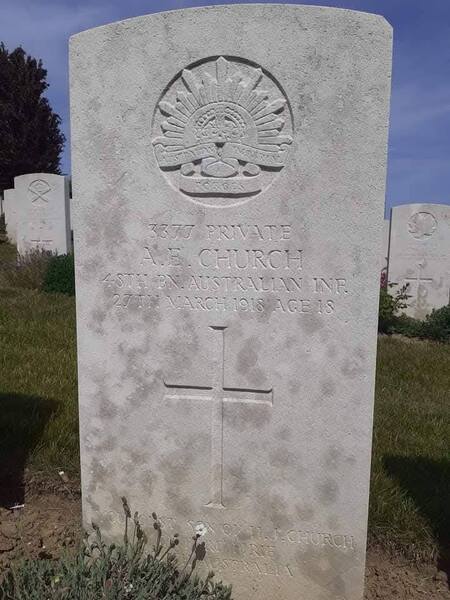
Today, Alfred Ernest Church rests in peace alongside his friends, comrades and brothers in arms at Ribemont Communal Cemetery Extension, Somme, and his grave bears the following inscription: "Youngest Son of H.J.Church of Port Pirie, South Australia."
Alfred Ernest Church had two brothers who served bravely in the Great War. The first of these was Private Number 5773 Frederick Thomas Robert Church who served with the 27th Australian Infantry Battalion. Unfortunately, Frederick was killed in action in Belgium on the 20th September 1917 at the age of 37. Sadly, his body was never found and his name is remembered today at the Menin Gate Memorial, Ypres.
Alfred's second brother was Private number 3716 Stanley Roy Church who fought in the 10th Australian Infantry Battalion.Stanley survived the war and died peacefully on August 27, 1945 at the age of 48.He is now resting in peace at St Georges Anglican Churchyard Magill, Adelaide, South Australia.
Alfred, Frederick, Stanley, brave and proud brothers in heart, it is with the determination of all Australia that you answered the call of duty to do your bit alongside your comrades on the battlefields of northern France and who, with honor and loyalty, with heroism and conviction, side by side, fought relentlessly in the darkness of the trenches which, far from home, drowned them in the despair and fury of a world at war which dragged them in the madness and chaos of abominable battles which were among the deadliest of the great war for a whole generation of men who gathered behind bugles and drums and who, around the highest values, gave their today in the mud and the blood of once green and silent fields which, under the shells, under the bullets and the flames, turned gray and over which, during four horrible years, were heard the howls of pain of men who, in the prime of their lives, were ruthlessly mowed down by the bursts of flesh-and-blood-thirsty machine guns that sent an entire youth to death but who fought fiercely to make peace prevail united in a camaraderie that nothing, neither pain nor suffering never broke.Together, through the poppies of villages which are today the symbols of the bravery and the sacrifices of the young Diggers, in Amiens, in Villers-Bretonneux, in Pozieres, these exceptional men stood tall and proud with behind them the conviction and the strength of the whole young Australian nation whose people did so much for my country during those years which marked the deadliest century in history but in the horror and the darkness of the trenches, it is here, in the Somme, that was born the friendship in which fought the Australian and French soldiers who, through the barbed wire, in the shell holes, lived and suffered together and went over the top side by side then these men became more than comrades, they became brothers who gave their today and their tomorrow to preserve our humanity, so that this war puts an end to all wars so that their children, their loved ones and future generations can live together, united by the same desire to defend the peace these young men fought and fell for more than a hundred years ago, so that their courage and sacrifices inspire us to try to make the world a better place as they did.More than a hundred years have passed, the machine guns, the cannons have become silent forever and the sun of a radiant spring today lights up the sky and the sacred soils of the Somme which, for a whole generation of men, was the hell on earth, slaughterhouses that took so many lives that were stopped in the barbed wire. Far from home, they fought with bravery and valour, with honor, words that, received on telegrams, broke so many families and left widows, mothers, fathers in mourning and who emptied so many homes of a happiness that was once so sweet and precious that the war shattered, families hurt forever by a sorrow so heavy to bear and which, for many of them, have never been able to visit the tomb of their husbands, their sons, their boys who gave everything they had for us but they will never be alone, their memory will never be lost or will never be forgotten and as long as I live, I will always watch over them with respect and love walking in silence and reverence in front of their white graves so that they may live forever.Thank you so much Alfred, Frederick, Stanley, for all that you have done for us, for all that Australia has done for us and to whom I will be forever devoted by bearing with pride and honor the friendship that unites our two countries that will meet again in Villers-Bretonneux for ANZAC Day.



Click images to start slideshow.