


MCQUEEN, Frederick Wallace
| Service Number: | 6129 |
|---|---|
| Enlisted: | 9 August 1915, Holdsworthy |
| Last Rank: | Corporal |
| Last Unit: | 13th Infantry Battalion |
| Born: | Roorkee, Uttaranchal, India, 20 October 1881 |
| Home Town: | Petersham, Marrickville, New South Wales |
| Schooling: | Scotland |
| Occupation: | Flour Inspector |
| Died: | Died of wounds, Belgium, 27 September 1917, aged 35 years |
| Cemetery: |
Lijssenthoek Military Cemetery Plot XXIV, Row G, Grave No. 1. NEARER MY GOD TO THEE |
| Memorials: | Australian War Memorial Roll of Honour |
World War 1 Service
| 9 Aug 1915: | Enlisted AIF WW1, Private, 6129, 13th Infantry Battalion, Holdsworthy | |
|---|---|---|
| 22 Aug 1916: | Involvement Private, 6129, 13th Infantry Battalion, Third Ypres, --- :embarkation_roll: roll_number: '11' embarkation_place: Sydney embarkation_ship: HMAT Wiltshire embarkation_ship_number: A18 public_note: '' | |
| 22 Aug 1916: | Embarked Private, 6129, 13th Infantry Battalion, HMAT Wiltshire, Sydney | |
| 4 Feb 1917: | Wounded AIF WW1, Private, 6129, 13th Infantry Battalion, GSW back, left leg and left forearm | |
| 17 Apr 1917: | Honoured Military Medal, For bravery and devotion to duty at Gueudecourt on the night of 4/5 February 1917 when in charge of a party carrying bombs and small arms ammunition - after reaching the captured trench he returned for more but despite being caught in a heavy barrage and with two his party killed, he brought over their load of bombs and his own. In two hours, McQueen made six trips backwards and forward through the heaviest barrage providing a supply of bombs that secured the right flank against enemy bombing attack. | |
| 3 Aug 1917: | Promoted AIF WW1, Lance Corporal, 13th Infantry Battalion | |
| 16 Aug 1917: | Promoted AIF WW1, Corporal, 13th Infantry Battalion | |
| 26 Sep 1917: | Wounded AIF WW1, Corporal, 6129, 13th Infantry Battalion, Third Ypres, Shell wounds abdomen and both legs | |
| 27 Sep 1917: | Involvement Corporal, 6129, 13th Infantry Battalion, Third Ypres, --- :awm_ww1_roll_of_honour_import: awm_service_number: 6129 awm_unit: 13 Battalion awm_rank: Corporal awm_died_date: 1917-09-27 |
Help us honour Frederick Wallace McQueen's service by contributing information, stories, and images so that they can be preserved for future generations.
Add my storyBiography contributed by Stephen Brooks
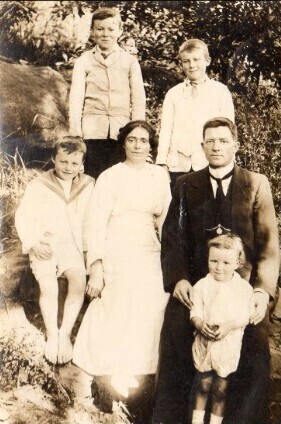
Frederick Wallace McQueen was 35 years of age when he died, husband to Anne and the father of four young boys, Archie (14), Reginald (12), Laurie (10), and Cecil (5). The family was living in Petersham, New South Wales at the time.
Frederick McQueen was the son of a Scotsman soldier, and had been born in India, when his father was on duty there. The family came to Australia in around 1895, when Frederick was about 14 years of age.
Prior to enlisting, Frederick worked for the Wheat Acquisition Board, which was a forerunner of the Australian Wheat Board.
He joined the 13th Battalion on the Western Front during December 1916. He took part in the 13th Battalion’s famous attack on Stormy Trench on 4 February 1917, an action in which Captain Harry Murray won the Victoria Cross. In taking the position, the 13th Battalion had to withstand a number of terrific counter-attacks, much of which involved furious bomb fighting. McQueen was in charge of aa part of five men who’s job it was to carry bombs from the Australian line to the captured German trenches.
McQueen was a awarded a Military Medal that night, as he got over to the captured trench and went straight back to the jumping off trench for more. As the party was returning, they were caught in the barrage, which was particularly heavy owing to the concentrated gun fire, and two of the party were killed. McQueen brought their loads of bombs over as well as his own. He returned at once for more although the barrage was still on. In two hours McQueen made six trips backwards and forwards through the heaviest barrage, and brought over such a good reserve of bombs that the right flank was secure against enemy bomb attacks.
He was badly wounded in the fight, with multiple shrapnel wounds and he was soon evacuated to England. He rejoined the 13th Battalion during August 1917 and was mortally wounded on 26 September 1917, during the Battle of Polygon Wood in Belgium. He died the next day of shrapnel wounds to his abdomen and legs in the 3rd Canadian Casualty Clearing Station.
His wife Anne and all four sons were awarded pensions. Anne never remarried and passed away in 1952.
His younger brother, Robert Alexander Colin McQueen 44th Battalion AIF also served and returned to Australia in 1919.



Click images to start slideshow.