







COLLIVER, Eustace James
| Service Number: | Officer |
|---|---|
| Enlisted: | 15 June 1915, Keswick, South Australia |
| Last Rank: | Captain |
| Last Unit: | 43rd Infantry Battalion |
| Born: | Norwood, South Australia, 9 July 1892 |
| Home Town: | Parkside, Unley, South Australia |
| Schooling: | Norwood Primary School, Rose Park Public School |
| Occupation: | Civil servant |
| Died: | Natural causes, Hawthorn, Victoria, Australia, 6 March 1951, aged 58 years |
| Cemetery: |
Box Hill General Cemetery, Victoria CE 212 6 |
| Memorials: | Adelaide Commissioner of Public Works Roll of Honour, Kersbrook Roll of Honor, Norwood Primary School Honour Board, Rose Park Public School WW1 Honour Board, Unley Town Hall WW1 Honour Board |
World War 1 Service
| 15 Jun 1915: | Enlisted AIF WW1, Lieutenant, Officer, Keswick, South Australia | |
|---|---|---|
| 9 Jun 1916: | Embarked AIF WW1, Lieutenant, Officer, 43rd Infantry Battalion, :embarkation_roll: roll_number: '18' embarkation_place: Adelaide embarkation_ship: HMAT Afric embarkation_ship_number: A19 public_note: '' | |
| 1 Nov 1917: | Involvement AIF WW1, Captain, 43rd Infantry Battalion | |
| 23 Sep 1919: | Discharged AIF WW1 |
Eustace James Colliver
Name: Eustace James Colliver
Service Number: Captain
Place of Birth: Norwood
Parents: William Colliver and Emily Colliver (neeChampion)
Date of Birth: 9 July 1892
Place of Enlistment: Keswick
Date of Enlistment: 15 June 1915
Age at Enlistment: 22 years 11 months
Marital Status: Single
Next of Kin: Mother,Emily Colliver
Occupation: Clerk
Religion: Church of England
Rank: Captain, 43rd Battalion
Memorials: Kersbrook Roll of Honor
CCEustace did basic training with A Coy at Mitcham and joined the 1st Depot Battalion 10/27 as an Infantry Sergeant on 16 December. He was sent to Officers’ School on 16 January 1916, receiving his commission on 3 March. With his unit, the 43rd Battalion, he embarked A19 Afric at Outer Harbor on 9 June. Eustace disembarked at Marsailles, France on 20 July. He was admitted to Fargo Military Hospital in England on 1 November, where he was treated for bronchitis, with his mother being notified of his condition by Army Base records, Melbourne on 11 November.
Base Records were extremely efficient in the duty of notifying next of kin of the welfare of the thousands of soldiers that were hospitalised throughout all the campaigns of the war.
Eustace rejoined his unit on 15 November and accompanied them overseas to France from Southampton on 25 November. In December he was despatched to the School of Instruction, rejoining them at Armentieres on 27 January 1917. Eustace was treated for debility on 4 August and upon recovering was sent serve at La Motte until June 1918. Eustace was appointed Captain on 1 January 1919 and awarded the Military Cross.His citation stated, “For conspicuous and good service. During the operations on the Somme from Hamel to Roisel from 8th August to 11th September,1918, Captain Colliver carried out his duties as Adjutant in a highly efficient manner. By his untiring energy and devotion to duty under very trying circumstances he greatly assisted in the success achieved by his Battalion.”
The Advertiser of 11 January 1919 announced that Capt.E.J.Colliver had been awarded the Military Cross. Upon returning from leave in England in March 1919, he was sent from France to Southampton, where on 12 June, he embarked S.S.Themistocles, disembarking in Melbourne on 8 August. Eustace was discharged the next day.
Eustace, in addition to the Military Cross, was awarded the 1914/15 Star, British Medal and the Victory Medal.
Eustace and his wife Emily had a daughter born at Sister Saint’s Home, Young Street, Parkside.2.
In 1936, Eustace was Secretary of the Retail Shopkeepers’ Association of South Australia.1.
Source: www.NAA;B2455;Colliver.E.J. Barcode 3272392.
www.awm.gov.au/collections.
www.VWMA/ Colliver.E.J.
Footnotes: 1 & 2.www.trove.nla.gov/di
Captain Eustace James Colliver. Military Cross
Submitted 30 August 2023 by christopher collins
Military Cross
During operations on the SOMME from March to September this officer acted as Adjutant and by his untiring zeal and devotion to duty he greatly assisted in the success of the Unit on many occasions.
For conspicuous and consistent good service. During the operations on the SOMME from HAMEL to ROISEL from 8th August to 11th September, 1918, Captain COLLIVER carried out his duties as Adjutant in a highly efficient manner. By his untiring energy and devotion to duty under very trying circumstances he greatly assisted in the success achieved by his Battalion.
Submitted 22 January 2016 by Daryl Jones
Biography contributed
Completed by St Dominic's Priory College
Eustace James Colliver was born in Norwood on July 9, 1892 to parents, Emily Colliver and W. H. Colliver who resided at Birks Street in Parkside. He had three brothers, Norman Champion Colliver, Henry Alfred Colliver, and William Gordon Colliver, as well as seven sisters. They all attended school at Norwood Primary School and at Rose Park Public School. Both his brothers served in WW1 and William Gordon was tragically killed at Perrone in France 1 September 1918. Before the war, Eustace’s occupation was a civil servant, he was single and he was Christian in tradition of the Church of Christ.
Eustace James Colliver enlisted on June 9, 1915 in Keswick. As a solider in the 1st Depot Battalion, he was promoted to Corporal on July 25 before attending N.C.O school and passing, where he received his Sergeant stripes. Soon after, he received his commission on March 3, 1916, and a month later he was appointed to the 43rd Infantry Battalion as a 2nd Lieutenant. He disembarked from Australia June 9,1916 and disembarked July 20, 1916 in Marseilles, France, before entraining the next day on the 20th to arrive at their next destination on the 21st, Havre, France.
The next day, the battalion embarked once again to arrive in Lark Hill, England, where the battalion’s training would take place. While in England, Eustace Colliver was admitted to Fargo Military Hospital on November 1, 1916 due to a case of mild bronchitis, which his next of kin, Emily Colliver, was notified of through a letter. He was discharged from the hospital and rejoined his battalion on November 15, 1916. After the 43rd Infantry Battalion trained in England for a few months, Eustace embarked November 25, 1916, for the front in France.
Eustace was promoted to Lieutenant in December, 1916. He was detached at a School of Instruction December 24, 1916 and rejoined his battalion on January 27, 1917. The 43rd Infantry Battalion took part in the Battle of the Messines in 1917, from June 7 to June 14. After the Battle of the Messines, the battalion was told to prepare for a diversion attack to distract from the attacked planning to be launched in Ypres, known now as the Third Battle of Ypres, in which Eustace commanded the B company. On 11 August, 1917, he was admitted to hospital in La Motte due to sickness or debility, but he recovered quickly and rejoined his battalion on the same day.
On August 21, 1917, he had approved leave to England and rejoined his battalion on in September commanding Companies A and D in the Battle of Passchendaele on 12 October, 1917.
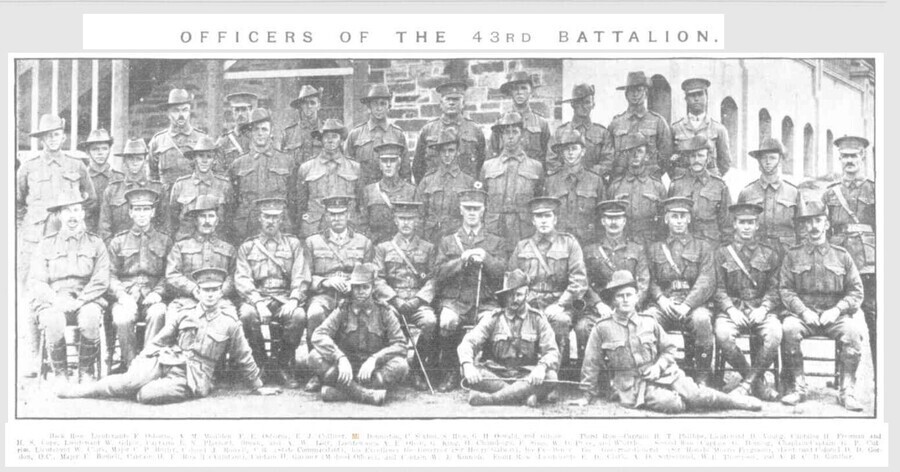
Sadly the attack failed and resulted in many casualties. Eustace was promoted to Captain in November and after, took place of Captain M. Dennison who was transferred to a different role due to illness. He was let to O.F.F School December 5, 1917 and rejoined his battalion January 5, 1918. He was promoted to Adjutant Vice on January 30, 1918. From March 21, 1918 to September 3, 1918, Eustace Colliver commanded his battalion in battles across the Somme from the battalion headquarters, including battles in Sailly-le-Sec, Villers Bretonneux, Hamel, Amiens, and Haut Allaines in North Sommes, which was the first phase in the German Spring Offensive. During another period of leave the 43rd Infantry Battalion took part in the battle known as the Hindenburg Line before being relieved on October 3 and the signing of the Armistice.
Eustace Colliver was awarded the Military Cross in January, 1919, his award was soon announced in The Advertiser newspaper on January 11, 1919. During the wait to return to Australia, he proceeded on leave to England embarking from the UK April 28, 1919 before disembarking in France. On June 12, 1919, he boarded the S.S. Themistocles headed for Australia, arriving in Melbourne on August 8, 1919. He was officially discharged from the A.I.F on September 23, 1919. After his arrival back in Australia he married Hilda Mary Pascoe (1892-1964 9 September 1919 at Hindmarsh in Adelaide. Together they had one son Brian Eustace Colliver born 31 January 1927. Brian served in WW2 with the Royal Australian Navy (PA5110)
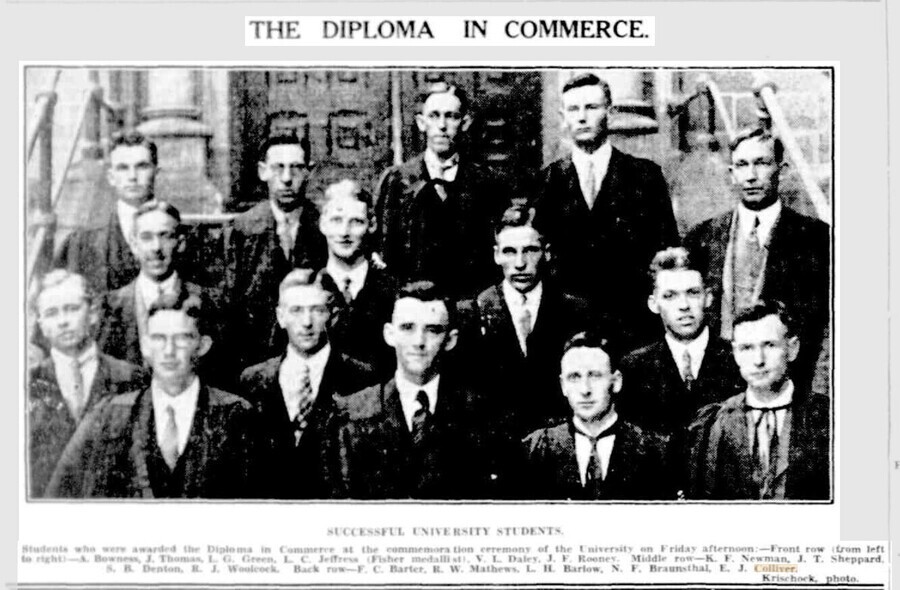
Later members of the 43rd Infantry Battalion held a reunion at the Prince of Wales Hotel, where Eustace announced his book, “History of the Battalion”, a book about the 43rd Infantry Battalion he had written with Lieutenant B.H. Richardson. The book was published in 1920. He joined the Returned Solders’ Club, along with other members of his Battalion. He received his Diploma for Commerce in 1928. In 1928, a reunion dinner was held to commemorate 12 years since their embarkation for France with Eustace as President of the Returned Soldiers League. In 1931, members of his battalion held another reunion dinner to mark 15 years since their embarkation for active service. Eustace became a secretary for the Retail Storekeepers Association in 1933. He also officiated at various marriages, one of them being the marriage of Ella Charlick and Lyon Brown. He passed away March 6, 1951 at 58 years old due to natural causes and is buried at the Box Hill Cemetery.


Click images to start slideshow.