







SHAVE, Michael John
| Service Number: | 1201583 |
|---|---|
| Enlisted: | Not yet discovered |
| Last Rank: | Warrant Officer Class 2 |
| Last Unit: | Australian Army Training Team Vietnam (AATTV) |
| Born: | Kingstone-on-Thames, England, 6 February 1943 |
| Home Town: | Toowoomba, Toowoomba, Queensland |
| Schooling: | Hinchly Wood County Secondary School, England |
| Occupation: | Soldier |
| Memorials: |
Vietnam War Service
| 13 Nov 1968: | Involvement Australian Army (Post WW2), Sergeant, 1201583, 9th Battalion The Royal Australian Regiment (9RAR) | |
|---|---|---|
| 19 Nov 1969: | Involvement Australian Army (Post WW2), Warrant Officer Class 2, 1201583, Australian Army Training Team Vietnam (AATTV) | |
| 22 Jul 1971: | Involvement Australian Army (Post WW2), Warrant Officer Class 2, 1201583, Australian Army Training Team Vietnam (AATTV) |
Fragments
Fragment One. An Exposure to Reality
1961. Pinewood Camp, Liebenau
After being expelled from the Army Apprentices School at Carlisle (a long story) I am posted to Liebenau; to 32 Armoured Workshop, as an armourer; the most boring job I have ever had. But quite
An Arborfield Influence still On My Conscience
It's the guest room at Dun Gypping. I am quaffing tepid tea
From a chipped, pint pot with A.A.S., someone has passed to me.
And although I have had better tea I really can't complain
About this brew I'm drinking now.
Perhaps I should explain:
When young and given jankers (seven days, ‘twas never less),
The powers-that-be would always make you work in officers' mess.
And if while there one felt the need to go and have a pee
Why! Just take off lid to tea pot, and urinate in the tea.
And cook would laugh and swirl it round, the steward serve it up,
Then come back to kitchen and tell us who had cup.
But that was years and years ago. Squaddies then but brutes
And here there is no jankers, and they don't take in recruits.
Thus this tea that I am sipping, poured out by you for me.
Might be strong and tepid but I know it's free of pee.
the nicest barracks. Built to look like a large farm, the camp has no square, no vehicle park, garages or repair facilities. There is an arched carriage way, the ceiling of which, despite the whitewash, bears still the shadowed Nazi emblems of its wartime past.
At work, other than bluing the then current service revolver, there is nothing to do but listen to the rants of my colleague, a once-upon-a-time staff-sergeant, reduced to the ranks for theft. There are three of us, but the boss I do not recall.
I do recall the Adjutant. He keeps the pigs, which have a habit of escaping. Indeed, I remember one beautifully sunny late afternoon, returning to Pinewood Camp from the workshop compound, our higgledy-piggledy column of marching soldiers is confronted by a disheveled and distraught Adjutant pursuing three porcine porkers intent on doing just that. We are marching past a bus stop at the time, behind which queue some of the civilian workshop staff, and their reaction to our reaction to his desperate ‘Stop those pigs’ completely fractures the CSM’s manic desire for good order and military discipline.
The CSM., having but one eye, is called Cyclops. His daughter is in rebellion and makes much of her father’s minions; sadly, I am not one of them. A German labourer works the kitchen boilers (I think). Having fought the Russians (Didn’t they all?) he is thought to be a great man, and the young me admires him.
Being bored and with nothing to do I study and manage to pass the theory examination to qualifyas a gun-fitter, third class. There being no guns, I am taken from the workshop armoury to act as one of the Unit’s two Regimental Policemen (I did not understand it either), - Cyclops takes a dislike to me (which should enamour me to his daughter but does not).
The members of a nearby Scottish Regiment, when drunk, believe our perimeter fence to be the East, West, German border; a few of them actually believe they have crossed over (we disabuse them).
Being an ex-apprentice, the authorities determine that I can read a map. And so, one day I have the honour of misleading an entire workshop convoy.
My driver, bless him, keeps asking if we are going the right way. He keeps on asking, right up to when the road peters out and bushes and trees bar the way, and no one can turn round and … embarrassed, yep!
As well, we have a fat staff-sergeant electrician whose main function, on schemes is to jump up and down on one’s overhead protection, which invariably necessitates its redoing. When our convoy stops, he urinates onto an electric fence and his convulsive agony has the entire workshop in hysterics.
Nighttime’s I get drunk. Liebenau has just the one pub, and, together with two other blokes, I make it my home. When off duty I live there, at the bar, carousing, singing with my two drunken mates, Aussie and Bill.
Bill is a bald headed corporal vehicle mechanic, not that that matters, but when he is drunk he urinates in his trousers. So, when in camp the early hours of most mornings find me and Aussie singing our way back from the village, supporting the urine sodden Bill.
All told I am not a good soldier.
Fragment Two.Wessex Barracks
1962. Fallingbostel
I forget for how long I serve with 32 Armoured Workshop. It’s been a time of testosterone fuelled, frustrations and unrequited lusts for Cyclops’s daughter, and the buxom, flaxen haired, kitchen maids, seemingly all related to my hero of the kitchen boilers and the Russian front; but I get posted as a gun-fitter, to Fallingbostel; to the 13/18 Hussars (QMO).
Barely nineteen years old, as I alight from the duty vehicle outside the guard room, I remember feeling especially important. An RP., comes out. ‘Eh up, thee!’
In a broad Barnsley dialect I am directed to the Light Aid Detachment HQ., and my new home.
This LAD. firmly sets my developing attitude towards the Army.
Its personnel, or rather the vehicle mechanics of the unit, are mostly national servicemen from Glasgow. Six year men, and three year men comprise its regular Army component, and everyone hostile, or sarcastically indifferent, to authority.
The Authority, I learn, is one Captain Ff—-s, whose one desire, seemingly, is to be taken for a hussar officer. And my immediate boss is Sergeant L. His one desire is to earn the approval of The Authority, which he does with an unconcealed, abject slavishness, hence everyone’s sarcastic indifference.
I get detached to a squadron of Centurion tanks, there to work under the supervision of a national service gun-fitter and my first job is refitting a number of tank mantlet covers. Made of canvas, the covers are secured to the tank by thin, narrow, metal straps of mild steel, bolted directly to the turret. Well, I cannot align the threaded holes in the turret with those drilled through the straps and increasingly become fed up with my colleague’s humoured sarcasm.
In the end, after a number of days, as I am about to explode, he goes off with one of the mantlet strips and has bolt heads welded over the holes that do not align; so - voila! Next one, thank you very much.
As well, I am told to adjust the torque on a range-drum. Torque? What’s torque? Peels of laughter, and a growing sense of inadequacy.
Fragment Three. Table Manners and a Driving Lesson
Wessex Barracks, Fallingbostel
In those days cigarettes are casually passed round. A social nicety, we call it “crashing the ash”. ‘Whose crash is it?’ being the common refrain.
Once, in the cookhouse, after the midday meal, it is my turn to “crash the ash” - but doing so will leave me with nothing to smoke for the rest of the day. So, after nonchalantly extracting a cigarette, and with a ‘Sorry fellas, it’s the last one I’ve got’, I cunningly toss the packet onto the floor, beneath the table, where Dave Fish, and with a broad grin, the rotten bastard, grinds it flat beneath the heel of his boot.
Dave is a fine soccer player; a driver, he plays for Army and is very much respected by the Unit’s jocks.
Because of my dismal work in the squadron, EME., decides to make me a driver, and Dave is tasked with the teaching. As we set off round the tank park I am thinking all is well, and well it is, until Dave tells me to watch out for reversing tanks, which, I explain, I cannot do because I have smashed my glasses; this abruptly finishes my driver training.
My glasses are a constant problem, and a great asset to the malingerer I have become. Rather than doing the gun-work, for which I have no inclination, I report sick and spend my mornings lurking about the Area RAP. If stuck for ailments with which to report sick, I break my glasses - although I am pretty good with ailments; and hands.
At night I like going into nearby Walsrode to see what, if anything, the Germans might present.
Brawling with the locals and damaged hands - what a life. I would say stupid, but in truth the me then enjoys it; and of course, the reputation of being hard.
The place where we go to box, The Roundhouse, is rumoured to have once been Officers’ Mess for the camp concentration guards of Belson. And my first bout there is memorable in that, before the entire Division, the skinny REME bloke wearing the coke-lid spectacles wins by a knockout in the first round, while his Hussar, body-building mate (a regimental hero, I might add) gets thrashed.
Now the LAD. has two sporting figures to respect.
And the Regiment thinks I am rather good too; because of my boxing prowess they accept me socially and despite my dismal trade skill I feel respected. I become Corps light heavyweight champion and play second row forward for the Hussars, which fits the Regiment’s concept of “decent.” And I am a character.
Fragment Four. Coming of Age
1964 Barker Barracks, Paderborn
The REME boozer lives in the attic of our barrack accommodation. It is the social centre of life, and being, as it were, surplus to establishment, it is my job to carry up the beer at resupply time.
The place needs painting and I volunteer. To Sergeant L’s disgust I am given the task, and so, with tins of primary colour I set about the bare, whitewashed brick of that attic room bar.
At school I was selected to sit for a Royal Society of Arts scholarship ( I didn’t - another long story) and as I paint I begin to doodle and soon the whole place is become muralised: black, red, yellow, green; I turn the entire bar into a tropical paradise, with parrots and a galleon and palm trees and blue water and a sky and they love it. EME invites the Commanding Officer up and briefly, yours truly is man of the moment.
Not long after, I am doing Jankers, one of the squadron commanders asks me to do a like mural for his squadron bar. He talks to the CO and I am excused my sentence to go paint his squadron’s bar room, again, primary colours and gloss paint.
Jankers though is rarely enjoyable: My twenty-first birthday is spent on Jankers - late at night in the cookhouse after everyone has gone, bashing dixies. It is February; bitterly cold; there is no hot water, and in the sinks the coagulating, floating grease from the dishes breaks up, like slabs of dirty ice. In the end I just dip and stack (and there are no complaints). And that night, after last parade, I break out of camp to celebrate my coming of age.
From Fallingbostel the 13/18 Hussars (QMO) move to Paderborn; and there I work in the recovery section, with big Bob Pennington.
Bob teaches me to drive the Conqueror ARV., and I have fond memories of sitting with him beside the Weser for three days, praying for something to happen, while NATO exercises its river crossing.
About then I also spend time in unit detention. I forget the crime, but my guard is that body-building mate of mine from early Fallingbostel days who had been thrashed in the boxing.
Both Bob and I enjoy brawling with the civilian population. Because of my ‘skinny’ build and glasses there is no end of willing participation, to my part. But Pennington is huge and, in his cups, frightening, so really most of our brawls are mine.
We adopt a dog, Woofer, and after dinner set off with it for long walks before returning to the NAAFI and the night’s beer. If in money, we head into Paderborn to see what might happen.
Fragment Five. Glamorgan Barracks, Duisburg
From Paderborn I am posted to an Artillery unit in Duisburg where I share a room with a perpetually drunk Welshman. Every night he comes back from the NAAFI, staggering drunk and singing, and invariably, just before going to bed, he pours a glass of beer to leave standing overnight beside his bed. Each morning, again invariably, he lights up a cigarette, takes a drag, exhales, then quaffs that flat, morning beer.
In my own hungover misery, the sight of this guzzling perversion is almost too much; as well, our room always smells of stale beer.
Another strange habit of Taff’s is leaving his sweaty socks suspended outside the window to dry (So far as I know they are never washed.). After, once the sweat has dried, he just scruffs them up and puts them back on.
Room inspections are awful: trained in the Army Apprentices system I can survive any sort of inspection, but Taffi is lost, totally lost. Bed making bewilders him and the thought of folding clothes… Suffice to say, for the state of our room he and I are nearly always confined to barracks, which means after duty fatigues and late night dress inspections at the guard room.
Whilst there, I qualify as a fitter-and-turner, third class. As such the unit machinery waggon is mine; except of course I do not drive.
The unit, 36 Heavy Air Defence, is armed with Thunderbird surface-to-air missiles and the missile technicians do their work in a secure compound off limits to we plebs.
There not being much machinery work I find myself helping the welder, who is a good bloke and a national serviceman. One of the few there.
They have an unusual, collective sense of humour in that workshop: One of the Staff Sergeants is asthmatic, and the blokes fill paper bags with dust, blow them up, then burst them under his nose to make him wheeze.
As well, my glasses disappear, and when I replace them so do the replacements. I find both pairs buried inside tins of prophylactic ointment. Consequently, one night my colleagues’ boots are stolen from their rooms, and next morning, alongside my own, they are found tac-welded to the workshop benches; and what a strange morning parade that makes.
No one ever seems to know who is doing what with which, but they are certainly doing. And within our midst there are the rival components of Scots and Irish who tease each other, without apparent malice; even though there are portents of the troubles to come. For instance, on the lavatory wall: ‘King Billy slew the Fenian crew’ - beneath which is penned - ‘while they were all asleep.’
The workshop does not have its own boozer, so we drink with the Gunners, and it is there I hear Barry Sadler singing his Ballad of The Green Beret.
A good friend, a fellow Londoner, works inside the missile, security compound; and Sunday afternoons he smuggles me into what is, in fact, a very exclusive little club where the missile technicians gather to drink Amstel beer.
He too has been a schoolboy boxer, and we work-out together after work. Married, his wife thinks I am leading him astray, and I am not her favourite man.
Others begin working out with us and it is not long before we have a unit boxing club. The staff-sergeant PTI. becomes involved, and 36HvyAd. win the Divisional unit team boxing.
Fragment Six. Hobart Barracks, Detmold
They send me not to Duisburg but to Detmold from Paderborn. The years have so befuddled my memory that I was about to eradicate 4 Armoured Workshops from these memoirs.
4 Armoured Workshop, Detmold; is where I am posted to and I have to say, after the Hussars, to be completely immersed in REME. is culture shock, and the nadir of my life as a British soldier.
There is no trade pretence and despite my protests I am employed on general duties inside the cookhouse. There are two others, likewise employed. One of whom is the lance corporal in charge. As a team we are compatible and the work is easy: stacking chairs, mopping floors - it is none work, and I hate it. I do not skive off though, because I do not want to be thought unfair to my colleagues: one of whom is of Jamaican descent and who does his work with flashing grin and loud song. The other, our boss, is Harry. Entrusted with the keys to the bread room, Harry takes his duties very seriously.
My accomodation at 4 Armoured is delightful: a circular room inside a sort of castle turret; even more delightful, I do not have to share it; and I festoon the walls with pencil drawings, much admired - by me. And I play indifferent rugby, and box at a local, civilian club.
The Germans seem to like me, I think because I am an Englishman, fighting in a German club.
I do not remember why I own a suit but have no shoes, though I do have a pair of carpet slippers. They do not go well together, and I am sure we make a strange sight shuffling through the snow to the local pub.
There, the publican, proud of his war service, and when drunk, brings out his photograph albums. I like him and we get on well together, despite my carpet slippers. He likes to show off a spring-loaded cosh that he keeps beneath the bar, but I never see him use it.
A Fijian and I, when in our cups, sing sea-shanties, making the crisp German nighttime melodious, well we think so, as we stagger home; Oh Shenandoah, being a favourite. In camp, in the NAAFI., my drinking companions are mainly the recovery mechanics: Ben, Arthur; but no one specifically. I get on with everyone, but not being of the workshop - never going there - is a barrier to friendship and I am pleased when posted to Duisburg.
Whilst at Detmold a Chieftain is brought in to have some specialist work done over the weekend. The corporal detailed to do the work resents it, and to demonstrate his considerable chagrin he runs a garden hose into the turret, closes all the ports, turns on the tap and takes off. I admire his defiance.
Now, back to sequence: 36HvyAD is my last posting with BAOR.
Fragment Seven, Rhine Army Headquarters. Rheindahlen
Posted to and en route to Aden I spend some weeks at the British Army HQ., Rheindahlen. Again - to my disgust - for general duties. My task there is providing cups of tea to the HQ officers.
For something to do in the evenings and having attained the scout cord before joining the Army, I attend meetings of the unit scout troop. The scout master is a crusty REME WO1., a wartime Infantryman, who keeps extolling my boxing (‘our light heavyweight champion’) to the assembled kids.
After meetings he and I share late night brews, and I listen to his stories of war; it is a revelation.
As well, I meet a mysterious corporal interrogator who keeps disappearing off to Berlin (always a romantic city). Impressed by both my WO1 and my corporal - I want to do what they have done or are, I imagine, doing.
I am at Rheindahlen for about six weeks - then it is to the REME Depot, Arborfield, and Aden.
Fragment Eight. Aden
Aden, 52 Command Workshop, and again to my absolute disgust general duties, this time in the Q. store. I count blankets and despatch laundry and clean lavatories. My compatriots are two elderly, local arabs.
The QM. is heard telling others that I am no trouble - that is, no trouble when with him; I resent that - and its implication. I feel ashamed because I have no status in the workshop. And when first I volunteer for internal security patrols they leave without me.
When eventually I do take part I enjoy the danger, the perception of it, and go out whenever I can.
Memories though are vague. I drink to oblivion every night, and on one of those nights, in my cups, I strike an NCO., a rude bastard of a corporal who is peremptorily clearing the bar before closing time. For this I get twenty-eight days detention.
The Commanding Officer tells me that it’s the last straw, my record is too long, and I am to be warned for discharge, “Services No Longer Required.” Strangely, my detention turns out to be an easy one. The Regimental Police are troopers from 13/18 Hussars (QMO.).
They remember my time with that Regiment, and they make me welcome. Each evening, we sit together in the Guardroom, talking old times and watching the Sun set over the desert.
Towards the end of my sentence an officer comes down with some papers for me to sign. As we sit down in my cell he says, ‘it’s not often we find someone of your intelligence in this situation.’ His remark leaves me speechless.
My final memory of British Army service is of using bleach, a matchstick and cotton wool, to avoid paying for a missing fork. It is a story of its own.
Fragment Nine. To Australia
1967 Toowoomba
At home (a council house in Oxshott) I have this feeling of being on leave. The pub is warm and friendly, and so is the Working Men’s Club, and it isn’t long before I am on friendly, first name terms with the locals of both, including those who frequent the pub saloon bar; and that is where I meet with three visiting Australians whose conversation briefly touches the war in Vietnam.
Now my employment at a light engineering company, working a capstan lathe at peacetime rates, while lucrative, is boring and this brief talk of war in a far-off land sparks interest. As well Mike Hoare is garnering notoriety in the newspapers; and in Aden I had sympathised with Ian Smith’s UDI. So why not, I think, go to Australia, learn about war - and then, if all is well, travel the World as a mercenary?
My saloon bar Australians scoff at the idea of military service - ‘Check out the Snowy Mountain Scheme’ they say. ‘No Australian wants to go to Vietnam.’ But then as far as I know no one there has been kicked out of the British Army, which rankles.
My five uncles, all of whom served during The War, do not say anything but in their presence I can and do imagine sidelong glances. My stepfather is likewise mute. Mom is her usual, cheerful, cockney self but constrained. Everyone is so damned polite, and I do not like it.
Australia House is receptive but will not enlist me in England for fear of the country being seen recruiting foreign fighters, specifically for Vietnam. However, they are receptive to my emigrating to do so. And thus, it is with the expressed intention of joining the Australian Army that I pay my ten pounds and pack my suitcase.
Flying via Fiji and reading Morris West (The Devils Advocate) I am excited by this new adventure of mine. At Brisbane Airport the emigrants are being collected into a remote corner of Arrivals, but I slip away. I want nothing to do with that. Outside, in the fierce Sunlight I buy a national newspaper; its headline and front page concerns the recent, posthumous award of a Victoria Cross.
The heat on the train to Toowoomba is sweltering and I quickly regret my jacket. Dead kangaroos and the occasional cow line the route; their desiccated bodies mute testimony to the fierce drought which has been ravaging the countryside.
From the railway station I take a taxi to the rented home of my Aunty Joy and Uncle Ken, who is mum’s brother. As I thank them for their hospitality their teenage daughter enthuses over my ‘cute’ English accent.
Fragment Ten. Enlistment
July 1967, Ashgrove
After six long weeks and a Brisbane medical examination my travel warrant arrives. Joy and Ken go with me to the bus station to see me off and I board the Greyhound bus for Brisbane.
Arriving early and deciding not to wait for the official transport I set off to walk to the Personnel Depot at Ashgrove. On my way there a Bedford three ton, (the transport) passes by. The back is full of civilians, aspirants like me. I get, and return, a raucous, joyful finger; and with that all the gloomy doubts I have been carrying about going to war are dispelled - finally.
At the depot I am shown to a room. I unpack my things and after eating a solitary, cookhouse meal turn-in early. Kipling (Soldiers Three); but my thoughts keep leaving the book, I am comparing now with that other, long-ago day at Arborfield.
These Army sheets feel cold, luxurious.
It takes eight days to gather our Queensland draft together. Eight pleasant, relaxing days in which we are sworn-in, given regimental numbers, issued “dog tags” and taught to make beds with hospital corners. All told there are twelve of us and unless detailed for fatigues (my one day on kitchen duties) we spend our days sprawled together outside in the shade beneath a Cumquat tree, chatting. And when we board the bus for the 1st. Recruit Training Battalion, it is an excited, overnight trip with gales of laughter and ribald songs.
Fragment Eleven, Recruit Training,
1967 July, Kapooka
On arrival at Kapooka, impressively smart corporals in starched jungle greens, black belts and the ubiquitous slouch hat gather us into groups of ten then tell us off to our respective rooms: four-man rooms; each with wash basin and large wall mirror; the bed spaces have built-in wooden wardrobes and fixed bedside lockers. These rooms are both pleasant and comfortable.
I find the basic training easy, foot drill a simple refresher course. I have always enjoyed field craft and the competitive aspect of weapon handling is fun. The instructors go about their work, most of them, without seeming spite or malice, and as to be expected, before every lesson they emphasise the reason for its learning ie. Vietnam, and every subject is individually tested:
For the swimming test (I can’t swim) I jump in, and by a series of monumental, kangaroo hops, each time pushing off from the bottom to gulp down air, I make it to the other, shallow end, of the swimming pool. The PTI. who grants my pass says that had I been unable to finally lift myself out of the water he would have failed me (The rest of the Platoon swim like fish.).
As well I am the only one of forty-eight who has to wear glasses.
I have written that most of our instructors did their work impartially, without spite or malice, but not all of them. One particularly nasty man has a misfortunate ailment that needs his attending the camp hospital several times a day for an injection of Penicillin. I am a patient in the hospital, with an infected ear and the treatment of that nasty bastard (the drill pig, not my ear) really cheers me up. The hospital is of spider configuration, eight wards, eight beds to a ward, and our ward looks onto and into the adjacent one - which in this case is empty of patients. Through the window we see our man lying across a table. He is on his belly; buttocks bared; there is a convulsive jerk as the needle penetrates, and as the injection takes place his face contorts. Our heroine, triumphant, radiant, gorgeous; vengeance taken thrice daily. And I never get to know her name.
Midterm we get weekend leave in Wagga Wagga and are jailed by the civil police. The Town Patrol come by and take us back to camp. All future leave is cancelled but nothing is said.
Fragment Twelve, Corps Training
October, Ingleburn
Finally, and after ten weeks, comes Corps allocation time. We have been asked for three preferences. My preferences are Infantry - three times.
Forty-eight of us queue before psych. officers who sit behind a trestle table - I step forward and salute. After perusing my file and a murmured discussion I am given to RAEME. ‘No, Sir. I am not.’ I am sent to the back of the queue while they “reconsider.” Once again, I step forward, salute. ‘You are going to Signals.’ ‘No, Sir. I am not.’ For my emphatic insubordination I front the Company OC., who just happens to be Infantry. He asks me where I thought I should be going. I tell him. He dismisses the charge. And I am Infantry. Almost.
With basic training completed and terribly hungover we bid our goodbyes to each other then board the assembled buses for, in my case, and that of about sixteen others, the Infantry Centre at Ingleburn to do sixteen weeks’ special to Corps, training.
The camp, built before the First World War, is a collection of wooden huts. Unusually it does not have a parade ground. It is pleasantly timbered. Unlike Kapooka we are to live in barrack rooms.
No more the coziness of Kapooka, now we share bare, concrete floored showers, and disconcertingly, the three rows of water closets are without doors.
The Platoon Commander is a sergeant. He earned a Military Medal in Vietnam with the Fifth Battalion; the Platoon Sergeant earned his Military Medal in Korea with the Third, and they do not like each other. Corporal Hill is the Section Commander. He is a black-haired Welshman and very dramatic. There is one other ex Brit. in the Platoon. He was Argyle and Sutherland Highlanders, and his thick, Scottish accent makes him barely understandable. We unite and begin a firm friendship.
There is a considerable difference between this Army and the other one. Here the corporals refer to the sergeants by their first name and we are not expected to stand to attention when they speak to us.
Each morning the barrack room gets inspected; initially we stand by our beds for it but as the training intensifies the by-your-bed inspections are dropped.
Most of our training is given in the field “out bush” in the Darts Forest region above Wollongong. Every night, now, when I look up at the vast, Australian night sky and reflect on what I have done and what I will do - I feel at home; that I have found my life.
Fragment Thirteen, Corps Training
Here at Ingleburn, I begin to learn the language eg., Yakka; Bludger; Fair Suck of The Sauce; and to the hysterical delight of my Australian comrades a possum urinates on my head from a tree up into which I am peering. Also, early one morning in the bush, I find a large spider floating in my brew. When I refer to it as another bloody freeloader then flip it out to continue sipping, Jock, who is frightened by the Australian bush, is most impressed.
By default, I am the leader of this group of young men bound for war. And I enjoy the respect.
But ours is not the only platoon in training.
One night we are sitting outside on the wooden steps of the barrack room, enjoying the evening coolness when a group from another platoon aggressively front up. Why - who knows? They want to fight one of us.
Their champion is a big, blond, Dutch bastard who of late has been constantly eyeing me off in the AFCANS amenities room. We brawl and I chew on his ear. They leave with their man unconscious and by next morning my reputation is forever established. His ear is massively swollen, and he must tell his fellows how it happened and who did it.
Many years after, I am reminded of this incident by someone, who at the time was a part of that hostile group. We laugh together but it is embarrassing - how times change.
A Funfair parks itself in the paddock next to our camp from whence a grazing camel is stolen. It appears next morning, attached by string to the cookhouse doors, solemnly munching on a bunch of carrots.
No one believes me when I deny it, and anyway there are more important things; much to learn and much to do: Camouflage, field signals, fire-and-movement, why things are seen, grenade throwing, using the bayonet (Jock excels at this), physical fitness, all essentials and taught without bluster. In the parlance, there is no bullshit, and I love it. We learn and practice the drills and mnemonics for fighting.
One day Corporal Hill assembles the Section together. He issues each man a sheet of commercial writing paper, an envelope, and a pen. “There have been complaints” he says - “you are not writing to your mothers.” Solemnly, he then begins dictating: “Dear Mum…”
One day we are drawn up beside a fast-flowing river. After instruction everybody pairs off to cross it. Jock and I are together, he knows the problems I have with water. We reach the other side, and I flounder ashore, leaving him to land our gear. This does not please the Sergeant Instructor who orders me back into the water to help. I do but cannot find Jock, who’s already beached the equipment. He, looking round and seeing me rolling about in the deep water - dives back in to rescue me in the classical manner; while the class laugh and applaud the clown who, strangled and exhausted and finally back on dry land, is seriously contemplating murder.
Fragment Fourteen, My Battalion
January 1968, Woodside
Time at the Infantry Centre flies by, and it seems in no time at all I am on a troop train, part of a draft to make up numbers for the just recently formed Ninth Battalion which is based in the Adelaide hills at a place called Woodside.
When we arrive, we find the Woodside camp to be an Ingleburn without trees, and it has a parade ground. Of note are the five folded army blankets on each bed.
Dismounting from the buses which have brought us from Adelaide we form up in three ranks outside of Battalion Headquarters to be told off to our respective Companies and jobs.
My name is called; I come to attention. The Chief Clerk, reading from a list and peering through the deepening gloom details: “Admin Company, stretcher bearer.” … but Kapooka and Ingleburn have taught me some of the ways of this Army and armed with that knowledge I forcefully explain that I did not come all the way from England, ‘sixteen thousand odd kilometres, Staff!’ to carry stretchers. I tell him, I am a rifleman. Either that or I am off, and you can all kiss my arse goodbye. Dead silence in the dark - then - belligerently, ‘Alright; Private Shave, C Company; Rifleman, and no more arguments - from anyone.’
Seven Platoon, the platoon to which I am assigned comprises three eight-man sections. They are housed in two adjoining huts. A corporal commands each section. As well there is a lance corporal for administration, or there will be when we get one. They all live in ‘Jack’ rooms at either end of each hut. At the moment, in this hut, there are just three of us, and after our first breakfast in an almost empty cookhouse we come back to sit on our beds and stare at each other, perplexed:
When, finally, a Corporal puts his head through the door we all stand to attention. He tells us to cut that bullshit, then sits down with us on an empty bed.
Corporal Glen has served in Malaya. He is short, squat, looks very strong, growls his sentences, and knows his job; we think.
Not many days later he despatches me to the Q store. There, to caustic remarks from the CQMS., I exchange my rifle for a machine-gun.
Fragment Fifteen, Coming of Age
Life in a battalion is unlike anything I have ever experienced. We are mostly national servicemen living and eating together in camp. That is when we are in the camp.
My Section’s lance corporal, its second in command, who, as well as being responsible for admin, also commands the gun-group, is a good bloke; in any fighting he will be my boss; a Londoner with a wicked sense of humour, his murmured comments from within the ranks have all of us in stitches and he is the typical national serviceman in that he has no respect for the Army nor its hierarchical authority.
The Platoon Commander, the ‘Young Thug’ laughs all the time. He is a second lieutenant thus low in the pecking order. We do not know how good or not he might be. We call him Boss, and he refers to us all by our first names. So does the officer commanding the company, but him we call Sir.
My offsider on the gun is a grave digger. I didn’t think they still existed. His wit is non existent, but he can certainly dig holes.
However, this is not the work I knew when in the REME., there is no beginning, middle and end. The job does not finish with the day; we are worked and worked hard: never ending contact drills (what to do’s when shit hits the fan); we ambush by night, every night, and the mechanics of setting up and dismantling; and we go without fresh rations. And always we dig.
I am fanatical with regards to my machine gun. I give it a title: The First Baron Woodside and insist that anyone passing by gives “The Baron” their time of day. The Boss cheerfully joins in. There is a weapon handling competition for the Battalion’s machine-gunners, and I romp home.
As my stock rises within the Company so does my self esteem. I feel good. Glen is telling everyone that he has never had a better gunner.
But yet there is no rhythm to our training. Or none that I can see. We go bush for seven days or ten days then we stand down for three, perhaps four.
All our spare time, my spare time, is spent in Adelaide. Drinking.
Fragment Sixteen, Post Exercise
Before anyone is stood down though equipment has to be cleaned and stored away for next time. For this the Company is given over to its Quartermaster Sergeant, a crusty veteran whose active service has embraced Tobruk, Crete, Korea and Malaya. His favourite endearment ‘You mongrel,’ and his constant diatribe of obscenity keep the diggers cheerfully engaged in what should be a rotten incursion into their stand-down time.
Weapons are easy, at least mine is. I take the Baron off to the cookhouse, behind which lives the steam gun. With powerful jets of steam I can easily remove any bush dirt from the weapon crevices. Then I spend time absorbing the moisture droplets with cotton wool. Once dried, oiled and reassembled the Baron is carefully inspected by Glen. Then it’s handed back in to the Company armoury.
Now for the tents. These are spread and hosed then left to dry in the Sun.
All the controlled equipment is carefully checked, which takes forever, and then, and then finally - once Staff is happy, the Company parades. I suspect this is to let the CSM and platoon sergeants have their fun.
The Company Commander, Major Lauri Lewis, gives a short debrief - the highs and the lows of whatever we have been doing - and then, finally, we are dismissed.
Fragment Seventeen, Aspiration
Those I drink with, when stood down, that is when I drink with anyone, are not the diggers, the blokes from my Section. They look to me as a sort of tribal elder (which I value). No, my mates in the pub are usually from the older, more experienced men of the Battalion, the corporals. British Army service and age have endowed me with a reputational experience equal to theirs, thus I am allowed to sit in enclave with the almighty as they wisely, and with serious intent, discuss the merits and otherwise of fire-and-movement, fire base, contact drills and the like, but usually I drink with people casually met. And I like to be alone, because it gives me time to reflect on me as an Infantryman.
As once, long ago with the Artillery in Duisburg, I envisaged being Staff Sergeant Barry Sadler, now - stood down in Adelaide, I reflect on my immediate fellows. Which of them do I envisage being? If I consider anyone good or better than I am at something it becomes a matter for emulation. Because I want to be the best and to be the best I believe demands this consideration.
Fragment Eighteen, April 1968. Mosquitoes and Water
Initially the Battalion’s training for Vietnam is conducted north of Whyalla, in an area of low scrub and salt bush called Cultana. The days there are very hot and we never seem to have enough water.
The two of us have been travelling on foot for some considerable distance. Drenched with sweat we move at scout-pace. Where we are coming from, where we are going to, what we are doing, or why, I don’t know. I do know we are desperately thirsty.
The surface water puddles across our way: milky, muddy, tepid, it isn’t nice. I look at my companion, he looks at me and gives a little nod. So now we stretch side by side in the Australian dust under the Australian Sun, lapping, sucking. The ‘Pommy bastard with his Abbo mate.
As protection against bush beasties we get two, pocket size, plastic squeeze bottles: A grey one for anti-mite, and a green one for mosquitoes.
We don’t find mites to be a problem so we empty out the grey bottle and refill it with vinegar with which we use to clean our weapons.
One evening, standing to in the gun pit, I can’t understand why I’m the only one being bitten by mosquitos. No one else is. What’s going on? As I loudly proclaim extreme displeasure at what seems unwarranted and vindictive activity I notice my gun-group colleagues surreptitiously smiling. The bastards have switched the contents of my bottles. Mosquitoes, I find, seriously enjoy vinegar.
Fragment Nineteen, Free From Infection
We have a new platoon commander, he refers to the diggers by surname without the prefix of rank and it’s resented.
Whereas our previous platoon commander, the ‘Young Thug’, was always laughing and approachable - and we called him ‘Boss’ - this one is anything but, and him we call Sir we also call ‘God’s Gift.’
At Woodside we are subjected to periodic inspections called FFI’s., that is we have our genitals visually inspected to make sure that they are free from infection. I gather it to be a hangover from the First and the Second World Wars, much as were the missing water-closet doors at Ingleburn.
To be inspected we stand by our beds with lowered trousers and testicles bared. It is most undignified and the invariable jocularity, the mirth of the occasion, I think, conceals extreme embarrassment as the Platoon Commander, ‘God’s Gift’, accompanied by Platoon Sergeant, roll book and pencil, moves from man to man checking for lice and other such infections .
‘God’s Gift’ is obviously very uncomfortable doing this and is just about to leave the hut when he’s told: “Mr. So and So used to checked our arse holes too, sir.” We never endured another FFI.
Fragment Twenty, A New Section Commander
June. 1968 Jungle Training Centre Queensland
Corporal Glen is promoted Sergeant to another Company and we look with disbelief at his replacement. Bombastic sarcasm, his usual mode of address, short, fat; Corporal Harry is straight from Kapooka, where he has been employed as a Corporal drill instructor.
Immediately the Baron draws his critical attention and I now carry my link in a bandolier which I don’t like doing.
Like ‘God’s Gift, Corporal Harry addresses us by surname without the prefix of rank, and rapidly looses the support of the section.
As an aid to navigation, essential aid when moving through the difficult terrain of the Canungra rain forest, we count paces. With Corporal Glen this worked well. With his successor though there are difficulties:
‘How far, Shave?’
‘Don’t know, Corp.’
‘What do you mean, you don’t know?’
‘I’ve forgotten.’
Pause for thought, then “How far, Stankowski?”
‘Don’t know, Corp.’
‘What do you mean you don’t know?’
‘You didn’t tell me to count…’
He deserves this and I have no sympathy for the little fat bastard.
As well there is a three day period during which we carry live ammunition. The Section 2i/c and I discuss what we might have to do should he (Corporal H) take us to Vietnam. He overhears this talk, and now that we are carrying real bullets, looks distinctly nervous.
I might add that during this period the ‘Baron’s’ muzzle perpetually trains itself on Corporal H.
The few non-tac nights we have at Canungra are usually spent about an open fire, relaxing with cans of beer. On one of these nights, Corporal H puts me on a charge for not using the urinal, that is for peeing in the bushes - Next morning the CSM tells me to behave myself and Corporal H leaves the Company.
Fragment Twenty-one August 1968, The passage of information:
We spend three weeks in the Flinders Ranges practicing counter-revolutionary warfare. One day the Platoon is on ten minutes notice to move. Everything is packed and ready. We are just waiting for the order. But then a shout from PHQ., “Shave”.
So, shrugging off our heavy packs we put them down. Everyone takes out their solid fuel and the little folding stoves we have been given; the Hexamine is ignited, precious water poured and placed on the stove, and the Platoon prepares to shave - again.
But then Sergeant J appears frantically waving his arms about in the air. ‘What are you doing? What are you doing?’
‘You told us to shave.’
‘No, I didn’t. The Boss wants to see Private Shave.’
I’m now feeling smug, and the Company Commander is less than amused.
Fragment Twenty-two, First Promotion
At the 25 metre range, Woodside camp.
I forget what I am doing there but I am alone. From nowhere the ‘Young Thug’ appears. Without any preamble: ‘We want to promote you.’
CHQ. have been onto me for some time about this but I’m not sure I want it. I mean it’s not as though the Army means anything, it isn’t my career.
I stroke the ‘Baron’; I don’t want promotion. I just want to be a machine-gunner, shoot people; excitement. Can there be anything worse than organising work parties and making out piquet lists.
I tell him. The ‘Young Thug’ laughs ‘You won’t be doing that. You will be the section commander’… pause for thought - promotion might have advantages ie., I would not be doing kitchen fatigues, which is a bastard and currently the bane of my life: wiping tables and mopping floors by day and then, after the evening meal, if there are no defaulters, bashing dixies.
The Battalion owns a hygiene inspector; a most hated man. A sergeant, who at the completion of our dixie bashing, while we stand by waiting for dismissal, minutely inspects every tray, pot and pan, and if one isn’t to his liking it’s all to be done again.
I happen to be on day three of seven days confinement to barracks and the blasted kitchen is looming large, so - I take the plunge.
And next day front the Company Commander, who promotes me lance corporal. Regardless of which, he says, I’m to complete my punishment.
Fragment Twenty-three, Embarkation Leave
Toowoomba is nine hundred and thirty miles away, which for an embarkation leave is too far to go, and so, without a vehicle and unable to travel, I’m solitary at the Woodside pub.
A mate, from another platoon but with whom I often enjoy an Adelaide beer or two, is discharged from the camp hospital; he invites me to stay with him at his mother’s house in Marrickville, a suburb of Sydney.
With train seats booked and time to spare we go to the races at Oakbank, I have never been to a horse race and thoroughly enjoy myself; the atmosphere; the sunshine; fine ladies, pretty girls; cold beer.
And we win a substantial amount of money.
In fact I have never been so rich. We have something like six hundred dollars to spend - that is we have between us almost four months salary. I’m delirious. This bloke is my hero.
Drunk - on the train to Sydney; sleeping the sleep of exhaustion. Woken by distressed mate. All our money has been lost, playing cards. Travelling the length of the train, searching; unsuccessful. We tour all the Marrickville pubs playing pool for beer. Well, he plays pool, I drink beer.
Now back at Woodside with clean clothes and sober, I regret the leave. It’s been a savage waste of time.
Fragment Twenty-four, The Occult
In barracks at Woodside: seated round a plastic folding table. Corporal H has it set up as a ouija board. Five of us take turns to breathe into a glass tumbler. We touch it with a finger and, moments later, without volition, incomprehensibly, the upturned glass begins to slide about the table from letter to letter. Afterwards, we agree. The whole thing is bullshit, and anyway it made no sense. Later, Frenchie tells me that it did make sense, in French. I look at him. He is very quiet and won’t meet my eye.
Frenchie is the only man in the Battalion who does not return from pre embarkation leave. I think I know why.
Fragment Twenty-five, The Way to Promotion
November 1968, Onboard HMAS Sydney, en route to South Vietnam:
I have been placed on two courses. They are being taught in conjunction with each other: Subjects “A” and “C” for corporal; respectively: instruction and military law. I am not too sure what relevance either subject has to what I am shortly going to be doing.
Whenever there is a heavy swell the deck is lined with vomiting soldiers. It pleases me to see that invariably Corporal H is one of them.
Nights are spent drinking and singing.
A sailor attempts to drown me with a bucket of water. He misses and soaks his mate who is sitting beside me. We both get up to thump him but he runs off.
Corporal H conducts another session on the ouija board. As before, we who are taking part sit round the table, our fingers on the glass which slowly begins moving - but this time I scoff and the glass, as if thrown, leaves the table to shatter against the wall behind my head.
As we pass Christmas Island I am giving a lesson on the M60 - I enjoy instructing and I’m told my lesson is a good one.
For the Subject C examination we sit in a classroom. I copy down my answers from Jock’s paper.
3 Section win a Ship’s general knowledge quiz; it happens that our national service, machine-gunner is a science graduate who knows everything.
The shipboard atmosphere is relaxed: for the Battalion’s birthday we parade in three ranks, by company on the upper flight deck; As the vessel rolls on its way so does the Battalion: three steps forward, three steps back. I pass “A” and “C”.
Fragment Twenty-six, Vietnam
1968, 20 November, Nui Dat
We bid farewell to the Navy and its 26oz cans of beer.
The port of Vung Tau stinks and is oppressively hot.
En route to our base at Nui Dat the convoy passes through Baria, the province capital. One wall of the cinema is holed, and the whole scared and pocked with bullet holes. The convoy comprises two and a half ton cargo trucks which have been rigged for counter-ambush, and as our vehicle passes the damaged and derelict cinema my blokes look on from its central, back-to-back seating, without comment, without jocularity.
I want to know why it hasn’t yet been repaired. I mean, it happened all of nine months ago. I don’t get an answer but at least they smile.
At Nui Dat we are greeted by two “old hands”. They are leftovers from the battalion we’ve replaced; men who have not yet completed their time in country.
Fragment Twenty-seven, we Celebrate
Nui Dat is a young rubber plantation and the tents we inherit, each twelve by fourteen feet, are well sand-bagged and duck-boarded. We are sleeping four to a tent.
As the Blokes begin to settle in, one of our oldies takes me down to view Three Section’s portion of the perimeter: The gun pit looks a bit too roomy but the rifle pits are fine and the area is clear of rubbish. We go back to Seven Platoon lines and I begin to unpack.
That night, after lights out and after standing to, the Blokes and I celebrate our arrival in country with a bottle of warm champagne. ‘God’s Gift’ isn’t happy and next morning I’m fronted to CHQ. The CSM laughs - ‘Just what we need, Mick.’ I’m to consider myself duty corporal until further notice.
Fragment Twenty-eight, The Tok-Tok Bird
Invariably our patrols are made in single-file with platoon headquarters behind the lead section and Company Headquarters behind the lead platoon. Within the section, when it’s conducted according to Hoyle, the scout group of two leads, closely followed by its section commander, the gun group of three, including the 2/ic, and then the riflemen, in that order.
The ‘Boss’, our Company Commander, is pretty elastic about this eg., I don’t usually use a scout; I figure that as I have the compass I know what direction to take without having to constantly direct the bloke in front; while a colleague in Eight Platoon puts himself behind his gun group with which, to that group’s chagrin, he leads the section. But mostly it’s Scouts out, followed by the Section Commander, the Gun Group and then the Riflemen.
We wear olive-drab clothing which, when soaked as it soon becomes by sweat, renders us hard to see against the jungle density. The equipment we carry weighs in at one hundred to one hundred and ten pounds. In this heat it’s a serious weight. But our oldies are providing good advice. Of immense value: ‘it’s five degrees cooler in the shade’. And of the metallic toc-toc sound we have been trying to close with for the past hour: - ‘will you tell that silly bastard it’s a bird’.
Fragment Twenty-nine, December 1968 The Clash
We are moving in parallel, two platoons up followed by CHQ. and then the third platoon. This is the first serious foray we’ve made against an enemy. Our platoon is on the right flank, leading in parallel with Nine; within Seven Platoon my section is tail end Charlie. In country like this one’s view is limited to the man in front and directly behind - hopefully; and we follow a game trail which twists and turns making navigation just wishful thinking. Silence is total.
We communicate with hand signals and by stage whispers. The jungle is beautiful and lush. For some reason we have stopped, and my blokes automatically move to take up fire positions; with the gun at two o’clock to the axis of our advance.
As I begin to physically check their positions on the ground a deafening, spiteful, echoing cacophony erupts. It’s Dusty’s gun.
As we’ve trained Frank takes over the section and I go in to PHQ. for orders. Two Section’s Kropi is already there looking solemn. It is noticeably that we aren’t taking any rounds. The noise stops. The silence is deafening.
‘God’s Gift’ goes forward to find out what is going on.
All too soon we learn that Dusty’s One Section has shot up Nine Platoon. One man is dead and three are wounded.
The Boss flies back with the casualties. He is calm and expects to be hung, drawn and quartered. The CSM wishes him luck anyway.
Fragment Thirty, Pause For Christmas
Christmas Day has been postponed. Instead 3 Section finds itself astride a road leading into a large area of paddy field. We are stopping and searching, mainly women on their way to and from the rice. We haven’t been told what to actually look for but treat this as a restful, relaxing time, which it is; and in the Sun we sprawl, laughing, joking, making ribald comments about the women shuffling by. Kids gather to cadge cigarettes and Max wins hearts and mines with magic tricks. He is astonishingly good. A woman approaches. She carries a baby, its nose profusely running. Mouthing the child’s nose, she audibly sucks then gobs into the dust. Max stops plying magic.
Fragment Thirty-one A Casualty
We section commanders have gathered at PHQ for orders, prior to moving off. Dusty mentions that Lenny (his scout), recognises the area. I scratch my head at this but don’t doubt it. That bloke can track underwater.
The track we are following is well used and frequently. Three Section lead off; actually I lead off. Movement through this sort of close country, this dense forest, where one’s visual distance is often just a matter of feet, following the twists and turns of an unfamiliar trail, demands particular attention to the passage of information. We do not talk excepting to stage whisper, and on the move use hand signals. At every significant change of direction, and there are many, one pauses to catch the eye of the man behind, indicating to him that point on the ground where the change is to take place; then one points out the new direction before stepping off. He, after acknowledging his understanding to you (a raised thumb) puts himself on the same spot before letting the next man know.
We have not gone far when the now familiar, that overwhelming, ear shattering noise of a machine-gun erupts to break the still silence. I move off the track for three or four paces - fast, then go to one knee; dropping my heavy pack. The gun-group has done the same and are now to my right rear. I know this. It’s what we do. The riflemen will be on the other side of the trail, fanned out and facing that flank. PHQ will be behind them. We wait for orders.
Later, sweeping through the contact area I see Dusty. He is being attended by the Company medical orderly.
In going to ground he squatted onto a panji steak which has pierced a thigh. Now the faecal ordure with which it has been smeared is doing its thing. Dusty’s leg has become massively swollen. He is flown out for urgent medical treatment.
Fragment Thirty-two Routine
At the end of each day the Company goes into harbour. It’s a drill: three platoons positioned like a rough, clock face triangle: that is from twelve to four; four to eight and eight to twelve; CHQ is at the centre.
To get into position each platoon files past the company guide who points to twelve o’clock - always a set number of paces. The ground is occupied thus: Seven Platoon, twelve to four; Eight Platoon, twelve to eight and Nine Platoon, eight to four. Depending on vegetation the occupation can be noisy with people unavoidably crashing and trampling their way through growth in order to maintain direction. The salient points: twelve, four and eight, are always machine-gun positions. The remaining six guns are positioned on the perimeter as the country dictates. Once in position packs are dropped and the entire Company listens. The perimeter is then coordinated by the ‘Boss’ to tie in and interlock the machine guns’ fields of fire.
Once done, clearing patrols are sent out, usually consisting of three men, line abreast; again: one patrol moving out through the twelve o’clock gun and in through four; another out through four and in through eight and another out through eight and in through twelve. Once the last man is back in, the Company listens. Then, on order from CHQ., sentries are posted and the jungle floor between each man’s position cleared.
Communication cord is laid along the resulting, narrow, continuous pathway to link everyone in the Company. This is the time when sentry rosters are made out, work parties detailed, shelters erected, hammocks slung, latrines dug, weapons cleaned, and of course, the evening meal. Because it is impossible to do all this silently, and to suppress noise only extends its existence, the Boss has instigated what he terms “the mad minute”, which speaks for itself.
Once all is complete, and just before last light, sentries are brought in and the Company stands to. Stand down, and night routine begins.
Fragment Thirty-three A Close Shave
It is morning and we have just been stood down. The water I am going to use for my morning brew is on the stove and I have just finished dry shaving.
Last night five enemy walked into our Harbour Ambush. We killed three of them and a work party has just been sent off to bury the bodies. From where I sit I notice the machine-gunner looking flustered. What’s the matter with him?
Frank comes over. He is concerned. They are hearing movement and want me to join them to check it out. I tell him it’s probably chickens but he is insistent.
At the gun I find Les and Russell peering intently into the bush. They are both in a semi crouch, Les has the gun at the ready.
We are at the edge of a bright, sandy track; the glaring contrast between it and the jungle shade is startling. The Company is still reorganising after last night and the noise of its reorganisation is enough to mask other sounds.
I crouch, just for the moment, with Les, but can neither see nor hear anything; so move to a flank for a better look. Through the dense foliage I sense rather than see movement. Again - there is definitely something there. - It’s a man! - It’s a man! - I can see him!
Signalling enemy to the blokes, I turn back, take a deliberate, careful aim, and fire - and that very instant get knocked to the ground. A thunderous noise, and a dense cloud of dust and sand erupts behind me and I scramble to cover.
Looking round, everyone is poised.
We wait, ready.
A description of what went on is passed back to PHQ. One Section then sweep across our front to clear the area, but seemingly without its section commander (Dusty’s replacement), a reinforcement just arrived who should be coordinating the sweep?
God’s Gift’ sends John to check out what’s been going on.
I go back to PHQ. with him, retrieving my bowler on the way.
Although we have had many contacts with the enemy and killed quite a lot of them very few of us actually get to shoot someone. It is strangely satisfying.
Frank and Jim are pleased: the RPG round which knocked me down detonated between them, miraculously hurting neither.
Whilst my head is bruised and swollen along one side it is otherwise undamaged. My dead man obviously had backup, with a weapon at the shoulder.
In retrospect backup made a damned fine shot - that was good shooting.
Fragment Thirty-four Smoking in Bed
I wake up to find my mattress a glowing ember excepting for the area soaked by my perspiration. As I carry it out of the tent a sleepy voice from the dark asks me if I need any help.
In the morning God’s Gift enjoys fronting me to the Boss. I feel gloomy. Losing one’s mattress by neglect is a capital crime, God knows what sort of crime destroying it might be; and I have only just been given my second stripe.
On the day, I parade to the Commanding Officer. The RSM. marches me into his presence escorted by two corporals from B.Company. We corporals haven’t seen each other since Woodside but proceedings prevent any sort of discourse.
The ‘Boss’ is standing behind and to one side of the CO., and as the RSM begins to read out the offence I catch his eye. Is that twitch a wink?
When the RSM has finished describing my crime God clears his throat. ‘You obviously have a drink problem Corporal Shave.’
‘Yes, Sir’ I tell him. ‘I can’t get enough.’
At this the RSM cracks up and the Commanding Officer looks down to hide his face.
One of the escorts pokes me with his elbow. He’s probably thinking I need restraining.
Once order has been restored I’m fined ten dollars, and the RSM tells me to fuck off.
Fragment Thirty-five That Hat
As a boy soldier at Arborfield my favourite reading had been Sven Hassel. In his book Legion of The Damned, Porta wears a top hat. I like Porta. He appeals. I want to be like him.
Here in Vietnam, when we patrol, the floppy cloth we wear on the head is constantly snatched at by the undergrowth. In bamboo it’s impossible. And with the weight we carry, and a weapon, this constant bending, this reaching down to pick up one’s hat from the ground is become tiresome; a quite stressful irritant; an irritant the which I am forcefully voicing to the World at large.
Unbeknownst to me the Boss is standing close by. ‘What would you wear instead, Guardsman Shave?’
Without giving it any thought I reply ‘a bowler hat,’ and thus it begins. Second hand, much worn, obtained God knows where from by a cousin in Tasmania, my hat, when it arrives, is everything I could want in a hat: The spikes of bamboo slide off its hard convex top. The rigid brim channels rain water away from my glasses.
My blokes in the Section like it. More to the point I am now Obergefreiter Joseph Porta, albeit with a different hat.
In true Bob Pennington style at the end of every operation the hat is filled with beer. Although its brim is greased with sweat and camouflage cream and left over bits there doesn’t appear to be any hesitant participation; and it’s passed solemnly round by those at my table to wonderful verses of Kipling and Service until at the last all roar “Up the old red rooster and more piss.”
Fragment Thirty-six, A Poltroon?
At the end of a long day, C Company having completed its harbouring and after the customary mad minute, I take one of the blokes forward of the gun to post as sentry. Before briefing him as to where I consider his immediate areas of threat, I go forward to have a look for myself at what is there.
Pushing through some greenery, not five paces from where I’ve left the sentry, I find a bunker, freshly dug. I let the sentry know and from him it’s passed to PHQ., and not before too long God’s Gift comes forward to have a look. I show him the fresh digging and we move on - almost immediately to find another bunker, equally fresh; and then another.
In jubilation I turn, but God’s Gift isn’t there. He has gone; without saying a word he has left. I am alone.
The sentry tells me that when he went back he didn’t say anything.
I remember, when in Australia he did something similar. We were firing the M79. grenade launcher. I had just recently qualified demolition of blinds, and down range were two of them. When I went forward to blow them, although not qualified, God’s Gift came with me, and together we laid the charges to blow up the blinds. At least I blew up mine. God’s Gift just managed to blow the casing off of his, leaving intact the explosive core. Seeing that he turned away and left me to finish off the demolition he’d bungled.
Fragment Thirty-seven A Commotion
Vung Tau; pretty girls, air conditioning and cold beer. We have been bush for ever: eighty-two days of sweat, prickly heat and silence. And we are very good: eighty odd men - ‘C’ Company - moving through the tropical rainforest so quietly as to startle the deer; we speak in stage whispers, use field signals; and are so very tired.
At the halt I have to go up and down the line because the blokes keep falling asleep.
We have averaged one contact every three days; short, sharp, lethal.
Every night a harbour ambush.To enable an unbroken sleep I insist on doing the first gun piquet and that Frank does the last.
In Vung Tau we can relax but talking normally still feels strange. Our weapons have been put away and we dress in civilian clothes. Now, sitting in an empty bar, ‘Jomo’ and I; it’s air conditioned and deliciously cold.
The street door bursts opens and a woman comes in. She throws something at us. It’s a powerful itching powder. We leap up from the table, desperately tearing at our shirts; furiously scratching. In rage and roaring our displeasure, we hurl glasses and ashtrays, shattering the coloured bottles arranged before the mirrored bar which disintegrates. Momma-san cowers, squealing, dismayed, horrified.
White helmeted American MP’s arrive, batons at the ready. But when they realise we’re Australian they stand back from the doorway and let us leave.
Still scratching, bare chested, we rush to one of the nearby “steam and clean” parlours. There one of the girls is despatched for new shirts. Now, clean and relaxed, our interrupted session recommences.
Fragment Thirty-eight A Brave Man
John, a section commander from Eight Platoon, has suffered a gunshot wound to the buttocks. Lying face down, he is savagely cursing as the medic separates the filthy fabric he wears from torn flesh.
Against the distant, fractured monotone of an inbound helicopter the CSM supervises preparation for the jungle penetrator.
Ordered to sort things out, ‘God’s Gift’ has detailed me. Dropping my pack I signal to Les; leaving Frank redeploying the Section, now minus its gun. We quickly move, one behind the other, to the area where John got shot. It’s a shallow depression some thirty metres in diameter and it separates us from Eight Platoon who, for whatever reason, are unable to close with the angry little bastard they’ve cornered there; and who’s now concealed and very nasty.
Les and I take time to scan the area but don’t see anything.
Apart from the noise of the still distant helicopter it’s very quiet. Indicating for Les to move onto higher ground where he might better observe things, I begin a slow, careful, leopard crawl along dead ground into the bowl of the depression. I haven’t gone far when I notice Les frantically signalling, he can see our man: - I mouth ‘well, shoot the bloody bastard’ - A short burst from the gun - howls of protest from Eight Platoon - ‘Did you hit him?’ A horrified shake of the head, and the deadfall alongside which I lie disintegrates.
Green tracer whips past my face. Instantly, and without thought, I pull back. Inexplicably my patrol webbing is left behind. Somehow it has fallen off, and with my rifle lies back there in a heap. But, again inexplicably, I am holding a hand-grenade. Flicking off the safety bale and pulling the pin I lob it in a high arc. It lands beside the target. A muffled explosion. I raise up to look. He is lying on his back, rocking from side to side. Keening. Retrieving my rifle, I aim and shoot. It is a good shot.
Fragment Thirty-nine A Pause. May 1969
C Company occupy a volcanic crater about nine kilometres southeast of Nui Dat. It is known as The Horseshoe. Our task there is to improve the fighting efficiency of an ARVN (Army of the republic of Vietnam) battalion. I don’t believe this. Everyone of my section are national servicemen. We have never instructed anyone at anything. Us! Improve them! How many years have they been fighting this war?
But all that aside it’s going to be a nice change. We have a functioning kitchen and the Company cooks are doing us proud; the boozer is well stocked. We are using the existing weapon pits and other than replacing sandbags we have nothing much to do.
With Andy, a section commander transferred from Eight Platoon. I share a deep bunker. It is fitted with two wooden bunks and has an assortment of suitable shelving for equipment and good overhead protection. Dug in nearby there is a section of mortars and Gary, their boss, sometimes lets me help launch the bombs, only illumination so far but ‘we’ live in hope of a proper fire mission. The rainy season is with us and everyone sits outside naked so that it might wash away the prickly heat. Which it does. The sandbagged steps leading down into our bunker are guarded by a snake. It lies coiled in the Sun and ignores both Andy and me. We leave it be.
When the battalion, the 2/48th ARVN., arrives we newly primed experts of Three Section take responsibility for showing how to a platoon of unimpressed but very curious Vietnamese soldiers.
It isn’t long before the Platoon Commander - his actual rank is Aspirant, and he is very young - takes my hand when walking about the Horseshoe. The blokes snigger at this but his platoon obviously like it. He speaks good English and willingly acts to interpret my instructions to his people, who seem to enjoy this break from the conflict as much as we do.
Poor Russell, his section of the platoon will not follow instructions and when he complains to authority, pointing out to my Aspirant - ‘they do it for Mick.’ He is very politely told ‘but “Mit” is very wise’ ( I hoot about this for days.).
The Vietnamese Platoon Sergeant and I are as one. In the evenings I take him to our boozer where we drink Australian beer together; he, I would trust with my life; for instance, while moving through dense scrub I disturb a wasp nest; in frantically trying to escape the maddened creatures my bowler hat falls to the ground, and my ARVN mate, without hesitation, gallantly rushes through the angry swarm to pick it up. Now while disturbed wasps might not be enemy soldiers they are still pretty unpleasant; as I say, him I would trust with my life. And I like his soldiering.
For the battalion’s grand finale we take them out bush for three days. Instead of calling the Boss Sir, “God’s Gift” lets the accompanying advisor, an American sergeant, use his first name. Which he does in our hearing and it’s resented, well, I resent it. And he keeps staring at my hat; I hope for a disparaging word, just one. But it doesn’t come.
Around their necks the soldiers wear red cowboy scarves and on the last day they present me with one. On it in black biro they have written little messages, Vietnamese messages that I don’t understand. My Aspirant tells me the scarf is an honour so on return to Nui Dat it is carefully packed away in my trunk.
The final exercise finishes without incident.
Fragment Forty, User Trials
In the bush but perplexed; looking down at this unopened packet of dehydrated food. It’s on trial; but what is one supposed to do with it? It’s the dry season. We have barely sufficient water for drinking. They know this, yet now the idiots expect us to use some of it for cooking!
Once, we trialed an ambush early warning devise. Like these dehydrated rations it doesn’t work: two wired probes are stuck in the ground to cover either approach and there is a screen; John watches the screen to let ‘God’s Gift’ know if anyone is coming. But the screen remains blank, even as one silly buggar stumbles over the claymore which kills him.
The blokes think trials of anything to do with this war are better left done at home, and that ambush early warning gets sent back - almost as quickly as these rations.
Fragment Forty-one July, 1969 - Ambushed
We are following a well used track alongside a noisy, lively little creek: One Section, PHQ., Two Section and then Three; then everybody else. The ‘Boss’ is on R&R., so is the CSM., and so is John, our Platoon Sergeant; the day is well advanced and we look forward to harbouring up and then having a brew with something to eat.
Suddenly, from in front, a number of heavy, concussive shots. It’s ‘contact front’ and we go into our usual, automatic, now well rehearsed drills.
After, leaving Frank to sort the blokes out, I hurry forward to PHQ. for orders: Andy’s One Section have encountered two armed men at a manufactured water point; both dressed in loin cloths. One escapes.
We secure the area, and while Support Section bury the body, ‘God’s Gift’ despatches Three Section across the creek to clear some high ground while One Section secure forward of the Platoon. As we do this, to maintain flank security between the sections, Andy and I call out to each other. The noise that makes is disturbing but inescapable. As we clear the area, Jack, now Three Section’s machine-gunner, waves to me from where he is squatting. I go over to find him scratching away the top cover of what is obviously a cache - mortar bombs.
We complete the clearing drills then move back to PHQ. and the Company. I feel pleased, reporting our find. Though what next transpires doesn’t please.
‘God’s Gift’ has been told by CHQ.: in the absence of the ‘Boss’ - the Company 2/ic., - to push on and take possession of the high ground. To do this he orders Seven Platoon to silently advance along the track: One Section, PHQ., Two Section, then Three. Both Andy and I remonstrate because it is now late afternoon and our issued maps indicate installations up there, and Charlie had been wearing nothing but a loin cloth; and if the high ground is occupied, which we believe it to be, our noisy reorganising has given everyone time to stand to - and of course, the cache.
Andy wants to bomb his way up with the grenade launcher but God’s Gift’ won’t have that. And I am told to shut my mouth.
Fragment Forty-two - we farewell ‘God’s Gift’
Knowing that you are going to be shot at feels somewhat strange. I have told Jack to stay with me, and as we advance very slowly alongside the track, through the heat, and the silence and the anticipation, I concentrate on remaining diagonally opposite Two Section’s last man. The blokes have been told not to walk on the track and to stay closed up. Frank will sort them into extended line when shit hits the fan; which of course it does.
Concussive thunder suddenly erupts to our front; my Two Section man disappears. Dropping my pack and yelling, ‘contact front.’ a call taken up and passed by those behind; I move forward to PHQ. which consists of ‘God’s Gift’; the Platoon signaller, Noel; and Max the batman. Scotty, Two Section’s lance corporal arrives almost at the same time (his section commander is on R&R) and we crouch together waiting for orders. ‘God’s Gift’ is directing Artillery fire over the radio but with the whips and cracks of incoming fire and the thunderous concussions of Andy’s battle, I can’t hear what he’s saying. Anyway, after, he gives the hand-set to Noel, looks at the ground for a moment, takes a deep breath then says "Go help them, Two Section" And to my horror, Scotty stands up, turns towards the contact area, and without knowing what the fuck is going on, without any sort of briefing, shouts "Come on Two Section, charge". Which they do, straight up the track. Not long after, ‘God’s Gift’ is hit and so soon as he realises this he begins crawling back to the safety of CHQ.
Punching my arm, Noel points to what ‘God’s Gift’ is doing. Getting up but keeping low I scramble to catch him, so as to retrieve the codes, the strobe light, the roll book; his marked map.
The blokes are now in two groups, one each side of the track: it’s a fire-base. Frank has the gun-group with him. I keep Noel, and Max is sent to join the riflemen who are deployed on my side of the track. Andy, limping badly, his foot burnt by the reflected back blast of an M72., and Scotty, have managed to disengage their people, and as the unwounded elements of One and Two sections dribble back along the track they are collected and incorporated into a perimeter.
Settled we wait; and with dust-off going on we sort ammunition and check each other for injury. Three Section have lost just one man.
In Memorium:
I remember Ray Kermode at Woodside.
Sitting on the bed next to mine
He was sewing buttons on a shirt and wincing
At my boozy, ribald, song.
It was not so much my singing (which was loud)
But the stupid, foul profanity which he hated.
Nowadays, I think I've changed - but Ray hasn't;
Ray can't, he's dead.
And you will never, ever put to right that wrong,
But needs must carry it forever
With you in your head.
Fragment Forty-three, Cracking Bamboo
Leaving the Platoon at fifty percent stand to, I go back to CHQ., for orders; and to let them know what’s going on (Wondering the while, why hasn’t authority come forward to learn for itself?). I find everyone on the ground, standing to (but not the sappers, they are sitting comfortably enjoying a brew). I am surprised because we haven’t been told to. The sappers tell me that the stand to is because CHQ., have been alarmed by cracking bamboo, which happens sometimes as darkness comes on - and sounds exactly like the cocking of a rifle. I bend down and in a stage whisper explain this to the only officer I can find, He gets to his feet, and looking round, loudly proclaims ‘you can stand down; it’s just the bamboo.’ The Company 2i/c., the acting Company Commander, is nowhere in evidence. But next morning when I attend CHQ. for orders, 7 Platoon is tasked by him with a ten thousand metres ‘deception’ patrol. I refuse the order. With one man killed and eight wounded, without a platoon commander or platoon sergeant, I think we, the remaining eleven, deserve a rest.
Fragment Forty-four Tasmania
For their R&R., the blokes have been going to Hong Kong; Singapore; Thailand. I arrive at Strahan, on the West coast of Tasmania. From the airport at Hobart, armed with beer for the journey, I hire a taxi. After some four, convivial hours, and having consumed all my beer, we arrive. leaving the driver to sleep it off,
I enjoy the fuss and the welcome of relatives I haven’t seen since childhood. Jennifer’s husband, Russell, races me off to the pub where I remain, more or less, for the next five days (never again do I see that taxi driver). Strahan being a fishing port, it has two pubs, and because of the fishing, as one pub closes so opens the other, and I am shunted between the two as the good citizens of the town vie with each other in doing their utmost to destroy (and what a destruction it is) one of Australia’s finest.
After five days I regain the tranquility of Nui Dat. No one believes my R&R stories.
Fragment Forty-five Largesse
The CSM. has named the new platoon commander ‘Jungle’. A lawyer by vocation, on full time duty and commissioned from one of the university regiments, he is CMF., and now our boss. He talks with a plum in his mouth and insists on referring to his batman, Max, as ‘my servant.’ This infuriates me but Max doesn’t seem to mind. Wisely, he listens to our experienced advice and on occasion is persuaded to change his mind.
And so life goes on. One lovely morning, it’s still cool, having deployed the blokes astride a faint trail, and whilst we brew up; cheerful noises are heard. Hastily putting down our coffee we take up weapons, to shoot dead two of the three NVA. soldiers who blindly walk into our position. One somehow manages to scamper off, but following the trail of his blood, we find then kill him too.
As support section dig their graves we search the bodies. The blokes discover, and are being allowed to keep a big bag of loose tobacco. We can certainly do with it. They now have the tobacco spread out on a large banana leaf. I’m a bit dubious as someone’s bloodied entrails are being carefully teased from the pile.
Meanwhile, CHQ. are ecstatic: the CSM has just finished counting eight hundred thousand piastre.
Fragment Forty-six, Friendly Fire
Napalm is destruction: burned, blackened trees; small, hanging gobbets of styrene; slim stems of fragile charcoal; the dust; the heat; the silence. And the smell. C. Company moves through it slowly; we lead.
A fixed wing FAC. drones overhead, then sharply banks to have a look at us. It approaches, its nose pointing, threatening. I tell my blokes to drop their packs and close up to me; we stand thus, in file, one tightly behind the other. To ensure our line remains straight throughout its length, without any bend, I extend my arms in cruciform, as does the man behind me, as does the man behind him. A rocket explodes on the ground and then another. Loudly, I order ‘Three paces left close march.’ and Three Section shuffles itself to stand within the aircraft’s parallel lines of attack.
Above its drone we can hear CHQ frantically calling BHQ., the Boss is on the hand set. Two more rockets. It banks again; and in preparation for this new approach we once more shuffle, adjusting our file. The “friendly” banks away. Its noise abates, and thankfully we can drop our arms.
Fragment Forty-seven, 18 November, 1969. Farewell C Company
The CSM lifts his beer and I respond with mine. It’s mutual respect. My new brassard is weighing heavy and I’m very conscious of its three stripes, and the occasion, which is my first drink in a Sergeants Mess. The ‘Boss’ has gone to Australia, in preparation for promotion. We farewell him in the boozer and are sorry to see him leave. He has been instrumental in my promotion, which will enable me, for the next six months, to work out of Pleiku as a platoon commander of Montagnards. Now, I drink a beer with the CSM., and reflect on that other, first promotion at Woodside so long ago, but really only yesterday.
At Luscomb Field, waiting for our flight to Saigon: Me; Dusty - who after sitting on a panji stake, has been working with Mobile Advisory Teams, and Dez, a bespectacled platoon sergeant from D Company. Dusty, of course, is well known but Dez is acting a bit off-hand - he being, as it were, a proper sergeant.
At Saigon, my bowler hat is taken away by the Team Adjutant to be locked away in his safe. The man acting as Adjutant is Ray Simpson. I exclaim sotto voiced to a horrified Dez, ‘I didn’t know he was Education Corp.’ Next day we fly to Nha Trang
Fragment forty-eight, 5th Special Forces Group, Nha Trang
I don’t think much of these Green Berets. We are housed in squalid barracks that desperately require cleaning. The Americans are confused by my British nationality. I tell them it’s ‘need to know.’
We assemble, officers and enlisted men, to learn where we have been posted. A Special Forces padre marches on stage. He calls us to sitting attention - and we pray; I giggle.
That night, Dusty, standing on a chair, sings ‘The Drover’s Dream’ while Dez and I learn about the unfortunate blond who, raped by an ape, falls pregnant; this recounted by a looming, drunk giant with whom we don’t choose to argue. Then, seeming without pause, it’s off to Hon Tre Island for some sort of course. I’m not sure what.
It transpires we are undertaking a Command and Control course for Special Forces’ enlisted men; meaning Me, Dez and Dusty. Every morning we run up a hill, with full sandbags on our backs, to shoot at targets. Then it’s higgledy-piggledy downhill for breakfast, chattering; laughing.
There are some fourteen of us students. Socially, never having jumped from airplanes, Dez and I are pariahs. Dusty, however, lords it over us; as well, he being commando trained, they love him. But no one loves John Wayne.
The Green Beret is showing and someone from the audience, disliking the film, begins shooting at its star with a .45 colt automatic. It catches on and when we leave, Dez, Dusty and I have been deafened by the concussive violence of audience disapprobation. Next morning there is hell to pay. Behind the cinema screen had been parked a little Bell helicopter and its pilot wants to know how he should explain the holes.
We sit in a classroom: me, Dez and Dusty, all in a row. The door burst open and a big, grinning, black man comes in carrying a trey of hypodermic needles. These he distributes to the class, intoning “Look to the man on your right; you are going to stick your needle in him; and the man on your left will stick his in you.” I grin at Dez, who is to my right. He isn’t happy but manages a half hearted leer at Dusty.
At my turn the hand of the man to my left is shaking, and each time he touches my arm with the needle a fleck of blood appears. As well, I start flinching. Despite the loss of blood and my composure, we finish, and I turn to Dez, who views my bloodied arm with considerable reserve.
Despite my trauma, I successfully draw blood from Dez, who does Dusty. I am not happy with the bloke to my left and heaven only knows how he is ever going to manage a tracheotomy, which is the next part of our lesson.
Fragment Forty-nine, Christmas 1969
We have to take leave and I spend some of mine in Toowoomba with Ken and Joy, then fly to Tasmania, with loud toys for cousin Jennifer’s children. Once again, family and Strahan overwhelm, and it’s with relief that I leave them for the little village of Bothwell, there to catch up with a C Company mate. But it’s obvious I am not in good health and he convinces me to report sick.
Now, in the repatriation hospital, Daws Park: Sore, upset and feeling rotten, I am told I’m being discharged from there as unmanageable, I think because of the Bacardi rum found in my bedside cupboard (put there by a sympathetic visitor from C Company); and the Military District RSM. will be confining me to a room in the sergeant’s mess; - apparently I’m contagious. Actually, I think I’m being discharged from hospital because the staff are afraid of me.
The Boss has been in. He sends ‘God’s Gift’ with reading materials. When ‘God’s Gift’ comes into my room, he mumbles something about the bravest thing he’s ever seen, then rushes out. I have no idea what he is talking about.
Christmas carols are playing on the radio. I shan’t be going back to Vietnam.
Fragment Fifty, Back to Life, 1970 Enoggera
My welcome back to 9RAR is warmhearted and sincere. We know everybody here. The RSM makes much of my arrival. Later, in my room, at The Sergeants’ Mess, as I unpack, I’m thinking things might not be so bad; they have pronounced me cured of whatever it is I had, and with three years of my six year commitment still to do, I’m feeling fit and raring to go.
I’m posted to B Company, where I confront a platoon of very bored, young soldiers. Officially, there is nothing to do. I cannot believe that there isn’t a training programme. We never see the Company Commander, and the CSM just sits all day at his office window; my Platoon Commander spends his time riding an imaginary Harley Davidson: He trots about, skidding and pirouetting along the grass edged pathways, between CHQ and the lines, making motor bike noises; this without any censure. I take my soldiers to play wide games in the close training area.
The diggers surreptitiously snigger when the CO (they call him Mary) parades the Battalion to proclaim his ‘shame’ - someone has performed a lewd act, at a local hotel.
We become Champion Company, judged so for having the cleanest lavatories in the Battalion (the new CSM actually hosts the officers of BHQ to a morning tea, using the Sergeant’s Mess silver, this between the water closets and the urinal trough). I attend a six week unit promotion course. It substantiates my sergeant rank. Dez rejoins us from Vietnam with a Military Medal; and at night we drink Bacardi coke together while resolving the World’s problems. As well, I get married.
Being a soldier and newly married isn’t easy. One must be at home in time for dinner; at the same time the RSM insists on one’s presence in the Sergeants’ Mess; which makes for conflict. As well, the determination to get back to Vietnam.
The Tropical Warfare Advisors Course: three months of tactics, weapons, communications, tactics, then more tactics. It’s taught at The Jungle Warfare Centre, Canungra. Dez is doing the same course and we use his car to get home on weekends. My wife helps me with the weekly TEWT - she is rather good.
Back with the Battalion, ‘Mary’ has the RSM march me into his office. Employment with AATTV. has been approved. But he’s reluctant to let me go and keeps on promising future, exciting times with the Battalion, but without clarifying what the future, exciting times might be. Emboldened, encouraged by the RSM’s obvious approval, I manage to fend off ‘Mary’s’ blandishments. And at home, with a child on the way, preparations commence for living apart.
Fragment Fifty-one July, 1971 , Jungle Warfare Training Centre, Nui Dat
We are training ARVN officers and NCO’s in jungle warfare techniques. Here in the Command Post at Nui Dat, I’m listening to birthday revelries coming from the Team House (it’s our ninth birthday), otherwise everything is quiet. A telegram: I have a daughter.
Smiling Jack, the CO., balanced on a tussock and wearing gaiters over his boots, looks down to expound his philosophy of war to the four of us: Buck,Tony, Curly and me. He sees no difference between this conflict and Korea; my colleagues and I exchange glances, Curly, the Boss, once a warrant officer like us, remains impassive; but then he hasn’t long been commissioned.
I visit C Company’s old lines. It’s somewhat weird, this treading the ways of the past; The blokes’ gun pit is still there; its sand bagging as good as when.
The students put in a cordon and search, and the 2i/c, an Engineer Major, bless him, ensures the Cessna, loud speaker aircraft, flies over the recipient village twenty-four hours before it’s meant to.
Tony and I share a tent; we practise close quarter disarming techniques on each other. Buck and I don’t get on. It’s a serious disharmony, interfering with work. We fight and I black his eye. Curly makes us shake hands. It resolves nothing, but Buck stops being critical. We relocate, to Baria. To the ARVN base of Van Kiep.
Fragment Fifty-two, Non Combat Violence, Van Kiep.
At Van Kiep, I am detailed to train the Demonstration Platoon: contact drills; fire and movement; obstacle crossings; field craft. Writing away for a box of toy soldiers (Grenadiers), I paint their busbies different colours, to represent the Platoon and its component groups: scout; gun; section commander; rifle group. My Demo Platoon paint their helmet liners in like colours, which makes every one of them a distinctive figure, and recognisable from a distance. The students enjoy the demonstrations, and my soldiers enjoy doing them; and they are fascinated by my little toys from England.
We travel to and from training in a purloined ambulance; the red crosses we conceal beneath brown paper, duck taped to the body.
Next door to our enclosure is the MACV compound. It’s very American, and their ammenities are air conditioned and refreshing. One night on our way home from there, and in the dark, a companion and I pause to urinate. Unfortunately, our aim is directed at the base of the MACV flag pole. A young, noisy, black American sentry roars out from the night and sets to with the butte of his rifle. We disarm him, but the guard have been alerted, and we must fight a rearguard action for most of the way home. Next day, on tenterhooks, I’m distraught to learn of my erstwhile companion being sent back to Australia - nothing is said to me.
There is a large tree in the middle of the compound; despite our urging, Smiling Jack refuses to have it removed.
As feared, we are attacked by mortar fire, and a round, detonating against the tree, produces large slivers of wood, vastly increasing the already lethal splinter effect.
My roommate and I are deep in a game of chess when the first round explodes, and as we scramble for the door, he deliberately spills the board. Now safely in our bunker, with its nice, overhead protection, we count bangs, but when the count reaches high, double figures, realise that we are counting outgoing, as well as incoming rounds. One Team member has been hit; next door the ARVN suffer sixty-one dead.
I’m sitting in the cool of the Team House, writing home to Oxshott. Everyone else is out at various training areas. An ARVN major approaches; aggressively drunk, he wants me to provide him with a pair of Australian boots. When I say no he pulls a Colt .45 from beneath his shirt and begins waving it about. I take the weapon from him, unload it, then strip it; tossing the parts as far as I can. Last seen he’s scrabbling on hands and knees, in the dirt.
Now, sitting down with the Team RSM who is visiting from Saigon to investigate. Apparently I’ve been attacked by a Sapper Corporal, who’s in hospital with multiple injuries, including a broken jaw. The RSM asks questions, but in truth I don’t recall anything much. Anyway, we agree it must have been self defence. It troubles me that I never get to meet my assailant.
Fragment Fifty-two, Real Soldiering, 1972
To England where my Wife, I, and the baby, hire a boat and cruise the Thames, from Long Ditton to Oxford. We stop at Didcot. A novice driver, I am chastised by an Oxbridge accent for nudging the stern of its very expensive looking vessel; on being told in soldier language where to go it peevishly replies ‘Oh, you Australians, you are so aggressive.’ I’m speechless.
Once more a sergeant, I’m welcomed back to the Battalion by the Commanding Officer. “God’s Gift” is the Adjutant. He ignores me.
The Government ends National Service, and my full strength platoon is decimated. As well, the Army looks at enforced stand downs, because Treasury hasn’t the money with which to pay it.
The RSM is posted elsewhere. I don’t like this new one. In the mess he stands-off - viewing everyone from a distance. My “raucous” Mess behaviour incurs his displeasure, and extra duties accrue.
Another child.
We are combined with 8RAR. At the celebrations, immediately after the parade, we sergeants are entertained by the officers in their Mess. I get taken to one side by the “Foul Fucker”, who is one of the departing company commanders. He begins explaining the events of July 69 but breaks down. I leave him silently crying.
Now, once more at full strength, military life with my platoon begins to make sense again. The men, my men, are all regular soldiers; the corporals, career men mostly, with operational service. The new Platoon Commander disappoints; he doesn’t train to be, but spends his time playing at being a soldier. One morning I arrive at work to find him on the Battalion Parade Ground drilling the platoon, this before the Company morning parade. I talk to the CSM., who talks to the Company Commander. The platoon commander is posted out.
Before that though, we spend a good three months at the RAAF Base, Butterworth. There the section commanders live in barrack accommodation with their sections, while I, my two colleagues and the CSM., live in the verdant luxury of the Sergeants’ Mess; where in the cool of the evening after dinner, with our drinks, we sit outside discussing the day. While across the water, in the dark of the tropical night, beckon the distant, twinkling lights of Penang.
Some nights I drink beer at the local pub, get drunk with my section commanders.
My platoon is good: we spend three weeks on patrolling exercises at The Jungle Warfare School, Kota Tingi. On one of them I am called forward to where the forward scout directs my attention to a pair of bodies lying on the ground to our front. They are unaware. Looking round we see others, equally unaware of our presence. Not long ago I have been railing at the noise my people make when moving through the jungle, but now I realise that we have patrolled into a group of 3 Para. lying in ambush; and they don’t know we are there.
When he’s told, our Company Commander is cock-a-hoop, and I get invited to the Para. Sgt’s Mess, to drink beer on the embarrassed RSM’s card, and in the canteen the diggers lord it over their British allies.
In Australia, the RSM. is being posted to Kapooka, He asks me to go with him! - as his Regimental Police Sergeant. Yuk! I attend a Warrant Officer promotion course. It involves drill and weapons instruction, and military law. I top it. Another child.
Fragment fifty-three, Melbourne. Peacetime Soldiering, 1976
As a newly promoted Warrant Officer class two, I report to Watsonia Barracks in Melbourne and to my new Unit, 3 Training Centre. The Unit is staffed by three warrant officer instructors and commanded by a captain, ex warrant officer. Admin consists of a staff sergeant quartermaster and a civilian girl clerk. We are housed in a heritage building of continual architectural interest and which is constantly photographed by earnest young men in spectacles and wearing backpacks. We teach military law, and methods of instruction relating to weapons and drill: Subjects “A” and “C”; there is a lot of parade ground work and business is brisk.
The OC wants me to attend a “Knife and Fork” commissioning course. It’s the last one, he says. I decline because Cambodia looks like becoming our next conflict and I would hate being precluded because of a junior commission. I hear Dez, likewise recommended, has accepted.
Another child. Life here is simple. Each morning I walk to work; usually bidding good morning to my old CSM. - last met at Nui Dat. Now a Captain, he is usually packing his golf clubs away in the boot of a car.
One morning, in my office: ‘Is your son called George?’ He has been found, playing in a nearby paddock. The dog (George Orwell) won’t let anyone near him. Taking them home I frown sternly at the one and make much of the other.
Danny, a neighbour, and I, make two large bookcases using his new bench saw. Dissatisfied, he gives me his, so now with two bookcases, on one I put up my Kipling collection, and knickknacks go on the other.
Two soldiers (Fijian brothers) are awaiting civil trial for killing a nightclub bouncer. I am told off to keep them in line until the trial. We go to the Area gymnasium and box and sweat and get fit. It’s a nice change from Drill and weapons. I enjoy myself.
In quiet times I go visit Staff Sergeant T.B. An irascible Infantryman, confined to a Q. store with a prosthetic leg. When upset by anyone, he hurls it at them.
Without bush work and the compulsion of Sergeants Mess, marriage settles down and our children begin school. Oh! I stop smoking.
Fragment Fifty-four, Company Sergeant Major, 5/7RAR, 1978 Holsworthy.
I remind myself that this is a mounted Infantry Battalion; different. I am CSM. Training Company; there are four of us. A soldier commits suicide, the which to investigate takes all of the Company 2I/c’s. time. And the OC. is busy, doing elsewhere. Corporal Dave, the Company’s only soldier, and its clerk, is incensed when I demand he polish the Lino covered, Orderly Room counter, and I take on production of a Subject 2 sergeant’s course (two week of condensed Infantry minor tactics): compiling syllabus, the necessary stores, rifle ranges, ammunition, transport; in short, everything; and it’s good and it’s with a triumphant flourish that the result is presented to a very appreciative OC. The CO. offers him Support Company, and he insists on taking me with him. We work well together. With his approval I instigate morning Company parades, something not done before with the Company. And Corporal Dave (he comes too) harasses the Company Clerk until the Orderly Room counter reflects a deep and satisfying glow.
The Reconnaissance Platoon Sergeant, nicknamed “Scruffy”, is charged with driver training, and over time teaches me to drive the M113, the vehicle in which we move the Battalion about. There is a slight problem though, because at test drive time my spectacles are broken - no, it’s legitimate; but even so, through the scrub I blindly go, as Scruffy commands: ‘left stick, Sir; right stick, Sir;’ and afterwards his congratulations, given without irony.
In the Sergeants Mess, one of my Platoon Sergeants, upset by the Company morning parade, ‘that bullshit’, asks me outside. He is a big man, and knocking him down pleases me. The next morning he parades with a swollen black eye, and my reputation is established.
The OC., having developed a religious mania, leaves the Army. He keeps telling me that the World is about to end - I refrain from comment, he is my boss, and I like him. A number of men volunteer as the training aids the Battalion is tasked to provide for a parachute jump instructor’s course at William Town. Their spur is an opportunity to parachute into water. I attend with the Pioneer Platoon Commander; my old CSM., now a Major, is on staff there. He delights in despatching me over water for my first ever parachute jump.
I know many of the staff from Vietnam, and after work, in the Millibar, the war stories flow thick and fast.
We all do enough to go home qualified military parachutists, as well as jumping into water, and feel very pleased with ourselves.
I’m pleased in that the diggers’ behaviour has been faultless. Early on we did have some late on parade. As punishment they were sent away to sweep the hangar while their mates went off to jump out of an airplane. The shame that that engendered put a stop to any further misbehaviour.
The CO. visits the soldiers’ dining room. It’s a large area where, in the evenings, the unit boxers train. He finds everyone on hands and knees, looking for my contact lens, which has fallen to the floor (we were sparring); with a ‘Carry on, CSM, no don’t get up’ he turns on his heel and leaves us to it.
One evening after work the RSM. finds George Orwell curled up outside the Mess, waiting for me. A bowl of water is placed on the porch and I get a bollocking. Pioneers build the dog a kennel, but then blow it up. I take them for a long run.
The CO leaves and I am posted to B Company. The OC., new to the job, is a little man with a little man’s complex. His Platoon Commanders are, all of them, well over six feet tall and he obviously feels uncomfortable. He talks to the diggers about South Vietnam; where he never went outside the wire; which wouldn’t matter but he talks as though he did. The men are good value, intelligent, willing; without war service. The OC’s boastful bluster serves them no good purpose. A new RSM arrives - I’m not sorry to leave.
Fragment fifty-five,
1980 The Royal Military College, Duntroon
CSM Support Company, commonly known as Weeds and Seeds.
The family are quartered within the confines of the college, opposite the band room. Three children attend the local Catholic school, while the youngest creates mayhem at home. My wife involves herself with netball and tennis, and I get to know a unique collection of soldiers. The cadets, parading every morning, march to music provided by the Australian Army Band corps, and my mornings pleasantly kick off to that distant, yet audible sound. Home is within walking distance of Company Headquarters.
The Weeds and Seeds, those soldiers involved with the grounds of the College, the ground staff, are of platoon strength. They comprise drivers sans license; and those Infantrymen too old or infirm for battalion life. The Platoon Sergeant is war damaged. A veteran of Long Tan he needs carefully talking through whatever needs doing. The Orderly Room Sergeant has but one eye, and one leg. He also wears a DCM. and speaks with a broad Scotch accent. The CQMS., whilst with 5RAR, stepped on a mine. He lost a foot and is grossly overweight; The married quarters are administered from this building and the WO1 responsible for their maintenance and upkeep, an Infantryman, also has but one foot. He lost the other one serving with AATTV.
Most of the cooks, stewards, musicians, sappers, RAEME, ground staff and unmarried civilian labourers live in a large building adjacent to CHQ. They have a canteen.
Christmas: all year we have been arranging a kids’ Christmas party. It’s funded by raffles and Lamington drives. Some of the wives complain about the possible violence of Punch and Judy.
One morning the Duty Corporal reports a bad smell emanating from a room in accommodation. It’s Paddy a civilian kitchen hand, he’s dead and decomposing; the police find five thousand dollars in his trouser pocket. Every morning I tour the College: cookhouse, kitchens, engineer workshop, RAEME., band room, and the grounds; especially the grounds. Once a week the Boss comes with me. We stop and speak with all the diggers. The Bosslikes soldiers. We find one digger, famously proud of his Harley Davidson, with the RAR Skippy badge emblazoned across the back of his leather jacket. A sapper, he has the grace to blush, and spends time polishing the windows of CHQ., on pain of death should he ever be seen wearing the jacket outside the confines of the College.
Private X. a very pretty stewardess, incurs my displeasure. She needs spend one Sunday polishing the Orderly Room floor. On my way home from the Mess, on the day, and passing close by the Orderly Room - I hear voices, male voices. Peering through a window I see Private X. She is sitting out of harm’s way, on a chair, on a table, while three Officer cadets, on their knees, diligently scrub away at the floor. Unwilling to disrupt such a fine initiative, I continue home.
One night, in the Sergeants’ Mess, playing cards with Jock and the Boss, a sergeant cook insists on wanting to beat me up; there is no other option than to go outside with him. We brawl, he takes a depressed fracture of the cheekbone to hospital. All hell breaks out. The RSM, an Artillery man and fastidious, wants me hung, drawn and quartered, and to involve the civil Police. But my opponent won’t press charges. The SO3 Ceremonial is appointed to conduct an enquiry into the incident, and after an anxious three days I’m exonerated. But I get a stern warning. And the Boss is cautioned.
A new RSM arrives. He is Infantry and I can stop looking over my shoulder.
Selected to attend the RSM’s course I begin extra physical training and damage a knee. The Doctor shows me how to strap it up, and so I prepare.
Fragment fifty-six, RSM’s Course. Singleton 1980
Unpacking, I have a corner bed space in this old fashioned, wooden barrack room. Many of the students I already know. It’s nice being here, at the Infantry Centre, and as I make my way down to the Mess I feel I’m home. Anticipation is exciting.
We parade each morning to be rigorously inspected by the directing staff. It feels weird. My boots are criticised as not being clean enough. The polish is like black glass but I haven’t spit-polished inside the heels. My critic raises his voice; spoken to like that, it takes a bit of getting used to.
My first lesson, colour drill, is assessed at only eighty percent, we all think it worth more; it’s depressing.
Another black mark, this time for one of my socks being inside out.
The DS are fast becoming ‘Them’; this course ‘me and them’.
Sword drill, Ceremonial; the Weapon lesson.
We hang our Polyester shirts out, with medal ribbons and Combat badge. My Combat badge (with many others) is reported for being a number of millimetres out of place. Everyone curses the Dress Manual.
Begrudged time taken to write a three hundred word essay on the film Zulu; what has this to do with anything?
Military Law: sitting in the classroom beside a fellow student, from SAS., he whispers “It’s all about locking people up. - but how do we prevent their going.”
A lecture score of ninety-eight percent; The Chief Instructor sits in for my next one.
Of an evening there are syndicate discussions. I don’t like them, see no reason for them, and refuse to attend. It’s selfish and unreasonable behaviour on my part, but I don’t care. One student insists on my participating. I admire his courage and do so - because of my wilful intransigence he wants to fight, but having only just escaped the result of my last brawl I decline, even though I know how that is going to look to other students.
Mess Accounting finishes the theory part of the course; during the exam the DS leave the room, so that we might talk ourselves through the questions; nobody fails Mess Accounting.
We spend one day playing golf. The rain buckets down, putting the course under water. We play on regardless.
Tactics; a holiday and enjoyable.
Now, the course having finished, we sit down to a debriefing by the Commandant who has read the course critiques. Mine is a column of single, caustic, adjectives. Although mentioning a “particular pommy bastard” among us, the Colonel doesn’t look my way. I have been told to see him afterwards.
Later, standing at ease outside his office awaiting his pleasure, I consider whether there might be such a thing as written insubordination, and whether my post course critique could be considered such. Resenting having to stand at ease like a private soldier, I sit down - it’s in for a penny, in for a pound.
The door opens and he sees me sitting - now we are for it. But instead I get a smile and a pleasant ‘Come in Sergeant Major, have a seat.’ Apparently my old Boss from C Company has just now been making enquiries about me on the telephone. It seems he wants me at Canungra, as his RSM., which is impossible, my not having gained a recommendation.
The Colonel,after recounting what the Boss has been saying, shakes my hand, and in a total turn around, smilingly says, while showing me the door, ‘I shall be looking at your future with great interest.’
Fragment fifty-seven, Journey’s End
‘Well, I don’t know what they want, CSM.’ and ‘You had your chance, and you blew it.’ So say my Boss and my RSM., although the RSM is rather drunk. I agree, but don’t really care, because I have a posting order to Canungra as Wing Sergeant Major, Battle Wing (my old Boss again).
As for life at Duntroon, it continues. One morning the Boss pokes his head round my office door. “Come and look at this” he says. It transpires that despite my course report’s non recommendation I have been posted to Melbourne, as an RSM., as RSM of the Group responsible for all recruit and Reserve officer training in Victoria, which includes the three University Regiments. Army Personnel have decided to overrule the Infantry Directorate, that my service record is too good to Not Promote me. The Boss looks at me, grins, and we shake hands. Well done, Mick, he says.
——————end
Submitted 22 February 2026 by Michael Shave
Biography contributed by VWM Australia
Rank on discharge: Warrant Officer Class 1
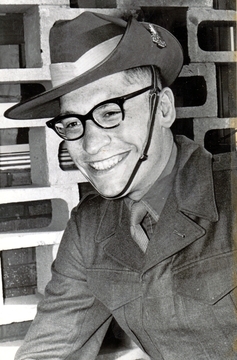
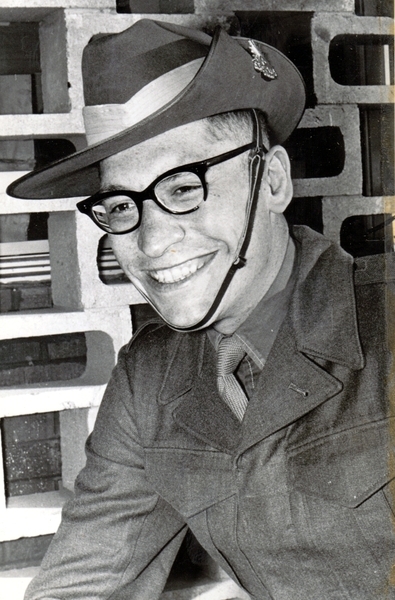
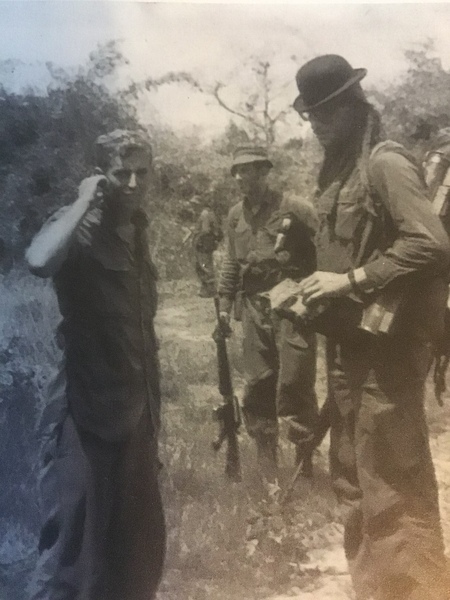
Click images to start slideshow.