








FRAZER, Kenneth Richard
| Service Number: | 452 |
|---|---|
| Enlisted: | 8 January 1916, An original member of B Company |
| Last Rank: | Private |
| Last Unit: | 36th Infantry Battalion |
| Born: | Binnaway, New South Wales, Australia, 1897 |
| Home Town: | Binnaway, Warrumbungle Shire, New South Wales |
| Schooling: | Not yet discovered |
| Occupation: | Labourer |
| Died: | Killed in action, Passchendaele, Belgium, 12 October 1917 |
| Cemetery: |
No known grave - "Known Unto God" Menin Gate Memorial, Ypres, Flanders, Belgium |
| Memorials: | Australian War Memorial Roll of Honour, Coonabarabran War Memorial Clock Tower, Ypres (Menin Gate) Memorial |
World War 1 Service
| 8 Jan 1916: | Enlisted AIF WW1, Private, 452, 36th Infantry Battalion, An original member of B Company | |
|---|---|---|
| 13 May 1916: | Involvement Private, 452, 36th Infantry Battalion, Third Ypres, --- :embarkation_roll: roll_number: '17' embarkation_place: Sydney embarkation_ship: HMAT Beltana embarkation_ship_number: A72 public_note: '' | |
| 13 May 1916: | Embarked Private, 452, 36th Infantry Battalion, HMAT Beltana, Sydney |
Help us honour Kenneth Richard Frazer's service by contributing information, stories, and images so that they can be preserved for future generations.
Add my storyBiography contributed by Stephen Brooks
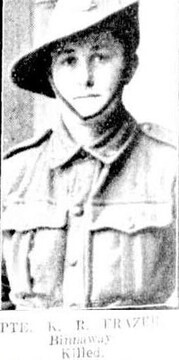
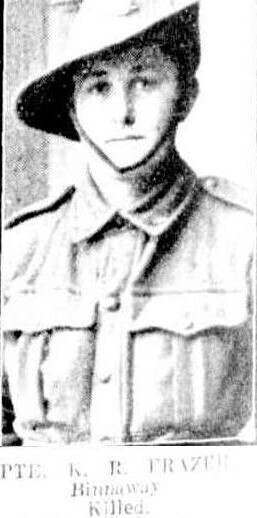
Kenneth Richard Frazer was one of four brothers who served in the AIF, the sons of Francis Stephen and Sarah Jane Frazer, of Binnaway, New South Wales.
Two of the brothers lost their lives, one was sent home badly wounded in 1917 and the fourth brother was decorated twice for bravery, winning the Military Medal and Bar before returning home in 1919.
His older brother, 1246 Tpr. Horace Ernest Frazer 7th Australian Light Horse, died of wounds on 7 August 1916 in Kantara, Egypt, aged 27.
Kenneth arrived in France with the 36th Battalion during November 1916. He was reported missing after the desperate fighting at Passchendaele on 12 October 1917. In his Red Cross wounded and missing file one of his mates said that Kenneth worked at the Brick Works in Newcastle before the war. He was said to be about 5ft 7inches, very dark, clean shaven and about 19 years of age. His mate said he had seen his grave at Hell Fire Corner near Ypres. There was a cross over it and his name and number were on it. “He was a good fellow.” Another soldier said he was “killed by a shell at Passchendaele and he was knocked about a good bit.”
He was reported as missing after the battle and his remains were never found after the war. He was officially declared as killed in action during April 1918.
The Mudgee Guardian reported on his death during May 1918.
“Mr. Francis S. Frazer, of Binnaway has received a letter from Captain R. A. Goldrick, who writes from France, March 16, with reference to the loss of Mr. Frazer's son, Private Kenneth Frazer, who has been missing since the operations before Passchendaele in October of last year. The loss of Private Frazer is referred to very regretfully, and it is affirmed that he was held in the highest esteem by the officers and men of his battalion. Captain Goldrick is himself able to speak in the highest terms of the young soldier from his close association with him on the parade ground, in the sports field and in action. “He never failed me, nor did he fail his platoon Commander, nor his chums. He was a boy who by his own self-respect begot of those with whom he worked. Kenneth lived clean, talked clean, fought clean. These qualities, and his bravery were fine, endeared him for all time in the hearts of his friends and in the history of his company. Your son was of a type of which I have only met one or two others. . .. Kenneth's loss is a very great one. . .. Unfortunately, I cannot tell you what became of him. I do not know, nor can most careful enquiries elicit any re-liable information from the few men who survived that day. I remember seeing him during the approach march, game and determined. I have a recollection of seeing him on the position of assembly a few minutes before the attack. One man was hit. I asked for something to bind him. It was a hot corner, but I think it was your boy who knelt down beside this man. I am not, sure; it was very dark. I was wounded five hours later. We were then the most advanced company. Subsequently they had to straighten the line; I was not with them then. Was he captured? Nobody can say. He was not of a sort to surrender. Yet he may have been incapacitated. It would be cruel to give you false encouragement, but …. he may be still alive. Truly we lost of our best that day."
Click images to start slideshow.