


COLLINS, Andrew
| Service Number: | 2530 |
|---|---|
| Enlisted: | 14 March 1916 |
| Last Rank: | Private |
| Last Unit: | 47th Infantry Battalion |
| Born: | Roma, Queensland, Australia, May 1893 |
| Home Town: | Gladstone, Gladstone, Queensland |
| Schooling: | Not yet discovered |
| Occupation: | Labourer |
| Died: | Colon Cancer, Eventide Nursing Home, Sandgate, Queensland, Australia, 20 December 1958 |
| Cemetery: |
Lutwyche Cemetery, Brisbane, Qld Anzac Portion 9, |
| Memorials: |
World War 1 Service
| 14 Mar 1916: | Enlisted AIF WW1, Private, 2530, 47th Infantry Battalion | |
|---|---|---|
| 19 Sep 1916: | Involvement Private, 2530, 47th Infantry Battalion, --- :embarkation_roll: roll_number: '19' embarkation_place: Brisbane embarkation_ship: HMAT Seang Choon embarkation_ship_number: A49 public_note: '' | |
| 19 Sep 1916: | Embarked Private, 2530, 47th Infantry Battalion, HMAT Seang Choon, Brisbane | |
| 9 Oct 1918: | Discharged AIF WW1, Private, 2530, 47th Infantry Battalion, 1st MD, medically discharged (exhaustion psychosis) |
Help us honour Andrew Collins's service by contributing information, stories, and images so that they can be preserved for future generations.
Add my storyBiography contributed by Evan Evans
From Australian Remembrance Army
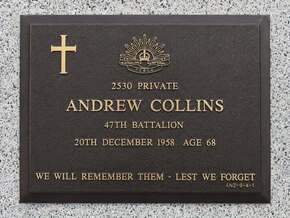
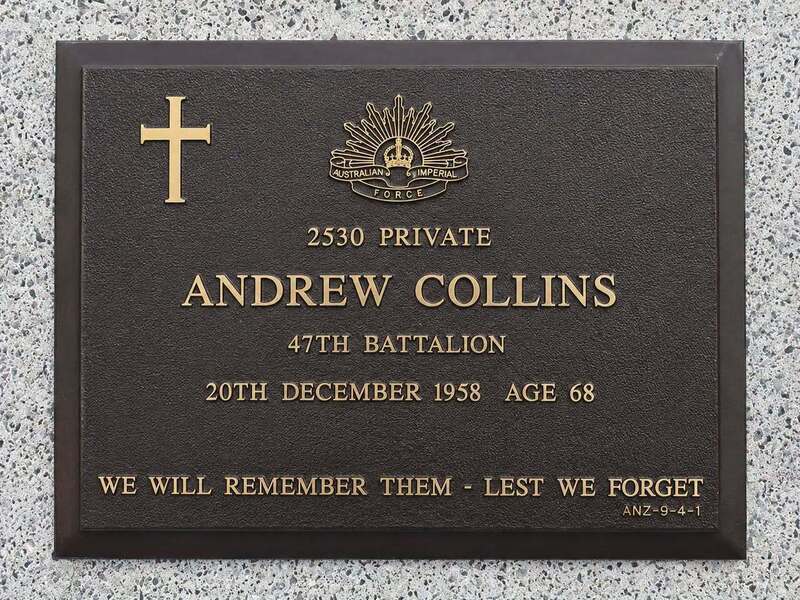
Australian World War One veteran Private Andrew Collins, Service No. 2530, is among almost 800 previously unmarked WWI veterans’ graves in Lutwyche Cemetery we have now marked with plaques in recognition of their service for Australia.
We unveiled his plaque in Lutwyche Cemetery on 16 May 2026, along with a further 185 plaques on the previously unmarked graves of Australian World War One veterans:
see Australian Remembrance Army Facebook page
Andrew Collins was born in Roma, Queensland. He enlisted in the Australian Imperial Force on 14 March 1916, stating that he was 23 years old and single. He named his mother, Mrs Collins of Roma, Queensland, as his next of kin.
On 19 September 1916, Collins embarked from Brisbane aboard HMAT Seang Choon. He disembarked at Plymouth, England, on 9 December 1916. After training in England, he proceeded overseas to France on 24 January 1917 and joined the 47th Battalion in the field in February 1917.
In June 1917, Collins was wounded in action at Messines. His records describe a gunshot wound to the arm, later noted as a compound comminuted fracture of the radius and ulna. The medical report recorded continuing loss of power in the forearm, impaired movement at the elbow and wrist, and treatment by massage.
Following the wound, Collins was treated through military medical units in France and England. His service and medical papers record movement through field ambulance and casualty clearing facilities, then hospitals including Rouen, Taplow, and The Lord Derby War Hospital at Warrington, Lancashire.
By August 1917, Collins’s records also noted a mental health condition diagnosed as “exhaustion psychosis.” The medical report stated that on 29 August 1917 he was reported as believing that “crabs or grubs” were growing in him, and that he later asked an orderly for poison to kill them. By November 1917, the report recorded that he appeared free from delusions, conversed rationally, and behaved well.
The medical report found the condition attributable to service during the war. The stated causes were “stress of campaign” and the gunshot wound to his arm. His arm injury was also recorded as a separate disability sufficient to cause invalidity, although the report noted that exhaustion psychosis was the disability for which he was brought before the board.
On 21 July 1918, Collins returned to Australia aboard S.S. Boonah. He arrived back in Australia in September 1918 and was discharged the following month. His service file records his return and discharge in connection with exhaustion psychosis, with continuing physical incapacity from the arm wound also noted.
Private Andrew Collins died of colon cancer at Eventide Nursing Home, Sandgate, Brisbane, on 20 December 1958, aged 68, and was buried three days later in Anzac Portion 9, Lutwyche Cemetery, Brisbane.
After decades without recognition at his place of burial, his grave now bears a plaque commemorating his service to Australia — ensuring his name endures among those remembered for their duty and sacrifice. His identity and dignity have now been restored.
We have remembered him.
Lest We Forget
Click images to start slideshow.