








SIM, Ernest
| Service Number: | 2798 |
|---|---|
| Enlisted: | 21 July 1915, Enlisted at Liverpool, NSW |
| Last Rank: | Lance Sergeant |
| Last Unit: | 18th Infantry Battalion |
| Born: | Barmedman, New South Wales, Australia, 1893 |
| Home Town: | Windsor, Hawkesbury, New South Wales |
| Schooling: | Not yet discovered |
| Occupation: | Fireman |
| Died: | Pneumonia, Weymouth, England, United Kingdom, 20 January 1919 |
| Cemetery: |
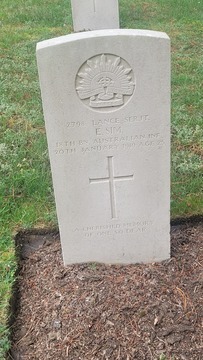
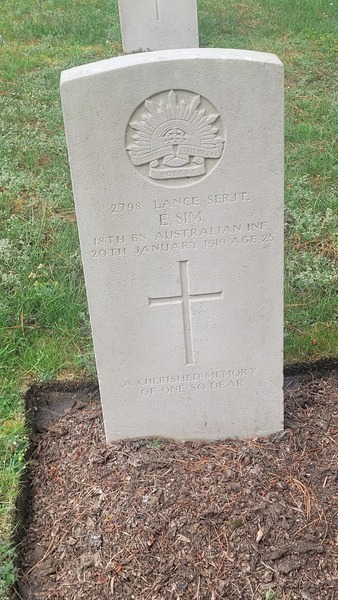
Melcombe Regis Cemetery, Dorset, England Plot 11, Row C, Grave 3063, |
| Memorials: | Australian War Memorial Roll of Honour, Goulburn District Railway Employees Great War Honour Roll, Haymarket NSW Government Railway and Tramway Honour Board, Windsor St. Matthew's Anglican Church WWI Roll of Honour |
World War 1 Service
| 21 Jul 1915: | Enlisted AIF WW1, Private, 2798, Enlisted at Liverpool, NSW | |
|---|---|---|
| 2 Nov 1915: | Involvement Private, 2798, 18th Infantry Battalion, --- :embarkation_roll: roll_number: '12' embarkation_place: Sydney embarkation_ship: HMAT Euripides embarkation_ship_number: A14 public_note: '' | |
| 2 Nov 1915: | Embarked Private, 2798, 18th Infantry Battalion, HMAT Euripides, Sydney | |
| 29 Apr 1917: | Promoted AIF WW1, Lance Corporal, In the field | |
| 4 Aug 1917: | Promoted AIF WW1, Corporal, In the field | |
| 16 Jun 1918: | Promoted AIF WW1, Lance Sergeant, In the field | |
| 8 Aug 1918: | Wounded AIF WW1, Lance Sergeant, 2798, Wounds to the left ankle and right leg. Invalided to England on 11 August 1918 | |
| 20 Jan 1919: | Involvement 2798, 18th Infantry Battalion, --- :awm_ww1_roll_of_honour_import: awm_service_number: 2798 awm_unit: 18 Battalion awm_rank: Lance Sergeant awm_died_date: 1919-01-20 |
Help us honour Ernest Sim's service by contributing information, stories, and images so that they can be preserved for future generations.
Add my storyBiography contributed by Carol Foster
Son of Herbert and Margaret Sim; husband of Elsie May Sim of 70 Carrington Road, Randwick, NSW
Medals: 1914-15 Star. British War Medal, Victory Medal
Biography contributed by John Oakes
Ernest SIM was born at Barmedman, NSW, on 7th February 1893. His parents were Herbert C and Margaret Sim.
On 19th September 1911 he joined the NSW Government Railways and Tramways as a cleaner (permanent) in the Locomotive Branch based at Harden, although he had been employed previously as a casual. On 28th March 1914 he was promoted to the grade of fireman, based at first at Harden. However, soon after his promotion he transferred to Picton on 2nd April 1914, to Junee on 1st June 1914, back to Picton on 4th November 1914 and finally to Goulburn on 22nd February 1915. On 4th August 1915 he was granted leave to join the Expeditionary Forces.
Ernest officially joined the AIF on 21st July 1915. He was posted to the 6th Reinforcements to the 18th Infantry Battalion with the rank of Private (Service Number 2798). When he enlisted he was very recently married and he nominated his wife, Elsie May (née Raymond), as his next of kin (their marriage was registered at Cootamundra in 1915). He gave her address as c/- Police Station, Windsor, NSW.
He embarked for Egypt aboard HMAT A14 ‘Euripides’ on 2nd November 1915.On 23 January 1916 when he was admitted to the 1st Australian General Hospital at Heliopolis with an injured back. He was in hospital for only three days before being discharged on 26 January 1916.
On 20th February 1916 he was admitted to hospital at Abbassia (Egypt) with venereal disease and was discharged to duty on 15th March 1916. He was taken on strength of the Overseas Base at Gherzireh on 16th March 1916. He was still in Egypt on 3rd April 1916 when he was transferred to the Anzac Police Corps at Abbassia.
On 21st July 1916 he was admitted to the 3rd Australian General Hospital at Abbassia with a bad case of sunburn (blistered back) but was sufficiently recovered to be discharged to duty on 26th July 1916. His tour of duty with the Anzac Police Corps finished on 26th August 1916 when he transferred back to the 18th Infantry Battalion, which was then at Abbassia. On 14th September 1916 he embarked at Alexandria for England.
On 3rd October 1916 he marched in to the 5th Training Battalion at Rolleston (England) from the 2nd Command Depot. On 28th October 1916 he was Absent Without Leave from parade on Saturday afternoon and was sentenced to 28 days detention by the Officer Commanding the 5th Training Battalion. This sentence was suspended by a superior officer the same day and Ernest left England for France on 2nd November 1916.
He reached the 2nd Australian Division Base Depot at Etaples on 3rd November 1916 and finally joined the 18th Infantry Battalion on the Somme on 18th November 1916.
On 17th February 1917 he reported injured with a broken toe. He was sent to the 9th General Hospital at Rouen, where he was admitted on 19th February 1917 for treatment. He was discharged to the nearby 2nd Convalescent Depot the next day and was discharged to the 2nd Australian Division Base Depot on 23rd February 1917. He reached Etaples (France) on 27th February 1917 but was soon moved on as he re-joined the 18th Infantry Battalion on 8th March 1917.
On 29th April 1917 he was promoted to the rank of Lance Corporal. He remained on duty with the 18th Infantry Battalion until 28 thSeptember 1917. During this period the Battalion was involved in the second battle of Bullecourt in France (3-4 May 1917) and the battle of Menin Road in Belgium (20th-22nd September 1917). Ernest was formally promoted to the rank of Corporal between these two battles, on 4th August 1917, having been Temporary Corporal since 16th June 1917.
On 28th September 1917 Ernest was posted to the 5th Training Battalion at Rolleston in England, and to be borne supernumerary to establishment. He marched in there on 2nd October 1917. On 21st November 1917 he was attached to the Permanent Cadre of the 5th Training Battalion. From 1st to 30th November 1917 he attended the 15th Rifle Course at the School of Musketry, Tidworth, and qualified as 2nd class with a fair knowledge of the Lewis Gun.
On 30th January 1918, Ernest left England to return to France where he marched in to the 2nd Australian Division Base Depot at Le Havre the next day. He left there on 3rd February 1918 and re-joined the 18th Infantry Battalion, which was on trench duty in Belgium, on 5th February 1918.
On 15th May 1918 he was slightly wounded in action in northern France but remained on duty.
On 16th June 1918 he was appointed to the rank of Lance Sergeant.
On 8th August 1918, during the battle of Amiens, Ernest was wounded in action again, but severely this time. He was evacuated to England where he was admitted to Southwark Military Hospital in London on 11th August 1918. He was suffering a slight bomb (hand grenade) wound to the left ankle and severe gunshot wounds to the right leg and arm. However, he recovered from his wounds and was sent on furlough from 28th October 1918 to 11th November 1918, when he went to No. 1 Command Depot at Sutton Veny. On
On 2nd December 1918 he was transferred to Headquarters AIF Depots, UK.
On 24th December 1918 he was sent to No. 2 Command Depot at Tidworth.
Shortly after this he came down with Influenza followed by pneumonia. He was admitted to Monte Video Hospital at Weymouth where he died on 20th January 1919.
A transcript of a letter from the Sister-in-Charge of the hospital, in his Red Cross Enquiry file gives more information:
‘He came into this Hospital very ill with pneumonia following Influenza, and from the first, was in a dangerously ill condition. His brother was sent for and was with him when he died and for some time before, so he was able to write home all particulars.’
Ernest’s grave is in Melcombe Regis Cemetery, Weymouth, Dorset, England. His place of association is Sydney, NSW.
- based on the Australian War Memorial Honour Roll and notes for the Great Sydney Central Station Honour Board.
Click images to start slideshow.