



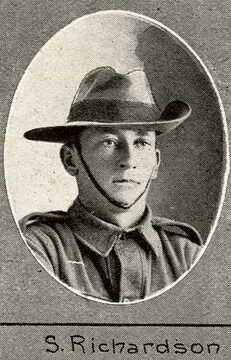
RICHARDSON, Sydney
| Service Number: | 2669 |
|---|---|
| Enlisted: | 15 April 1915 |
| Last Rank: | Lance Corporal |
| Last Unit: | 49th Infantry Battalion |
| Born: | Crows Nest, Queensland, Australia , 10 April 1884 |
| Home Town: | Crows Nest, Toowoomba, Queensland |
| Schooling: | Glenavon State School, Queensland, Australia |
| Occupation: | Grazier |
| Died: | Died of wounds, France, 8 September 1916, aged 32 years |
| Cemetery: |
Etaples Military Cemetery Plot X, Row C, Grave No. 10. |
| Memorials: | Australian War Memorial Roll of Honour, Crows Nest (Qld) War Memorial, Maidenwell, Wengenville & District War Memorial, Nanango War Memorial |
World War 1 Service
| 15 Apr 1915: | Enlisted AIF WW1, Private, 2669, 9th Infantry Battalion | |
|---|---|---|
| 16 Aug 1915: | Involvement Private, 2669, 9th Infantry Battalion, Battle for Pozières , --- :embarkation_roll: roll_number: '9' embarkation_place: Brisbane embarkation_ship: HMAT Kyarra embarkation_ship_number: A55 public_note: '' | |
| 16 Aug 1915: | Embarked Private, 2669, 9th Infantry Battalion, HMAT Kyarra, Brisbane | |
| 8 Sep 1916: | Involvement Lance Corporal, 2669, 49th Infantry Battalion, Battle for Pozières , --- :awm_ww1_roll_of_honour_import: awm_service_number: 2669 awm_unit: 49th Australian Infantry Battalion awm_rank: Lance Corporal awm_died_date: 1916-09-08 |
Help us honour Sydney Richardson's service by contributing information, stories, and images so that they can be preserved for future generations.
Add my storyBiography contributed by Stephen Brooks
Sydney Richardson was the son of William Herbert Richardson and Elizabeth Robinson, both of whom had passed away many years before WW1. His younger brother, 2790 Pte. Edward Richardson 15th Battalion AIF had been killed in action on 6 July 1916, aged 23.
‘Syd’ Richardson was a grazier of Glenaven, Crow's Nest at the time and gave his next of kin as Mrs. John Campbell (his sister Amy) of Glenaven. He was mortally wounded during the heavy fighting at Mouquet Farm on 3 September 1916 and though he made it to a General Hospital at Etaples he died of his wounds about five days later. His war medals went to an older brother, Ernest Richardson.
Biography contributed by Ian Lang
# 2669 RICHARDSON Sydney 9th / 49th Battalions
Syd Richardson was born at Crows Nest to William and Elizabeth Richardson of Glenaven. Syd, like his other siblings, attended Glenaven State School and then worked on the family property at Glenaven just north of Crows Nest. Syd attended a recruiting depot, probably in Toowoomba, on 15th April 1915. He told the officer he was 31 years old and gave his occupation as grazier. His parents were by that time deceased and Syd named his sister, Mrs Amy Campbell of Glenaven as his next of kin.
Syd reported to Enoggera Camp where he was allocated to the 8th reinforcements of the 9th Battalion. Four months later, Syd and the other 120 men who comprised the 8th reinforcements embarked on the “Kyarra” in Brisbane. Unusually, Syd chose not to have any of his pay of 5/- a day deducted and placed in a bank account. The “Kyarra” sailed via Melbourne and Fremantle to Suez in Egypt where the reinforcements proceeded to the one of the many infantry camps that had been established.
The 9th Battalion had been on Gallipoli since the first day; in fact, it was one of the first battalions ashore on 25th April. By the end of October, sickness and battle casualties had reduced the strength of the 9th and the battalion was withdrawn to the Greek island of Lemnos where hospitals and rest camps had been established. On 18th November, the 8th reinforcements joined the 9th Battalion on Lemnos. After an inspection by Lord Kitchener Minister for War in the British Government. the decision was made to abandon the whole Mediterranean campaign. The troops still occupying the trenches at Anzac were withdrawn from Gallipoli, achieved in secret and at night by the Australian forces. This withdrawal proved to be one of the few successes of those seven and a half months of the Gallipoli Campaign. The 9thBattalion, in rest camp on Lemnos, never returned to the peninsula but remained on the island until evacuated back to Egypt in January 1916. Syd’s few weeks on Lemnos entitled his service to be recognised with the 1914/15 Star in the 1920s.
During the first months of 1916, the AIF in Egypt went through an expansion, effectively doubling in size from two divisions to four. This doubling was achieved by splitting the original Gallipoli battalions to form the nucleus of two battalions, with additional numbers being drafted from the many reinforcements in the camps. The 9th Battalion was split to create two cores of veterans, one which would be redesignated the 49th Battalion. On 25th February 1916, Syd Richardson was transferred to the 49th Battalion. In April he was promoted to Lance Corporal.
After almost four months of intensive training in Egypt, the 49th was ready to rejoin the war on the Western Front. On the 5th June, the battalion boarded a transport in the Egyptian port of Alexandria; arriving in the French port of Marseilles one week later. The battalion then boarded a train for the long journey across France to the northern sector of the Western Front around the city of Armentieres. This part of the front was considered to be relatively quiet as the ground was so boggy that frontal assaults on a large scale were impossible. The 49thsettled into the routine of trench warfare. For those veterans of Gallipoli in the battalion, this period of the war was seen as almost a holiday. Battalions routinely rotated in and out of the line with comfortable billets in the rear areas. Hot food from the battalion cook wagons was delivered to the frontline daily and there was even fresh water delivered via a system of pipes. There was time for recreation when not in the line with sports and games organised as well as the ability to frequent the numerous cafes in the villages where “Vin Rouge”, (Red wine) eggs and chips could be had for a few francs. At the front, contact with the enemy was limited to trench raids and artillery barrages. The situation would not last.
On 1st July 1916, General Haig, supreme British commander of the Western Front, launched what he hoped would be the grand offensive to end the war. He chose as his battleground the area which separated the British and French armies, the valley of the River Somme. Haig was trusting in the sheer weight of numbers of his army. (The British government had introduced conscription in late 1915 and the increased force was often referred to as Kitchener’s New Army). History records that the British suffered 60,000 casualties on the first day. It was apparent that barbed wire and machine guns were more than a match for straight lines of soldiers marching with bayonets fixed towards heavily defended positions.
In spite of the enormous cost in manpower, Haig had no choice but to push on.
By the middle of the month, little ground had been taken and Haig called up three AIF divisions, the 1st, 2nd and 4thAustralian Divisions to move south from the Armentieres sector to Albert to take part in the Somme offensive. The village of Pozieres half way between Albert and Bapaume, sat on the highest point of that part of the battlefield and occupied a commanding position. Pozieres was taken by the 1st Division on 26th July. The second division’s objective was to take a blockhouse which had been built on the site of a windmill above the village of Pozieres. The windmill was behind two lines of trenches, and provided a panoramic view of the surrounding countryside. With the village and the windmill in British (Australian) hands, the 4th Division, including the 49th, moved into the front-line trenches to hold the line against a ferocious counterattack. There was no plan to attack; the 4th Division simply had to occupy the trenches and endure what many veterans described as the heaviest artillery barrages of the war. The 49th, like most of the battalions, suffered heavy casualties. With Pozieres ridge secured attention turned towards a ruined farm which the Germans had heavily fortified by extending the cellars and creating a line of three defensive trenches. The farm, a little over one mile from Pozieres, was depicted on the maps as “La Ferme du Mouquet” but the Australians referred to it as “Moo Cow Farm” or “Mucky Farm.” The assault on the farm had to be conducted up a shallow gully on an ever-narrowing front that was enfiladed by German artillery and machine guns on three sides. The ground was so churned up by high explosive shells that advancing troops could not recognise a trench line when they reached it. Attempts to dig new trenches were unsuccessful due to the loose ground caving in. The three AIF divisions that had taken and held Pozieres were put back into the battle for Mouquet Farm. Throughout August, the British command continued to waste Australian lives in futile frontal assaults. A final assault was planned for the 3rd September by three battalions of the 13th Brigade, one of which was the 49th, placed on the right flank of the attack. At first things went well but the German defenders with an overwhelming advantage as far as defence was concerned eventually drove the attack back to the start line. The 49th was withdrawn from the battle for Mouquet Farm on 4th September without the objective being reached, but at considerable cost. Amongst the casualties was Sydney Richardson.
Syd had sustained a compound fracture of his right upper arm and a head wound, probably the result of an artillery shell. He was taken by ambulance train to the 4th Australian General Hospital at Camiers near Etaples on the French coast. Syd died of his wounds on 8th September 1916, aged 32, and was buried in the large Etaples Military Cemetery. Syd’s sister, as next of kin, was officially notified of his death by telegram. Other family members, including a step brother in Mundubbera learned of Syd’s death from casualty lists published in newspapers. Amy Campbell chose the following inscription for Syd’s headstone: REST IN PEACE.
According to the rules laid down for the distribution of service medals to deceased servicemen, Syd’s eldest brother, Edward of Blackbutt received the 1914/15 Star, Victory and Empire Medals. He also received a similar clasp of medals for his other brother, Edward.

Click images to start slideshow.