



CARSE, Arthur Edward
| Service Number: | Officer |
|---|---|
| Enlisted: | 1 October 1914, Enlisted at WA |
| Last Rank: | Lieutenant |
| Last Unit: | 16th Infantry Battalion (WW1) |
| Born: | Ascot Vale, Victoria, Australia, 11 December 1892 |
| Home Town: | Victoria Park, Victoria Park, Western Australia |
| Schooling: | Sunbury State school No 1002, Victoria, Australia |
| Occupation: | Civil Servant |
| Died: | Wounds, 15th General Hospital, Alexandria, Egypt, 2 May 1915, aged 22 years |
| Cemetery: |
Alexandria (Chatby) Military and War Memorial Cemetery, Egypt Row Q, Grave 432 |
| Memorials: | Canning District R.S.L. Memorial, East Perth Department of the Minister for Mines Roll of Honour, East Victoria Park Memorial Wall, Kings Park Western Australia State War Memorial, Sunbury War Memorial, Victoria Park Church of the Transfiguration Fallen Honour Roll, Victoria Park State School Honour Board, Victoria Park War Memorial |
World War 1 Service
| 1 Oct 1914: | Enlisted AIF WW1, Second Lieutenant, Officer, 16th Infantry Battalion (WW1), Enlisted at WA | |
|---|---|---|
| 22 Dec 1914: | Embarked 16th Infantry Battalion (WW1), --- :embarkation_roll: roll_number: '12' embarkation_place: Melbourne embarkation_ship: HMAT Ceramic embarkation_ship_number: A40 public_note: '' | |
| 1 Feb 1915: | Promoted AIF WW1, Lieutenant, 16th Infantry Battalion (WW1) | |
| 25 Apr 1915: | Honoured Mention in Dispatches, ANZAC / Gallipoli, Date unclear when earned but between 25 April 1915 and 2 May 1915 London Gazette, second Supplement, No. 29251 on 5 August 1915; Commonwealth Gazette No. 133 on 28 October 1915. | |
| 2 May 1915: | Involvement Lieutenant, 16th Infantry Battalion (WW1), ANZAC / Gallipoli, --- :awm_ww1_roll_of_honour_import: awm_service_number: awm_unit: 16 Battalion awm_rank: Lieutenant awm_died_date: 1915-05-02 |
Help us honour Arthur Edward Carse's service by contributing information, stories, and images so that they can be preserved for future generations.
Add my storyBiography contributed by Carol Foster
Son of William Macklin Carse and Clara Carse nee Wells of 11 Cargill Street, Victoria Park, WA. Brother of Alice May Carse, Lilian Alice Carse and Violet May Carse
Medals: Mentioned in Despatches, 1914-15 Star, British War Medal, Victory Medal
Lieutenant Carse was a clerk in the Mines Depart ment, Perth, 23 years of age, and single. He was exceedingly popular wth his ieMow employees, and his death is greatly regretted.
Second-Lieut. Arthur Edward Carse was another of the younger generation of officers, having been born in 1892. His first experience of military life was in the 86th Infantry Regiment, in which he was gazetted a second lieutenant on October 28, 1912. Shortly after the outbreak of war he was accepted for active service, and was attached to the 16th Battalion as second lieutenant.
Another youthful W.A. officer among the fallen is Second Lieutenant Arthur Edward Carse, who has died of wounds. Lieutenant Carse was born in 1892, and is therefore only 23 years of age. He joined what is now the 86th Infantry Regiment some time
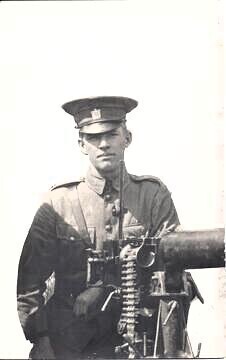
back, and rising from the ranks secured a commission in 1912. Prior to thc outbreak of war he had command of the machine-gun section of this regiment, and it was machine-gun work in which hé specialised. Enlisting soon after the outbreak of war, he
was attached to the 16th battalion. His relatives reside at Victoria Park. Lieutenant Carse was the beau ideal of a young citizen officer, and wide-sprcad was his popularity, both in the 86th regiment and the battalion to which he was attached on joining the A.I.F.
Biography contributed by Geoff Tilley
Arthur Edward Carse was born in Ascot Vale, Victoria on 26th December 1892 to parents William Macklin Carse and Clara Carse (nee Wells) who were married in Victoria in 1891. Arthur was one of six siblings four sisters and one brother. Two of Arthur’s oldest sisters, Lilian and Violet both died during infancy at Ascot Vale in 1891 and 1892.
It is unknown the exact date when the Carse family moved to Western Australia, however it was prior to 1895 as this is when Arthur’s youngest sister Alice was born in Victoria Park in December 1895. Arthur’s two other siblings Mabel and brother Edward were born in 1898 and 1900 also in Victoria Park.[1] The electoral role has the family residing at 11 Cargill Street Victoria Park.
Arthur’s schooling was undertaken initially at Sunbury State School No 1002 Victoria[2] then at Victoria Park State School and Stott’s College Perth. After his schooling Arthur was employed as a “clerk” a civil servant with the Mines Department, Records Branch in Victoria Park. It is recorded he was very popular with his peers having a kind nature and that he was a “man of superior attainment, with a fine character that won him the admiration and respect of all with whom he made contact” [3]
Arthurs military career began as a cadet at the age of 12[4], later joining with the Citizens Militia, Western Australian Highlanders where he attained the rank of Sergeant. He later joined the 88th Infantry Regiment. Arthur became a machine gunner where he was sent for training at the School of Instruction for Machine Gunners at Randwick, Sydney in July 1912.
On returning to Western Australia Arthur was given command of the 86th Infantry Regiment’s Machine Gun Section with the rank of Second Lieutenant which was gazetted on 28th October 1912.
With the outbreak of the First World War in August 1914, Arthur joined the Australian Imperial Force, (A.I.F.) in October 1914 where he was granted a commission as a Second Lieutenant, appointed as commanding officer of the machine gun section in 16th Battalion. He had not yet reached the age of 23 years being one of the youngest officers to take command. Arthur had the respect of his fellow officers and men, some who were clearly older than him.[5]
In the following months of November and December 1914, 16th Battalion embarked from Western Australia for further training at Broadmeadows, Melbourne. Arthur arrived on 28th November 1914. On disembarkation the companies of 16th Battalion paraded at Spencer Street railway station before boarding trains for a short journey to Broadmeadows via Essendon. On arrival at the camp, the men commenced erecting tents, where they later found there were not enough tents for all the men.[6]
It was on 22nd December 1914 that Arthur along with his battalion embarked from Melbourne aboard troopship HMAT Ceramic A40 where it arrived and took up anchorage in King George Sound, Albany on the 27thDecember 1914.
HMAT Ceramic was a part of the second ANZAC convoy, consisting of 17 ships that were transporting 11,000 ANZAC troops, departed from King George Sound on 31st December 1914 heading for the Middle East. The first Australian Imperial Force convoy had already departed King George Sound on 1st November 1914 with 20,000 troops aboard 38 troopships. The Albany shoreline would be the last sight many of the men would ever have of Australia.
HMAT Ceramic arrived in Alexandria, Egypt on the 1st February 1915 where the battalion conducted further training before embarking for Lemnos in preparation for the Gallipoli campaign. On Arthur’s arrival in Alexandria, he was promoted to Lieutenant.
It was on 12th April 1915 that Arthur with the battalion departed Alexandria, arriving in Mudros Harbour Lemnos on 15th April 1915 where the battalion practices landing from ships boats in preparation for the impending landing on the Gallipoli Peninsula.
It was late in the day at about 5.30pm of the 25th April 1915, that Arthur with his battalion landed at the beaches of Gallipoli, Arthur was one of the first Australian machine guns that was set ashore. In the days after the landing Arthur’s machine gun section went about doing work in organising the positions of the machine guns in the firing line around Pope’s Hill.
It was on the 27th April 1915 that Arthur was in the front line organising the machine guns when he was warning Sergeant Herbert Sykes[7] to conserve his fire and not to expose himself unnecessarily.
The details of how Arthur was wounded were written in a letter by Sergeant Herbert Sykes 16th Battalion of the machine gun section, to Arthur’s mother and the details of Sykes letter were printed in The Daily News, Newspaper 23rd December 1915, page 3.
Sykes writes that he replied to Arthur, ‘Right Ho” and told Arthur “But you had better get out of here sir, it’s too warm to be pleasant and we can’t afford to have you taking chances unless absolute necessary”.
Arthur laughed in that quiet way of his. I turned to the gun but suddenly remembered something I had forgotten to tell him. I had just turned in time to see him stagger and fall. Arthur said, “Its all-right Sykes, don’t leave the gun”. I saw him for a few minutes after I relieved off the gun. He shook hands with me and smiled. God he was game, grit right through and a soldier every inch.
We put him on a stretcher and the boys of the section carried him down. They would not let the bearers take him down, they thought too much of him. That was the last I saw of your brave son. The last words I heard him say before he was carried away were “Good Luck boys”[8]
Sykes writes on stating to Arthur’s mother, “Previous to the landing your son was one of the finest gentlemen and most efficient officers I have the pleasure to meet, and beloved by all under him and all who knew him. He proved to be (as we say) true blue and was the first of the machine gun section M.G.S. to reach the firing line and so had the honour of leading the first machine guns to get into action on the Anzac position”.[9]
Arthur was evacuated off the Gallipoli Peninsula to the hospital ship HMHS Galeka and transported to the 15th General Hospital in Alexandria.
The Matron of the hospital in a letter to Arthur’s mother under the date of November 3, Lieutenant Carse was admitted into the hospital on the morning of May 2 suffering from severe gunshot wound of the shoulder. There was absolutely no hope of his recovery when he was admitted, and he died at 11pm the same night. He was unconscious the whole day. You have my deepest sympathy in your sad loss” the Matron wrote.[10]
Arthur had succumbed to his wounds on the 2nd May 1915.
In a letter written and dated 23rd May 1915 by Lieutenant Colonel Harold Pope the commanding officer of 16thBattalion conveying his utmost sympathy for the loss of their son to the parents of Private Harold William George[11] a machine gunner in the section.
Pope goes onto write of the circumstances of Harold’s action,
“On the Monday we were strongly attacked all day fighting during the whole night and on Tuesday we were so strongly attacked that we were in danger of being driven out halfa dozen times. During the course of this fighting your son was hit by machine gun fire and killed instantly with several shots. Young Rowley who was been rather a pal of your son I fancy, was killed in the same manner at about the same time”.[12]
Pope continues on and writes about Arthur’s demise in the letter to Mr and Mrs George,
“Lieutenant Carse (since died of wounds) I understand the Machine Gun Officer told me of these losses and he himself hit badly later in the day. They tell me that your son and Rowley were too daring that they would look above the parapet of the trench to see the effect of their fire. They in common with everyone else who held that position, which was the key to the who position, the Army Corps still occupies, without question displayed the most splendid heroism.[13]
Private William Ronald Leslie Rowley[14], also a machine gunner in the section.
Lieutenant Pope writes on that the machine gun section lost 15 out of 34, three of the section were mentioned in despatches.
Lieutenant Arthur Edward Carse was buried in the Alexandria (Chatby) Military & War Memorial Cemetery. He was posthumously awarded a Mention in Dispatches (M.I.D.) for his outstanding work with the machine gun section. He was 22 years of age.
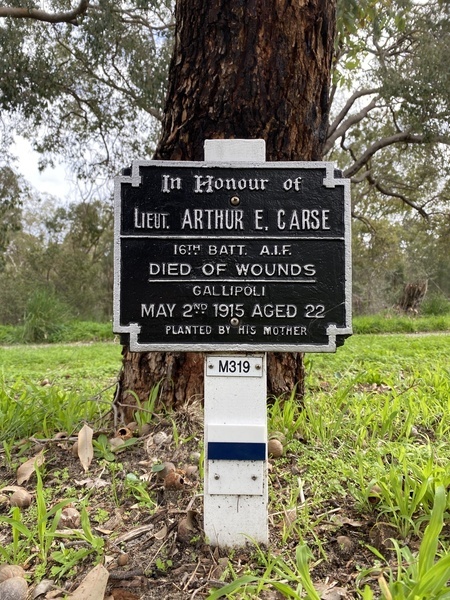
On the 3rd August 1919 Arthur’s mother took part in the first Honour Avenue in Kings Park held in May Circle planting a tree for Arthur. This first dedication was dedicated to 404 fallen soldiers on the fifth anniversary of the outbreak of World War One.
Lieutenant Arthur Edward Carse you are remembered with honour.
[1] Bartlett Family Tree. www.ancestry.com 10 July 2023.
[2] Virtual War Memorial Australia - https://vwma.org.au/explore/people/147404
[3] https://www.awm.gov.au/sites/default/files/files/Stories_by_State_Arthur_Edward_Carse.pdf 10 July 2023.
[4] https://www.anzacs.org/pages/AOcarse.html. 10 July 2023.
[5] Bloody Angle. Bullecourt & Beyond 16th Battalion AIF 1914-19. Ian Gill.
[6] Bayonets & Barb Wire. 16th Battalion AIF 1914-19. Neville Browning OAM.
[7] 339 L/Cpl H.J. Sykes. 16th Bn Machine Gun Section.
[8] www.trove.nla.gov.au. The Daily News 23 December 1915, page 3.
[9] www.trove.nla.gov.au. The Daily News 23 December 1915, page 3.
[10] www.trove.nla.gov.au. The Daily News 23 December 1915, page 3.
[11] Pte H W B George, No 705 16th Bn. Clerk 20 years of Claremont. Killed in Action 27 April 1915.
[12] Handwritten letter to parents of Pte George dated 28 May 1915 by Lieutenant Colonel Pope.
[13] Handwritten letter to parents of Pte George dated 28 May 1915 by Lieutenant Colonel Pope.
[14] Pte. W.R. Rowley, No 637 16th Bn. Agriculture Student 20 years of Cottesloe. Killed in Action 27 April 1915.




Click images to start slideshow.