






GOVE, Andrew Coull
| Service Number: | 2600 |
|---|---|
| Enlisted: | 13 June 1915 |
| Last Rank: | Sergeant |
| Last Unit: | 13th Infantry Battalion |
| Born: | Gourdon, Kincardine, Scotland, 6 April 1891 |
| Home Town: | Aberdeen, Scotland, United Kingdom |
| Schooling: | Not yet discovered |
| Occupation: | Mortar engineer |
| Memorials: | Ballarat Australian Ex-Prisoners of War Memorial |
World War 1 Service
| 13 Jun 1915: | Enlisted AIF WW1, Private, 2600, 13th Infantry Battalion | |
|---|---|---|
| 9 Aug 1915: | Involvement Private, 2600, 13th Infantry Battalion, --- :embarkation_roll: roll_number: '11' embarkation_place: Sydney embarkation_ship: HMAT Runic embarkation_ship_number: A54 public_note: '' | |
| 9 Aug 1915: | Embarked Private, 2600, 13th Infantry Battalion, HMAT Runic, Sydney | |
| 16 Nov 1916: | Promoted AIF WW1, Sergeant, 13th Infantry Battalion | |
| 4 Feb 1917: | Honoured Distinguished Conduct Medal | |
| 11 Apr 1917: | Imprisoned Bullecourt (First) | |
| 20 Mar 1920: | Discharged AIF WW1, Sergeant, 2600, 13th Infantry Battalion |
Help us honour Andrew Coull Gove's service by contributing information, stories, and images so that they can be preserved for future generations.
Add my storyBiography contributed by Stephen Brooks
Andrew Coull Gove was a remarkable soldier, being recommended for gallantry on several occasions. He had been born in Gourdan, Scotland and was the son of David Gove of Aberdeen, Scotland, his mother having died when he was about 12 years of age. He was reported to have been in Sydney for about four years before he enlisted there during early 1915. He gave his occupation as a mortar engineer.
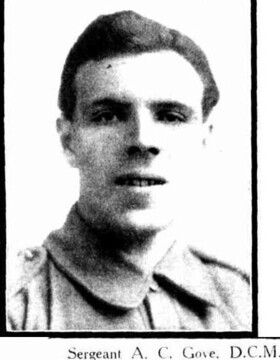
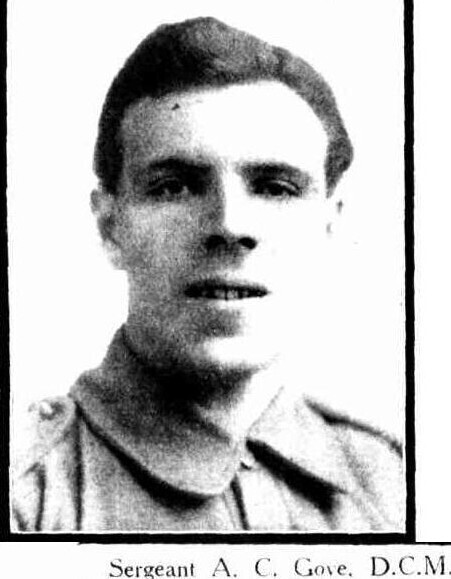
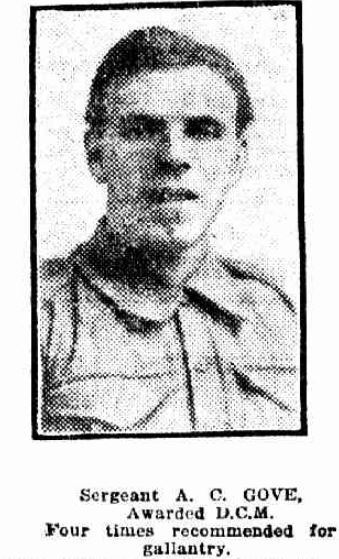
During 1917, his photograph was printed in the Sydney Mail along with the following report.
“Sergeant Gove has been four times recommended for gallantry for gallantry in the field, in addition to receiving the D.C.M. His bravery first won him promotion from private on the field at Pozieres, where, along with three others, he held a trench for five days. On another occasion, when his officer was wounded, he took command of the men and advanced on the enemy’s lines. Coming to a dugout with Germans inside, who refused to surrender, he threw a bomb amongst them, causing heavy losses. Sgt. Gove came to Australia about four years ago, and, joining up shortly after the outbreak of war, he was at the Gallipoli landing. He is the son of Mr. David Gove of Gourdon, Kincaidshire, Scotland.”
Gove actually landed on Gallipoli during October 1915 to join the 13th Battalion. He had a long recommendation for gallantry at Pozieres for which he received no award. At Stormy Trench in 1917, he was recommended for three separate acts of bravery, for which he received the D.C.M. He had been promoted to Sergeant during November 1916.
2600 Sergeant Andrew Coull Gove (unspecified recommendation) Pozieres.
“Near Mouquet Farm on the night 14/15th August 1916, when his Company was manning the trench preparatory to an advance, Sergeant Gove was in a bay with Lieut. Farlow and two others. Just as the signal was being given to move into No-man's land, 2 shells fell amongst the four, fatally wounding Lieut. Farlow, killing the two men and completely burying Sergeant Gove, who was later carried down an old German dug-out in our line. Later, when the Company returned to their trenches after suffering very heavy casualties, word was shouted down the dugout (which was occupied by wounded men) that the Germans were making a counter-attack and the trench was practically empty. Sergeant Gove, who was still badly shaken, rushed to his post, and with the handful of men in the trench succeeded in beating off a bombing attack made by fully fifty of the enemy. He himself accounted for a German Officer and four Germans with one bomb, the enemy being so close as to make this proceeding extremely dangerous for the thrower.
The following morning the enemy attempted to bomb down an old communication trench which connected the opposing line and in which we had placed a block. Sergeant Gove called for volunteers, and taking post behind the block, succeeded in driving the enemy back with four casualties.
The work of this N.C.O. is remarkably good both in and out of the line, and he is looked upon as a pillar of strength in his Company, He is always the first to volunteer for any enterprise demanding skill and courage.”
Recommendation for Distinguished Conduct Medal.
"In the attack on Stormy Trench, east of Gueudecourt, on the night of 4/5th February 1917, Sergeant Gove was detailed to ensure the bomb supply of his Company. When the attack was launched, he was one of the first into the enemy trench. Single handed he captured a dugout containing five Germans. Handing his prisoners over to one of his Platoon he immediately organised a small party of carriers and made three trips through an intense barrage and a hail of machine gun fire. Within half an hour he had carried over 1,000 grenades into the captured line.
At “stand-to” on the morning of 9th February a shell exploded in the trench wounding four men and igniting a box of German flares near where Gove stood. The explosion of the flares set on fire the boxes of a small dump of bombs, several of which exploded. Without a second's hesitation Sergeant Gove pulled some sandbags from the parapet and damped the fire. This action performed with total disregard of his own life undoubtedly saved many others, and I cannot too strongly recommend him for the D.C.M.”
Gove was taken prisoner of war during the disastrous first battle of Bullecourt in which the 13th Battalion again suffered very heavy casualties, on 11 April 1917.
Gove sent a postcard to a friend in Sydney from Limburg prisoner of war camp in Germany a few weeks after he had been captured.
“Prisoner 11.4.1917, most of the boys were either wiped out or captured. Benson is also here as well.”
He was repatriated to England in late 1918, returned to Australia in late 1919, and discharged during March 1920.
Click images to start slideshow.