





THOMSON, Franklin
| Service Numbers: | 2702, 2702A |
|---|---|
| Enlisted: | 6 August 1915 |
| Last Rank: | Private |
| Last Unit: | 52nd Infantry Battalion |
| Born: | Townsville, Queensland, Australia , 7 July 1896 |
| Home Town: | West End, Brisbane, Queensland |
| Schooling: | Not yet discovered |
| Occupation: | Engine cleaner |
| Died: | Brisbane, Queensland, Australia, 16 April 1945, aged 48 years, cause of death not yet discovered |
| Cemetery: |
Lutwyche Cemetery, Brisbane, Qld Anzac Portion 7 |
| Memorials: |
World War 1 Service
| 6 Aug 1915: | Enlisted AIF WW1, Private, 2702, 26th Infantry Battalion | |
|---|---|---|
| 19 Jun 1919: | Discharged AIF WW1, Private, 2702, 52nd Infantry Battalion, 1st MD, medically dishcharge, wounding (left leg amputated) | |
| Date unknown: | Involvement Private, 2702A, 26th Infantry Battalion |
Help us honour Franklin Thomson's service by contributing information, stories, and images so that they can be preserved for future generations.
Add my storyBiography contributed
From Australian Remembrance Army
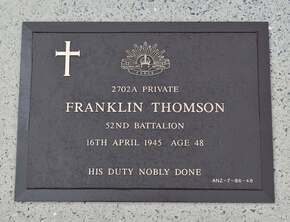
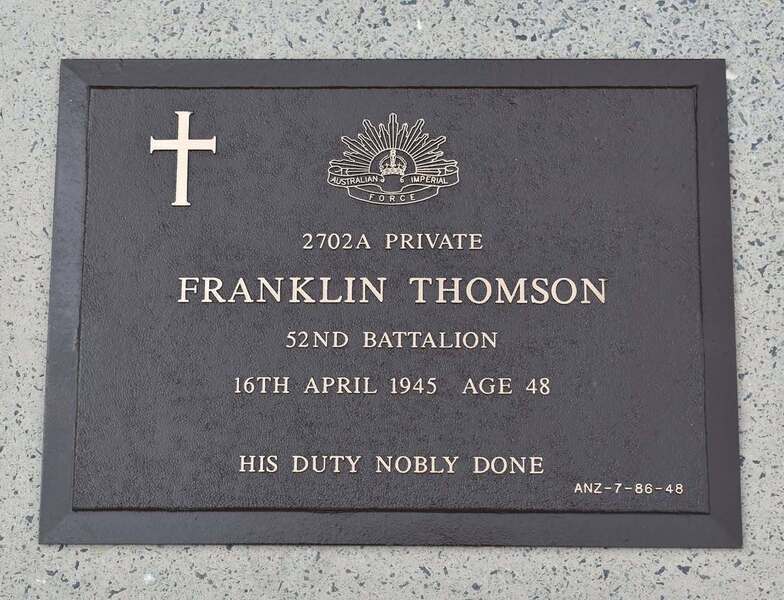
Australian World War One veteran Private Franklin Thomson (Service No. 2702A) is among almost 800 previously unmarked WWI veterans’ graves in Lutwyche Cemetery we have now marked with plaques in recognition of their service for Australia.
We unveiled his plaque in Lutwyche Cemetery on 15 April 2023, along with a further 246 plaques on the previously unmarked graves of Australian World War One veterans:
See Australian Remembrance Army Facebook page
Franklin Thomson was born on 7 July 1896 in Townsville, Queensland, to James Thomson and Jane Thomson (née Standing). He enlisted in the Australian Imperial Force at Frasers Hill, Queensland, on 18 October 1915. He was 19 years of age and employed as an engine cleaner, and nominated his mother as his next of kin.
His file shows there was later confusion between him and another soldier, Tennyson Thompson, who had the number 2702. Franklin’s number was therefore recorded with the added letter “A” to distinguish him from the other soldier.
On 21 October 1915, Franklin embarked from Brisbane aboard the Seang Bee with the 6th Reinforcements, 26th Battalion. He later served with the 52nd Battalion.
After training overseas, Franklin proceeded to France on 4 December 1916 to reinforce his unit. He rejoined his unit from hospital on 25 January 1917.
On 19 April 1917, he was reported sick, and on 24 April 1917, he embarked for England, where he was admitted to hospital suffering from frostbite of the toes. After treatment, he returned to France from Southampton in July 1917 and rejoined his battalion.
On 25 September 1917, Franklin was wounded in action in the field in France. His wounds were recorded as severe gunshot wounds to both legs. He was evacuated to England aboard the Hospital Ship Warilda on 5 October 1917 and admitted to Bath War Hospital.
His injuries resulted in the amputation of his left leg, recorded in his file as “G.S.W. amputation left thigh” and also as “amputation left leg.” One entry notes that the amputation had not previously been reported, indicating that later records clarified the full extent of his wounds.
By December 1917, Franklin was recorded as convalescent and progressing favourably. Because of the severity of his wounds and the amputation, he was no longer fit for active service.
In January 1918, he was listed to return to Australia aboard HMAT Karoola for discharge. The ship left Cape Town on 12 February 1918, and Franklin arrived back in Australia in March. Franklin Thomson was discharged from the Australian Imperial Force on 19 June 1918.
After returning to Australia, Franklin Thomson faced significant post-war difficulties. Newspaper reports describe him as a military pensioner who used a crutch in place of his left leg and lived on a pension of £1 2s 6d per week. In April 1920, while Anzac Day commemorations were taking place, Franklin appeared in the Brisbane City Police Court after damaging a glass window in Mary Street. The report described him as a “crippled soldier” and stated that he had no means other than his military pension. He pleaded guilty and was ordered to pay the cost of the window by instalments, with imprisonment imposed only in default of payment.
In 1929, he was again before the court after an incident at Spring Hill involving Ettie Dawson, during which he damaged her false teeth. The report stated that he had been drinking. He was fined and ordered to pay compensation.
These reports indicate that Franklin’s post-war life was marked by physical disability, limited income, alcohol-related trouble, and contact with the courts. His wartime wounds had left him permanently disabled, and his later circumstances suggest the long-term personal and social effects of his service continued well after his discharge from the AIF.
Private Franklin Thomson died on 16 April 1945, aged 48, and was buried in Anzac Portion 7, Lutwyche Cemetery, Brisbane. He was unmarried, with no known children.
After decades without recognition at his place of burial, his grave now bears a plaque commemorating his service to Australia — ensuring his name endures among those remembered for their duty and sacrifice. His identity and dignity have now been restored.
His Duty Nobly Done.
We have remembered him.
Lest We Forget
Click images to start slideshow.