








76621
CHURCHMAN, Norman Horace
| Service Number: | 2346 |
|---|---|
| Enlisted: | Not yet discovered |
| Last Rank: | Private |
| Last Unit: | 50th Infantry Battalion |
| Born: | Norwood, South Australia, 11 May 1889 |
| Home Town: | Gawler, Gawler, South Australia |
| Schooling: | Not yet discovered |
| Occupation: | Moulder |
| Died: | 10 February 1954, aged 64 years, cause of death not yet discovered, place of death not yet discovered |
| Cemetery: |
West Terrace Cemetery (AIF Section) Section: KO, Road: 5, Site No: 46 |
| Memorials: | Ballarat Australian Ex-Prisoners of War Memorial, Gawler Council Gawler Men Who Answered the Call WW1 Roll of Honor, Gawler St George Anglican Church Honour Roll, Gawler War Memorial |
World War 1 Service
| 21 Sep 1915: | Involvement Private, 2346, 10th Infantry Battalion, --- :embarkation_roll: roll_number: '10' embarkation_place: Adelaide embarkation_ship: HMAT Star of England embarkation_ship_number: A15 public_note: '' | |
|---|---|---|
| 21 Sep 1915: | Embarked Private, 2346, 10th Infantry Battalion, HMAT Star of England, Adelaide | |
| 11 Nov 1918: | Involvement Private, 2346, 50th Infantry Battalion | |
| Date unknown: | Wounded 2346, 50th Infantry Battalion |
Help us honour Norman Horace Churchman's service by contributing information, stories, and images so that they can be preserved for future generations.
Add my storyBiography contributed by St Ignatius' College
Norman Horace Churchman was born in May 1889, in Norwood. He was living in Gawler at the time of his enlisment. In his early life, he worked as a moulder – someone who specialized in creating sand moulds for casting molten metal, to create parts and tools commonly used in the mining, railway and agricultural industries.
At the age of 26, Churchman enlisted for service abroad with the Australian Imperial Force (AIF) in Keswick on 20 March 1915, where he was assigned to the 10th Battalion. Six months later, he embarked from Adelaide on board the HMAT Star of England.
On 25 December 1915, in Alexandria, Churchman was taken on strength in the 10th Battalion, before being temporarily detached to the Assistant Provost Marshall (APM) less than two months later, on 18 February 1916. The Assistant Provost Marshall was the military police of the army. Members were responsible for maintaining discipline among soldiers, guarding prisoners of war, and keeping order in the military camps and nearby villages and cities. Privates were commonly detached to the APM for extra manpower, and there were always APM staff wherever there were troops stationed. Egypt was a major base for ANZAC troops, a place for major camps and training grounds, and the APM were required to control discipline in these areas. Norman Horace Churchman and the other APM staff in Egypt managed the leave of soldiers and the behaviour in the Egyptian cities, deal with issues like fighting and crime, and guard detained soldiers and prisoners. The Australian soldiers were notorious for common misbehaviour, so working in the APM was a very important role to ensure discipline and stability throughout the military ranks.
On April 2 that year, Churchman was taken on strength in the 50th Battalion, after being transferred from the 10th. Between August and November 1916, Churchman, along with the rest of the battalion, fought on the Western Front in France. Their service took place in highly competitive and critical areas such as Pozières, Warlencourt and near Bapaume. During this time, they experienced the horrors of trench warfare, with constant exposure to artillery shelling and sniper fire.
On 5 November 1916, Churchman was documented absent without leave (AWL). Because of this, the Commanding Officer of his battalion awarded him a week of 2nd tier field punishment the day after. This level of punishment in the military consisted of a soldier remaining with his unit, receiving extra duties and labour, being confined to barracks or camp when not working. On 2 January 1917, he was admitted to hospital with an infection, where he stayed for 73 days.
After marching into the French commune of Etaples, on 20 March 1917, Churchman rejoined his unit. 13 days later, on April 2, he was reported missing in action (MIA) during the Attack on Noreuil. It was documented on April 2 that two officers and 60 other ranks were believed captured. Later that day, word was received that Churchman was captured by the German forces, and was being held as a prisoner of war (POW) at Limburg Camp. Limburg Camp was designed to hold close to 12,000 prisoners during World War One, and it was essential in its agricultural facilities, where the allied soldiers were forced to labour, working to grow and harvest food for the Germans. Soldiers inside the camp were allowed to send letters and communicate to loved ones back home. In a letter to his mother which he wrote on April 4 1918, Churchman says that he is in improved health since his active service for the ANZACs, and that him and five others have been working on a farm together. He also asks his mother to send through some games, so that they can pass the time. In a later letter from Churchman, dated 12 June 1918, he says that they were grateful for the parcels they received, although it was a while before they had been able to access them. He also says that the British soldiers (also known as Tommies), often say that people look after the Australian soldiers well, and Churchman knows they do.
After the armistice on 11 November 1918, the Australian soldiers were repatriated, and brought back home. On 24 December 1918, Churchman arrived in England after being released from the POW camp, where he was granted leave until the 30 December. Finally, he returned to Australia on 2 March 1919.
Churchman was then discharged on 5 July 1919. Overall, Churchman had served abroad for 3 years and 212 days, and served for 4 years and 108 days altogether.
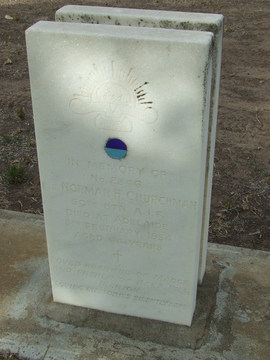
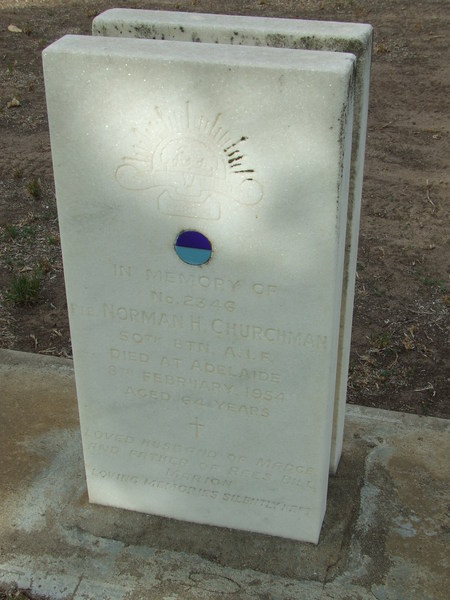
In March 1921 Churchman married Marion Underwood, and had at least three children: Rees, Billy and Marion. He moved to the suburb of Southwark, where he lived with his family until he passed away on February 10, 1954, aged 64. He is buried at West Terrace Cemetery, in the AIF section.
BIBLIOGRAPHY
1914-1918-Online (WW1) Encyclopedia. (2024). Prisoners of War (Australia) / 1.0 / handbook - 1914-1918-Online (WW1) Encyclopedia. [online] Available at: https://encyclopedia.1914-1918-online.net/article/prisoners-of-war-australia/#toc_interrogation_and_treatment.
1915 Coo-ee March. (2014). Letter from W. H. Saunders about HMAT Star of England voyage and arrival in Egypt 1916. [online] Available at: https://cooeemarch1915.com/2014/04/20/letter-from-w-h-saunders-about-hmat-star-of-england-voyage-and-arrival-in-egypt-1916/ [Accessed 9 Apr. 2026].
Adfa.edu.au. (2026). Details - Norman Horace Churchman. [online] Available at: https://aif.adfa.edu.au/showPerson?pid=52719.
Awm.gov.au. (2026a). AWM4 23/67/10 - April 1917. [online] Available at: https://www.awm.gov.au/collection/C1345871?image=11 [Accessed 11 Mar. 2026].
Awm.gov.au. (2026b). AWM4 23/67/10 - April 1917. [online] Available at: https://www.awm.gov.au/collection/C1345871?image=11.
Awm.gov.au. (n.d.). AWM4 Subclass 23/67 - 50th Infantry Battalion. [online] Available at: https://www.awm.gov.au/collection/C1339165.
Awm.gov.au. (2026c). Outdoor portrait of Prisoners of War (POW) at Stammlager POW camp, Limburg, Germany. Identified ... [online] Available at: https://www.awm.gov.au/collection/C396835?image=1 [Accessed 15 Mar. 2026].
Awm.gov.au. (2026d). Records of the Assistant Provost Marshal, 1914-18 War. [online] Available at: https://www.awm.gov.au/collection/C2130834.
Awm.gov.au. (2026e). THE GERMAN PRISONER OF WAR (POW) CAMP, STALAG 383, SHOWING PRISONERS IN THE OPEN SPACES BETWEEN ... [online] Available at: https://www.awm.gov.au/collection/C206935?image=1.
Department of Defence. (2024a). 1914-1915 Star. [online] Available at: https://www.defence.gov.au/adf-members-families/honours-awards/imperial-awards/1914-1915-star.
Department of Defence. (2024b). British War Medal 1914-20. [online] Available at: https://www.defence.gov.au/adf-members-families/honours-awards/imperial-awards/british-war-medal-1914-20.
Department of Defence. (2024c). Victory Medal. [online] Available at: https://www.defence.gov.au/adf-members-families/honours-awards/imperial-awards/victory-medal.
Naa.gov.au. (2024). Abbreviations used in First World War and Second World War service records | naa.gov.au. [online] Available at: https://www.naa.gov.au/explore-collection/defence-and-war-service-records/researching-war-service/abbreviations-used-first-world-war-and-second-world-war-service-records.
Naa.gov.au. (2026). Service Record - Norman Horace Churchman. [online] Available at: https://recordsearch.naa.gov.au/SearchNRetrieve/Interface/ViewImage.aspx?B=3249000&S=1.
National Archives of Australia (2024). First World War: Repatriation of Veterans | naa.gov.au. [online] Naa.gov.au. Available at: https://www.naa.gov.au/students-and-teachers/student-research-portal/learning-resource-themes/war/world-war-i/first-world-war-repatriation-veterans.
SA Red Cross Information Bureau Record - Norman Horace Churchman. (n.d.). [online] Slasa.sa.gov.au, pp.1–15. Available at: https://images.slsa.sa.gov.au/sarcib/SRG76_1_3251.pdf.
The Editors of Encyclopedia Britannica (2017). British Expeditionary Force. In: Encyclopædia Britannica. [online] Available at: https://www.britannica.com/topic/British-Expeditionary-Force.
Tibbitts, C. (2021). Casualties of war. [online] Australian War Memorial. Available at: https://www.awm.gov.au/wartime/article2.
Trove. (2026). Family Notices - The Advertiser (Adelaide, SA : 1931 - 1954) - 9 Feb 1954. [online] Available at: https://trove.nla.gov.au/newspaper/article/47565735.
UNSW Canberra - The AIF Project. (2026). Norman Horace CHURCHMAN. [online] Available at: https://aif.adfa.edu.au/showPerson?pid=52719
vwma.org.au. (n.d.). 50th Infantry Battalion. [online] Available at: https://vwma.org.au/explore/units/6.
Click images to start slideshow.