







ORIEL, Phillip
| Service Number: | 6853 |
|---|---|
| Enlisted: | 10 September 1916 |
| Last Rank: | Private |
| Last Unit: | 1st Machine Gun Battalion |
| Born: | Dubbo, New South Wales, Australia, 18 June 1898 |
| Home Town: | North Sydney, North Sydney, New South Wales |
| Schooling: | Not yet discovered |
| Occupation: | Clerk |
| Died: | Brisbane, Queensland, Australia, 23 January 1959, aged 60 years, cause of death not yet discovered |
| Cemetery: |
Lutwyche Cemetery, Brisbane, Qld Anzac Portion 9 |
| Memorials: |
World War 1 Service
| 10 Sep 1916: | Enlisted AIF WW1, Private, 6853, 13th Infantry Battalion | |
|---|---|---|
| 8 Nov 1916: | Involvement Private, 6853, 13th Infantry Battalion, --- :embarkation_roll: roll_number: '11' embarkation_place: Sydney embarkation_ship: SS Port Nicholson embarkation_ship_number: '' public_note: '' | |
| 8 Nov 1916: | Embarked Private, 6853, 13th Infantry Battalion, SS Port Nicholson, Sydney | |
| 7 Jun 1919: | Discharged AIF WW1, Private, 6853, 1st Machine Gun Battalion , 2nd MD, medically discharged |
Help us honour Phillip Oriel's service by contributing information, stories, and images so that they can be preserved for future generations.
Add my storyBiography contributed by Evan Evans
From Australian Remembrance Army
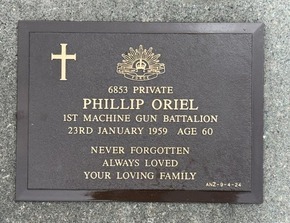
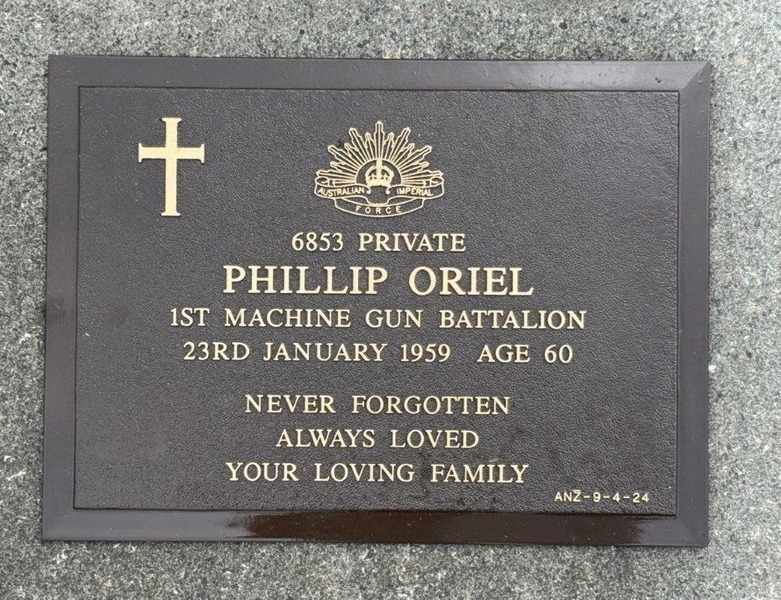
Australian World War One veteran Private Phillip Oriel (Service No. 6853), is among almost 800 previously unmarked WWI veterans’ graves in Lutwyche Cemetery we have now marked with a plaque in recognition of their service for Australia.
We unveiled his plaque in Lutwyche Cemetery on 20 September 2025, along with a further 161 plaques on the previously unmarked graves of Australian World War One veterans:
See Australian Remembrance Army Facebook page
Phillip Oriel was born on 18 June 1898 in Dubbo, New South Wales, to William James Oriel and Lavinia Annie Oriel (née O’Shea). He enlisted in the Australian Imperial Force in Sydney on 3 October 1916 at the age of 19, recording his occupation as a clerk and naming his mother as next of kin. He embarked for overseas service from Sydney aboard HMAT Port Nicholson on 8 November 1916 and arrived in England in January 1917, where he was posted to the 4th Training Battalion at Codford. During training he was briefly hospitalised with scabies before returning to duty.
In September 1917, Oriel proceeded to France and was posted to the 4th Australian Divisional Base Depot at Le Havre. He was hospitalised the following month with trench fever and transferred to England in November for treatment at Mill Road Auxiliary Hospital, Liverpool. After his discharge in December 1917, he returned to duty and proceeded again to France in early 1918.
On 2 May 1918 he was wounded in action, sustaining a gunshot wound to the right thigh, and was evacuated through France to England, where he was treated at Brant War Hospital. He returned to duty later that year and transferred to the Machine Gun Training Depot at Parkhouse before re-embarking for France in September 1918. He joined the 1st Machine Gun Battalion and was wounded for a second time on 22 September 1918, suffering a severe gunshot wound to the left leg with a fractured tibia. He was again evacuated to England and treated at Bath War Hospital.
Following discharge from hospital in November 1918, Oriel returned to Australia in January 1919 and was subsequently discharged from the AIF.
His father, William James Oriel, also served in the AIF (Service No. 2970), enlisting in Sydney and recording his wife, Lavinia Oriel, as next of kin. William survived the war and died in August 1949; he is buried at Winton Cemetery, Queensland.
Private Phillip Oriel died on 23 January 1959, aged 60, and was buried in Anzac Portion 9, Lutwyche Cemetery, Brisbane. He was unmarried and had no known children.
After decades without recognition at his place of burial, his grave now bears a plaque commemorating his service to Australia — ensuring his name endures among those remembered for their duty and sacrifice. His identity and dignity have now been restored.
We have remembered him.
Lest We Forget.
Click images to start slideshow.