




GLEESON, Thomas Timothy
| Service Numbers: | 2428A, 2428 |
|---|---|
| Enlisted: | 9 February 1916 |
| Last Rank: | Private |
| Last Unit: | 47th Infantry Battalion |
| Born: | Not yet discovered |
| Home Town: | Yangan, Southern Downs, Queensland |
| Schooling: | Yangan State School, Queensland, Australia |
| Occupation: | Farmer |
| Died: | Killed in Action, Belgium, 20 August 1917, age not yet discovered |
| Cemetery: |
Derry House Cemetery No.2 |
| Memorials: | Australian War Memorial Roll of Honour, Crows Nest (Qld) War Memorial |
World War 1 Service
| 9 Feb 1916: | Enlisted AIF WW1, 2428A, 47th Infantry Battalion | |
|---|---|---|
| 19 Sep 1916: | Involvement Private, 2428, 47th Infantry Battalion, Third Ypres, --- :embarkation_roll: roll_number: '19' embarkation_place: Brisbane embarkation_ship: HMAT Seang Choon embarkation_ship_number: A49 public_note: '' | |
| 19 Sep 1916: | Embarked Private, 2428, 47th Infantry Battalion, HMAT Seang Choon, Brisbane | |
| 20 Aug 1917: | Involvement Private, 2428A, 47th Infantry Battalion, Third Ypres, --- :awm_ww1_roll_of_honour_import: awm_service_number: 2428A awm_unit: 47th Australian Infantry Battalion awm_rank: Private awm_died_date: 1917-08-20 |
Help us honour Thomas Timothy Gleeson's service by contributing information, stories, and images so that they can be preserved for future generations.
Add my storyBiography contributed by Ian Lang
# 2428A GLEESON Thomas Timothy 47th Battalion
Tom Gleeson was born around 1876 to Thomas and Margaret Gleeson at Warwick. The family lived in the Yangan district near Warwick and Tom attended school there. Upon leaving school, Tom worked on the family farm and labouring in the district. Tom’s parents moved to “Pinelands” at Crows Nest but Tom remained at Yangan.
Tom attended the Army Recruiting Office in Brisbane on 9th February 1916. He advised the officer he was 40 years and three months old. The maximum age for enlistment was 45. His medical record records three scars on his legs and arm, probably the result of farming accidents. Tom named his father Thomas snr of “Pinelands” as his next of kin. He also disclosed that he had been charged with drunkenness by Warwick police. Tom took a train from Brisbane Central to Enoggera station and reported to Enoggera Camp where he was placed temporarily into a depot battalion before assigned as a reinforcement for the 47th Battalion.
The 5th reinforcements of the 47th Battalion continued to train at Enoggera before embarking on the “Seang Choon” at Pinkenba on 19th September 1916. Troop transports sailing from Australia to England sailed from Fremantle to Durban and Capetown to re coal, then out into the Atlantic with a stop at Sierra Leone before arriving at Plymouth. This route avoided the likelihood of encountering enemy submarines which operated in the Mediterranean and approaches to the English Channel, but took a considerable amount of time. Tom and the rest of the reinforcements landed in Plymouth on 9th December; they had been as sea for almost three months.
The reinforcements travelled by train to Codford and the 12th Brigade Training Battalion where they saw out the winter. On 28th March 1917, Tom boarded a cross channel steamer at Folkstone for the short crossing to France and the large Australian Depot at Etaples. He was marched out on 31st March to make his way to his battalion and was taken on strength by the 47th on 7th April 1917. Tom had arrived on the Western Front just as a series of attacks against the heavily defended Hindenburg Line were about to begin. The British 5th Army under General Gough was under orders to attack the Hindenburg Line at Bullecourt with his infantry, following which the cavalry would be put into the breech. Gough planned to use the 8 battalions of the 4th and 12th Infantry Brigades of the AIF as his spearhead. The 47thBattalion was part of the 12th Brigade of the 4th Australian Division which had been attached to Gough’s command.
Tom Gleeson, still with no experience of actual warfare, and the rest of the 47th Battalion moved up to the assembly areas through driving snow on the 8th April. Gough’s initial plan followed the usual script beginning with days of artillery bombardment to cut the several bands of barbed wire, followed by an infantry assault supported by a creeping artillery barrage. As the time for the attack drew closer, Gough had a conversation with a junior officer from the British Tank Corps. The junior officer convinced the general that tanks would be able to smash through the wire more effectively than cannon fire. What the officer did not reveal was that the tanks were only training tanks with well worn machinery prone to breakdown operated by inexperienced crew.
At the last minute, Gough changed his plans, dispensing with the artillery altogether. He ordered the infantry to move up to the jumping off tapes in preparation for the attack on the 10th April. The men lay on the snow covered ground awaiting the arrival of the tanks, all of which failed to make the start line on time either because of breakdowns or getting lost. Having revealed his plan to the German defenders, Gough postponed the attack for 24 hours. On the 11thApril, the 46th and 48th Battalions, with the 47th Battalion in support rose up from the snow covered ground and trudged towards the formidable defences before them following the same plan of the previous day. There was no artillery support and the tanks mainly failed for the second time. The few tanks that did proceed past the start line either became stuck in shell craters and tank traps or were put out of action with accurate artillery fire.
Many of the attacking infantry were hung up on the bands of wire which remained intact where they were cut down with enfilading machine gun fire. Remarkably, sufficient numbers of 12th Brigade men got through to take two lines of the German trenches which they managed to hold for seven and a half hours. The 47th was called upon to provide companies to reinforce the 46th and 48th. Ammunition and bombs (hand grenades) were being ferried up to the front by other 47th battalion men. Many of the carrying party men remained at the front to support those already there and so even more men found themselves sheltering in the captured German trenches. By the end of the day, most of the 12thBrigade forces had been committed to the battle. The German defenders began to box in the Australians stranded between the belts of barbed wire and the Brigade with ammunition exhausted was ordered to retreat. Many men ran at top speed across the snowy ground which made them easy targets for the defenders on the flanks. It is likely that Tom Gleeson at some point in the Bullecourt action was exposed to enemy fire for the first time. He was lucky to have escaped unscathed.
The battle, which became known as 1st Bullecourt was a complete disaster. The AIF command was highly critical of Gough’s handling of Bullecourt. Writing soon after the battle, the Australian War Historian Charles Bean said the plan to take Bullecourt had as much chance of success as a plan to capture the moon.
After the Somme campaign at Pozieres and Mouquet Farm in 1916 followed by the fiasco at Bullecourt, the entire 4thDivision had earned a well earned rest.
The British Field Commander, General Haig, planned a totally British campaign, which included Dominion troops, in the Ypres salient in Belgian Flanders. The plan aimed at spearing through the German defenders to the Belgian ports on the English Channel. To do so he planned for a series of battles in the summer and autumn of 1917, each of which created a stepping stone to the next objective. The first of these stepping stones was a ridge line which was occupied by the enemy and overlooked the ground that was to be used for the build up of British forces. The ridge ran almost due south from a position just outside Ypres, where spoil from a railway cutting had been dumped (the famous Hill 60) towards the village of Messines and on to Warneton on the French border.
The preparations for the Battle of Messines were carefully planned. Large scale models of the terrain to be covered were constructed and all troops who were to take part, which included Tom and the 47th Battalion, were walked through the models to familiarize themselves with their objectives. The general in charge at Messines had three and a half million artillery shells at his disposal which would be fired in the days leading up to the attack. In addition, British and Australian tunnellers had been undermining the Messines Ridge for almost 18 months; placing high explosive charges in tunnels directly underneath the German defences.
At 3:10 am on the 7th June, 19 of the underground mines beneath the Messines Ridge were fired simultaneously. It was the largest man made explosion in history and the noise could be heard in London. The 47th Battalion had spent the night at Bulford Camp and many men did not eat breakfast and displayed a great deal of nervous energy. After roll call, the battalion assembled and marched off, sweating profusely in their heavy woollen uniforms. The men marched through cultivated fields avoiding the choked roads on the way to Hill 60. Each man carried two water bottles but was under strict orders not to touch them as it was anticipated that water would be short over the coming days.
Two Australian Divisions were included in the order of battle for the attack at Messines. The 3rd Division AIF, fresh from England and with no battle experience, had responsibility for the northern sector of the front while the 4th Division was tasked with attacking the second line of German trenches, the Oosstaverne Line, behind the village of Messines itself. The 3rd Division’s advance was virtually flawless in its execution but the 4th Division encountered difficulties due to the broken ground caused by the mine explosions. A British Brigade was supposed to be supporting the 12th Brigade on its right flank but failed to keep up with the advance. Consequently, the battalions of the 12thBrigade had to spread out too thinly in an effort to cover the gap in the line. Back at brigade HQ, there was confusion as to how far the Australians had advanced as they had failed to respond to a signal from a low flying aircraft to fire flares.
The British artillery, unaware that there were Australians on the Oosstaverne Line, bombarded the trenches with high explosive. At this point in the battle, a part Chinese private from the 47th, Caleb Chang, began to relay messages back to HQ by using signalling flags he had made himself. In order to be seen, Shang stood upright behind a tree facing HQ; unaware that there was a German sniper in the tree. Remarkably, Shang not only survived that incident but went on to be a reliable self taught signaller. The 47th consolidated the Oosstaverne position over the next few days and withstood a heavy enemy counter attack on several occasions. On the 14th June, the 47th was relieved and went into a rest area behind the line to regroup, clean equipment and take on reinforcements. Thomas Gleeson had survived his second major battle.
In July, the 12th Brigade re-entered the line at Hill 63, supported by British regiments, with the object of holding the newly acquired ground. The Germans continued to rain high explosive shells on the British front line but the intensity of the barrages began to fall away once it was realised that the British had taken to constructing underground bunkers to protect the troops.
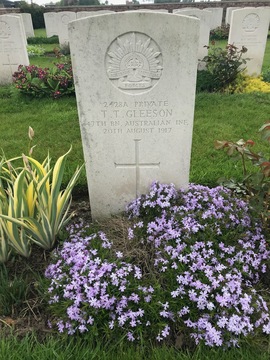
After another rotation of supports, frontline and rest, the 47th relieved the 13th Irish Battalion near Derry House. On the 20th August 1917, the German Gunners resumed heavy and haphazard shelling of the front line during which seven men of the 47th were killed and 18 wounded. One of those killed was Thomas Gleeson, aged 42. Thomas was buried at the Derry House Cemetery in Flanders. His mother was granted a pension of £1/-/- a fortnight. Thomas’ name appears on the Crows Nest war memorial, where his parents lived, but he is not listed on the memorial at Yangan, where he had spent most of his life.


Click images to start slideshow.