



MADDEN, Trevelyn Ernest
| Service Number: | 4859 |
|---|---|
| Enlisted: | 11 October 1915 |
| Last Rank: | Lance Corporal |
| Last Unit: | 56th Infantry Battalion |
| Born: | Rouchel, New South Wales, Australia, 15 July 1892 |
| Home Town: | Singleton, Northumberland, New South Wales |
| Schooling: | Rouchel Public School, New South Wales, Australia |
| Occupation: | Fireman |
| Died: | Died of wounds, France, 28 November 1916, aged 24 years |
| Cemetery: |
Heilly Station Cemetery VI C 22, |
| Memorials: | Australian War Memorial Roll of Honour, Gundy Public School Honour Roll, Haymarket NSW Government Railway and Tramway Honour Board, Singleton Public School HR, Singleton War Memorial |
World War 1 Service
| 11 Oct 1915: | Enlisted AIF WW1, Private, 4859, 4th Infantry Battalion | |
|---|---|---|
| 8 Mar 1916: | Involvement Private, 4859, 4th Infantry Battalion, --- :embarkation_roll: roll_number: '8' embarkation_place: Sydney embarkation_ship: HMAT Star of England embarkation_ship_number: A15 public_note: '' | |
| 8 Mar 1916: | Embarked Private, 4859, 4th Infantry Battalion, HMAT Star of England, Sydney | |
| 3 Nov 1916: | Wounded AIF WW1, Lance Corporal, 4859, 56th Infantry Battalion, Gunshot wound to skull and left leg. Admitted to 1st ANZAC Dressing Station, then No. 36 Casualty Clearing Station. Died of wounds on 28th November 1916. | |
| 28 Nov 1916: | Involvement Lance Corporal, 4859, 56th Infantry Battalion, --- :awm_ww1_roll_of_honour_import: awm_service_number: 4859 awm_unit: 56th Australian Infantry Battalion awm_rank: Lance Corporal awm_died_date: 1916-11-28 |
Help us honour Trevelyn Ernest Madden's service by contributing information, stories, and images so that they can be preserved for future generations.
Add my storyBiography contributed by Faithe Jones
Son of John Ernest MADDEN and Mary Clothilda McDonald who married in NSW in 1888 - they were living in Harriett St South Singleton, NSW
His brother George Vernon MADDEN (SN 1856) also served in WW1
Biography contributed by John Oakes
Trevelyn Ernest MADDEN (Service Number 4859) was born on 15th July 1892 in Muswellbrook. He began working in the Railways on 30th August 1909 as a shop boy in the locomotive branch. He became a cleaner in 1910, and then a locomotive fireman in 1913. He was granted leave from the Railways on 26th October 1915 when he enlisted in the AIF. He was 23 when he enlisted.
He embarked at Sydney on 8th March 1916 on HMAT A15 ‘Star of England’. After disembarking in Egypt on 20th April 1916, he was taken on strength of the 56th Battalion at Ferry Post. He embarked on 19th June 1916 from Alexandria to join the British Expeditionary Forces and disembarked shortly after at Marseilles (France) on 29th June. He was appointed Lance Corporal.
He was injured in the field on 3rd November 1916 and was admitted to the 1st ANZAC Dressing Station. He had received a gunshot wound to the skull and left leg. He died of these wounds at the No. 36 Casualty Clearing Station in France on 28th November 1916 at the age of 24. He was buried in Heilly Station Cemetery, Mericourt-L'Abbe, Picardie, France.
After his death, his parents were sent some of his personal items, such as a metal watch, a letter, and a locket. They were also sent his British War Medal and his Victory Medal in honour of his service.
-based on the Australian War Memorial Honour Roll and notes for the Great Sydney Central Station Honour Board.
Biography contributed by Evan Evans
From Francois Somme
LCpl 4859 Trevelyn Ernest Madden,
56th Australian Infantry Battalion, A Company,
14th Brigade, 5th Australian Division, AIF
Over a hundred years ago, our beautiful Somme region, now enveloped in the chill of a fine autumn and the silence of a blanket of leaves slowly falling from the trees, was anything but peaceful. For thousands of young men, shivering in the cold, their feet stuck in the mud and their hands covered in blood, their only youth was the cataclysm of the fury of a world at war. In the brutality of the battles that, in the Somme, were among the deadliest of the Great War, they fought bravely. Among these exceptional men lived, served, and fell thousands of Australian soldiers who, alongside their French brothers-in-arms, did their duty with incredible devotion and camaraderie. When I arrived in the Somme almost nine years ago, I knew nothing of these heroes, but after visiting the battlefields of Pozières, I became fascinated by The story of these brave men, to whom we owe so much, made me think, "I must do something to share their story and what they experienced here, while also telling who they were. I must do something to keep their memory alive and perpetuate it." Every day, I learn something new about these men, I learn who they were and what the ANZAC spirit is: a spirit of brotherhood, solidarity, shared effort, determination, and conviction; a spirit of loyalty that bound these young men to their comrades in the trenches and to Australia, their country, a country I fell in love with through their eyes and the values that united these sons, brothers, and fathers in the war. A country that is now in my heart, my own, and whose colors I will always proudly wear amidst the poppies where thousands of Diggers rest in peace, whom I will always watch over with love and care,with dignity and respect so that their faces, their names and their stories live on forever.
On this day, it is with the utmost respect and deepest gratitude in my heart that I would like to honor the memory of one of these young men, one of my boys of the Somme, who gave his life for Australia and France, for each of us and our children.I would like to pay a very respectful tribute to Lance Corporal number 4859 Trevelyn Ernest Madden who fought bravely in the 56th Australian Infantry Battalion, A Company, 14th Brigade, 5th Australian Division of the Australian Imperial Force, and who died of his wounds 109 years ago, on November 28, 1916 at the age of 24 on the Somme front.
Trevelyn Ernest Madden was born on July 15, 1892, in Rouchel, New South Wales, Australia, and was the son of John Ernest Madden and Mary Clothilda Madden (née McDonald), who married in 1888 and lived on Harriett Street, South Singleton, New South Wales. Trevelyn was educated at Rouchel Public School and after graduation, began working for the railways on August 30, 1909, as a shop boy in the locomotive branch. He became a cleaner in 1910, and then a locomotive fireman in 1913, and was granted leave from the Railways on October 26, 1915, when he enlisted in the AIF.
When Great Britain declared war on Germany in August 1914, the British Empire was drawn into the conflict as well. At the time, Australia was a dominion within the empire. The initial reaction of the Australian people after the declaration of war was one of excitement and anticipation. For the young men who rushed to enlist in the Australian armed forces, the war was seen as a chance to travel abroad and an opportunity for adventure. Moreover, the Australian people considered it the duty of loyal citizens to defend and serve their mother country, Britain.
Although Australia was still a young nation, its people were nonetheless united in what they considered a just cause,to defeat the enemy that was challenging Britain. With the majority of Australian citizens at the time being of English descent, it was to be expected that a sense of patriotism would prevail. In the days before the war began, Australian Prime Minister Joseph Cook expressed a view that reflected public opinion at the time: "Remember that when the Empire is at war, so is Australia at war.I want to make it quite clear that all our resources in Australia are in the Empire and for the Empire and for the preservation and security of the Empire." The early enthusiasm would begin to fade, however, as the reality of the war set in. As the war dragged on, the enlistment of Australian volunteers steadily declined.
Despite attempts to introduce conscription, the Australian army consisted only of volunteer soldiers during the war. At the start of the war, Australia established a new force, the Australian Imperial Force (AIF), to serve overseas. The AIF originally consisted of two divisions; eventually it was expanded to five. The Australian troops were combined with New Zealand forces to form the Australian and New Zealand Army Corps, or ANZAC. The ANZACs, in turn, were organized into two corps: the 1st ANZAC Corps and the 2nd ANZAC Corps.
The AIF also included several Light Horse cavalry brigades, which were key to operations in the Middle East. Three Australian Light Horse brigades were combined with a New Zealand mounted unit in 1916 to form the ANZAC Mounted Division.
Australian women were not permitted to fight in the Great War. However, thousands of women traveled to war zones to serve as nurses for injured soldiers. Other women contributed to the war effort by preparing and distributing food or driving ambulances. Some women were wounded, and many suffered from the same diseases that affected the soldiers.
Life at home during the war was very challenging for women. Not only did they need to uphold their family responsibilities, but they also had to deal with the consequences that the war brought, including food shortages and the emotional hardships associated with the loss of loved ones. Women at home supported the war effort through volunteer and fund-raising activities. Women’s organizations active during the war included the Australian Red Cross, the Australian Women’s National League, the Women’s Christian Temperance Union, the Country Women’s Association, and the Australian Women’s Service Corps. Women produced and packed huge quantities of food and hand-knitted items of clothing to send to the troops. Women also raised money to assist soldiers’ families, particularly war widows with young children.
Driven by a deep sense of loyalty to his country and a strong sense of camaraderie, compassion, and admiration for those who had already joined the AIF, Trevelyn also enlisted on October 26, 1915, at Narrabri, New South Wales, in the 4th Australian Infantry Battalion, 15th Reinforcement. After a training period of just over four months, during which he learned rifle handling and the basics of modern warfare, such as bayonet charges and hand-to-hand combat, he embarked with his unit from Sydney, New South Wales, on March 8, 1916, aboard the HMAT A15 Star of England and sailed for Egypt. He arrived at Port Said on April 20 and, the same day, at Ferry Post, was transferred and taken on strength into the 56th Australian Infantry Battalion, A Company. The 56th Battalion, under the command Lieutenant Colonel Allan Humphrey Scott was raised in Egypt on 14 February 1916 as part of the "doubling" of the AIF. Half of its recruits were Gallipoli veterans from the 4th Battalion, and the other half, fresh reinforcements from Australia. Reflecting the composition of the 4th, the 56th was predominantly composed of men from New South Wales. The battalion became part of the 14th Brigade of the 5th Australian Division. Two months later, on June 19, Trevelyn and his new unit, on board the troopship "Huntsend", proceeded overseas for France from Alexandria.
On June 29, 1916, after a ten-day voyage without notable incident across the Mediterranean Sea, Trevelyn finally arrived in France and was disembarked at Marseille. From there, comprising a force of 24 officers and 740 other ranks, the 56th Australian Infantry Battalion boarded a train for Thiennes in northern France, arriving on July 3 in heavy rain.
Here, Trevelyn and his comrades underwent a further period of training, including marches and practice with gas masks. Each man of the 56th also received a steel helmet, which many considered too heavy, and they preferred to continue wearing their slouch hats. Then, on July 9, after a hot meal followed by tea, the men of the 56th moved to Estaires for their new billets. Shortly after, on July 12, they marched to Fleurbaix and relieved the 46th Australian Infantry Battalion. In this relatively quiet sector of the front line, Trevelyn and his comrades nevertheless suffered from German artillery bombardments, which did not prevent the men of the 56th from maintaining a high spirit and good humor in the trenches. However, on July 13th, the battalion lost its first two men, killed by German rifle grenades. This incident was a shock to the reality and brutality of war for Trevelyn; however, it was nothing compared to what awaited him and the men of the 56th, who, on July 19th, were thrown into the hell of the Battle of Fromelles, the first major engagement of Australian troops on the Western Front and also the deadliest for the AIF before the carnage of the Battle of Pozières, in the Somme, which began on July 23rd.
The Battle of Fromelles on 19 July 1916 was a bloody initiation for Australian soldiers to warfare on the Western Front. Soldiers of the newly arrived 5th Australian Division, together with the British 61st Division, were ordered to attack strongly fortified German front line positions near the Aubers Ridge in French Flanders. The attack was intended as a feint to hold German reserves from moving south to the Somme where a large Allied offensive had begun on 1 July. The feint was a disastrous failure. Australian and British soldiers assaulted over open ground in broad daylight and under direct observation and heavy fire from the German lines. Over 5,500 Australians became casualties. Almost 2,000 of them were killed in action or died of wounds and some 400 were captured. This is believed to be the greatest loss by a single division in 24 hours during the entire First World War.
Over two years after the battle, on the day of the Armistice of 11 November 1918 when the guns of the Western Front finally ceased firing, Australian official war correspondent, Charles Bean, wandered over the battlefield of Fromelles and observed the grisly aftermath of the battle: "We found the old No-Man’s-Land simply full of our dead", he recorded, "the skulls and bones and torn uniforms were lying about everywhere".
Miraculously, Trevelyn survived the hell of the Battle of Fromelles but lost many of his friends. The 56th Battalion, which fought bravely, suffered the loss of 370 casualties during the battle.
On July 21, 1916, exhausted and having suffered enormous losses, the men of the 56th Battalion were relieved by the 58th Australian Infantry Battalion and moved into billets at Bac-Saint-Maur for a period of rest and reorganization which, unfortunately, was short-lived.On July 23, they moved back into the trenches at Fleurbaix, near Elbow Farm, where they relieved the Rifle Brigade. They were supported by New Zealand soldiers and together were employed in improving their positions, repairing the parapets and duckboards. During the same period, numerous patrols were conducted in no man's land, and it was quickly discovered that the German troops opposite the 56th Battalion were actively working on constructing new communication trenches and laying numerous lines of barbed wire in anticipation of further Australian attacks. During this period In the relative calm, the men of the 56th, under the supervision of Chaplain Holliday and Father Kennedy, also had to bury their comrades who had been killed in the preceding days. This strongly suggests that it was another sad moment for Trevelyn, who had to say goodbye to his friends who were not fortunate enough to survive the previous fighting around Fromelles. Death, however, did not stop claiming lives, and on July 26, just a few steps from Trevelyn, Second Lieutenant Denny was shot through the head by a sniper. Then, on August 6, the 56th was relieved and moved into billets behind Fleurbaix for a well-deserved period of rest. During this time, the men of the battalion enjoyed hot baths and received new uniforms and clean underwear before returning to the trenches they had previously occupied.
On September 8, 1916, the men of the 56th were again relieved from the front line and moved back into billets.They then underwent a period of training, but on September 21, they returned to the front line. However, the Germans remained silent, and no major action was taken on either side of the front line. But the Australians had to face a new enemy: the cold, a particularly biting cold that made every task especially difficult, particularly for the men who had to remain standing at listening posts. From September 25, blankets were distributed to everyone in an attempt to improve living conditions in the trenches and to maintain the morale of the men who, in the mud, suffered in silence. A persistent and thick fog added to the difficulties encountered, making any raiding attempts impossible, but nevertheless, it did not prevent furious artillery duels from taking place. On September 27, for his courage and his Dedication, Trevelyn was appointed to the rank of Lance Corporal and then on October 14th, with his battalion, moved to Bailleul where a particularly difficult training period followed, including hand-to-hand combat exercises, bayonet charges, musketry exercises, as well as anti-gas drills and practice assaults on enemy trenches. The battalion demonstrated a very high level of effectiveness and on October 16th, it was noted in the battalion's war diary: "All ranks are showing a considerable improvement and the general discipline and smartness throughout the battalion has improved wonderfully".
On October 18th, Trevelyn and the troops of the 56th Australian Infantry Battalion left Bailleul and marched to Pont-Remy in the Somme.There, in heavy rain, they settled into their new quarters and encountered the tired, gaunt, and somber faces of other Australian battalions who, like a grim message, warned the men of the 56th Battalion, "The Somme, here it's hell on earth, lads." Two days later, on October 20th, they proceeded by motorized buses to Montauban, not far from Mametz, a small village in the Somme which, on July 1st, 1916, the first day of the Battle of the Somme, was the scene of horrific carnage. The following day, they occupied a sector of trenches called "Thistle Dump," between Montauban and Longueval. The men of the 56th Battalion, horrified, then entered trenches in very poor condition and Flooded with water, mud, and blood, surrounded by shell-pounded landscapes of death, they could see the bruised and lifeless bodies of men and horses everywhere as far as the eye could see. They relieved the men of the 19th Manchester Regiment in this sector. Immediately, in the days that followed, the men of the 56th worked hard under German artillery fire to deepen, improve, and fortify their trenches, but this work was not without danger. After only one day in the trenches of the Somme, the 56th Battalion suffered the loss of one officer, six other ranks killed, and 19 wounded. On October 23rd, the 56th Battalion was relieved by 200 men of the 53rd Australian Infantry Battalion and took up positions in support trenches before being sent to rest camps, where Trevelyn and his comrades were comforted by hot meals as well as a cup of tea. However, even at rest, living conditions were dreadful, the terrible weather made things even worse, as written in the battalion's war diary on October 29: "The camp is now becoming in a very bad condition, as the continued bad weather is making the ground in a very bad state, and mud is now almost everywhere up to the men's ankles, and it is therefore practically an impossibility to keep the men's feet dry."
On October 30, 1916, the men of the 56th Battalion moved back into the trenches. Trevelyn and A Company occupied the "Cobham Trench" in the Flers sector, supported by the 57th Australian Infantry Battalion, and prepared for an offensive planned for November 1st. The offensive aimed to capture several lines of heavily fortified German trenches, known as "The Maze," which were heavily defended by numerous machine guns. However, this attack was postponed until November 5th. Unfortunately, on October 30th, the Germans, anticipating an attack that day, heavily shelled the Australian lines. Trevelyn was mortally wounded by shrapnel in the head and left leg and was immediately evacuated to the 1st ANZAC Dressing Station and then to the 36th Casualty Clearing Station, located near the present-day Heilly Station Cemetery but, despite the care he received, he died on November 28, 1916. He was 24 years old.
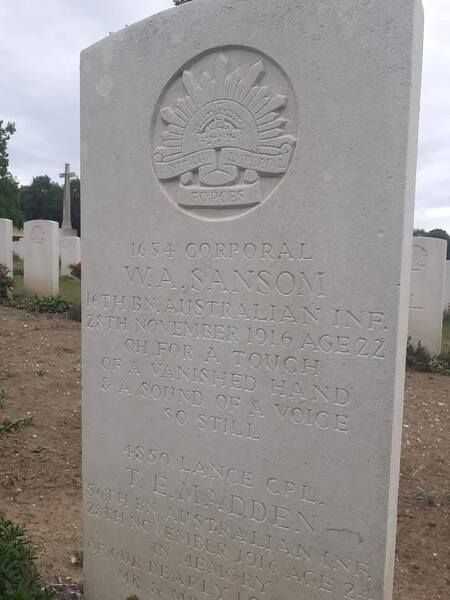
Today, Trevelyn Ernest Madden rests in peace alongside his friends, comrades, and brothers-in-arms at Heilly Station Cemetery, Mericourt-l'Abbé, Somme, and his grave bears the inscription: "In memory of our dearly loved son, Mr. and Mrs. Madden." Trevelyn shares his grave with Corporal number 1654 William Arthur Sansom, who served bravely in the 16th Australian Infantry Battalion and was killed in action on the same day as Trevelyn, on November 28, 1916, at the age of 22.
Trevelyn Ernest Madden had a brother who also fought bravely during the Great War. He was Private number 1856 George Vernon Madden who served in the 34th Australian Infantry Battalion. George survived the war and returned to Australia on November 20, 1918.
Trevelyn, on this day, it is with great solemnity and deep respect for you that, with the words of a simple Frenchman but a proud adopted Aussie, I would like to express in these few words all my gratitude, my admiration for you, as well as all my love and pride for all the young Diggers who here, around Amiens, on the sacred grounds of the Somme, for us who are fortunate enough to live today and our children who will live tomorrow, for all of us who are lucky enough to know peace, love, and freedom, gave their lives.
The Somme, so beautiful today and bathed in light, dotted with millions of poppies, flourishing and so pleasant to live in, was, more than a hundred years ago, for millions of young men then in the prime of their lives, a living nightmare, an apocalypse of fire, a turmoil of steel, a world of death scarred by countless Scars of barbed wire in which, under fire, amidst cries of terror, so many men killed each other, opposed only by the color of their uniforms, but exacerbated by the madness of orders, by the thirst for power of men wanting even more, were driven forward to conquer territories in deadly battles, in the chaos and brutality of assaults sometimes doomed to failure, to massacre. But on each side of the front line, none of these young men wanted to take their own lives and rush toward the suicide of the world. They were sons, brothers, loved ones who expected so much from life, who wanted nothing more than to live, to share the tenderness of loving arms they hoped to find again, as well as the love of mothers and wives who awaited the return of their husbands.
These young lions, so beautiful in the fervor of their youth, did not fight to destroy families or to take a father from their children, but they fought united by loyalty to their comrades, by love of their country, by love of those who awaited them at home, for the hope of a better world, for the dream of a world filled with the laughter of children. And in the Somme, at Amiens, Villers-Bretonneux, Flers, Dernancourt, Pozières, they endured the thunder of artillery, the noise and fury of shells, rains of metal that, heavy, implacable, and murderous, brought for four years only death, despair, and madness.
The Somme led the world into the hell of the most murderous century in the history of humanity; it was the stage upon which flowed the blood and tears of an entire generation of men who, day and night, lived in the mud among the rats and the Lice, beneath darkness streaked by the mournful symphony of fire-spitting metal pieces that relentlessly shattered, pulverized, and reduced to ashes the bodies of men and horses, plowing cratered soils infested with death, with guts and bones, soils still poisoned today by the madness that unfolded here.
But behind this nightmare, the bravery, solidarity, and brotherhood of the Australian soldiers also emerged, and in the face of chaos, in the face of death, they brought with them hope, a wind of freedom, a wind carried in a spirit of camaraderie that proved stronger than anything through horrific trials, a wind that was born on the reddened sands of the Gallipoli beaches and that still shows itself today strong and alive on every poppy of the old battlefields and cemeteries of the Somme, flowers that still bear the names of all the Diggers who fought and fell here, and in them continues to grow the beauty and strength of the ANZAC spirit that bound all Australian men and women together in the fight to give their best for others, to give our children a future.The Somme, in the midst of war, witnessed the world's cruellest horrors. More than a hundred years have passed since the hell of the Great War; the cannons have fallen silent, the machine guns have rusted in the mud, and the old trenches, season after season, are covered with flowers, beauty, tranquility, and serenity. The screams have given way to birdsong, the silent acrobatics of butterflies, and the soft footsteps of squirrels.
But in the fields of the Somme, behind countless rows of white graves, stand forever young, proud, strong, and beloved, thousands of Diggers who, through their eternal epitaphs, tell us and pass on their stories and their hopes. Here, in the Somme, will always stand strong and alive the memory of the Australian soldiers whom I am proud to watch over and whom I love, each one of them, like my sons, and whom I will love forever, like Trevelyn, like my Boys of the Somme.Thank you so much Trevelyn, for everything you did for France and Australia, whose love, gratitude, and respect will forever be yours.At the going down of the sun and in the morning,we will remember him,we will remember them.



Click images to start slideshow.