







PIDGEON, John Thomas Burch
| Service Number: | 39318 |
|---|---|
| Enlisted: | 17 December 1917, Brisbane, Qld. |
| Last Rank: | Gunner |
| Last Unit: | 3rd Field Artillery Brigade |
| Born: | Derby, England, 23 June 1884 |
| Home Town: | Torwood, Brisbane, Queensland |
| Schooling: | Not yet discovered |
| Occupation: | Butcher |
| Died: | Brisbane, Queensland, Australia, 16 July 1947, aged 63 years, cause of death not yet discovered |
| Cemetery: |
Lutwyche Cemetery, Brisbane, Qld ANZ-7-80-40 |
| Memorials: |
World War 1 Service
| 17 Dec 1917: | Enlisted AIF WW1, Gunner, 39318, 3rd Field Artillery Brigade , Brisbane, Qld. | |
|---|---|---|
| 30 Apr 1918: | Involvement Gunner, 39318, Field Artillery Brigades, --- :embarkation_roll: roll_number: '4' embarkation_place: Sydney embarkation_ship: SS Port Darwin embarkation_ship_number: '' public_note: '' | |
| 30 Apr 1918: | Embarked Gunner, 39318, Field Artillery Brigades, SS Port Darwin, Sydney | |
| 19 Nov 1919: | Discharged AIF WW1, Gunner, 39318, 3rd Field Artillery Brigade |
Help us honour John Thomas Burch Pidgeon's service by contributing information, stories, and images so that they can be preserved for future generations.
Add my storyBiography contributed by Faithe Jones
Son of Isaac Burch Pidgeon, Heussler Terrace, Torwood, Brisbane, Queensland
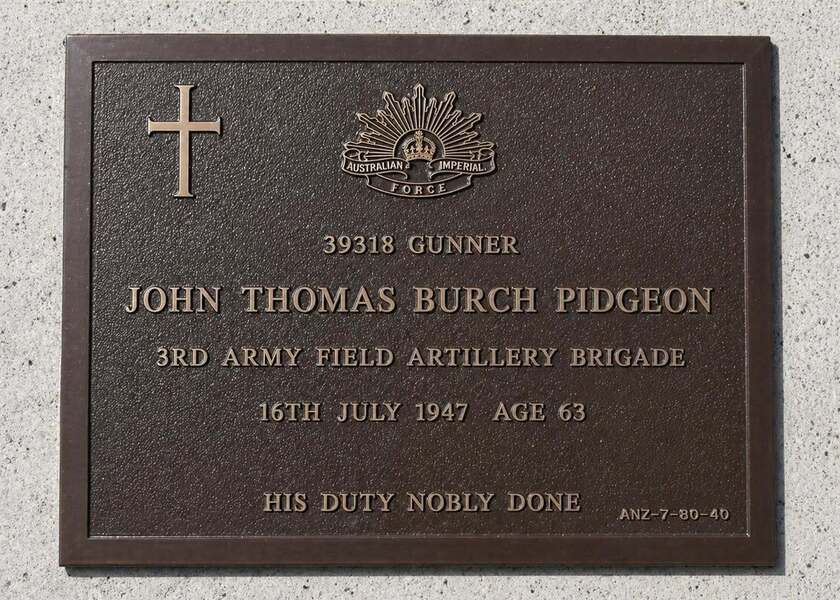
HIS DUTY NOBLY DONE
Biography contributed by Evan Evans
From Australian Remembrance Army
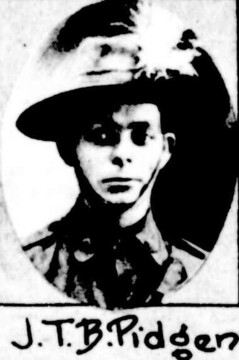
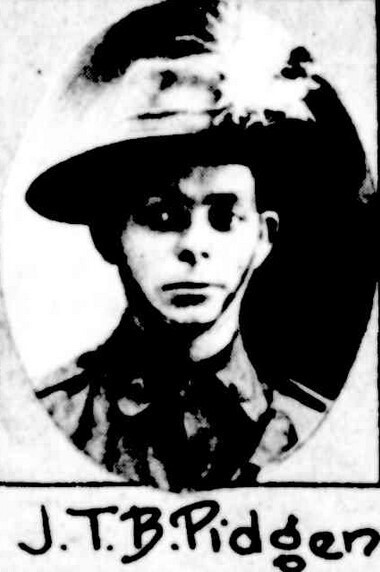
Australian World War One veteran Gunner John Thomas Burch Pidgeon (Service No. 39318), is among almost 800 previously unmarked WWI veterans’ graves in Lutwyche Cemetery we have now marked with plaques in recognition of their service for Australia.
We unveiled his plaque in Lutwyche Cemetery on 15 April 2023, along with a further 246 plaques on the previously unmarked graves of Australian World War One veterans:
See
WWII enlistment (medically unfit for service): https://recordsearch.naa.gov.au/.../Int.../ViewImage.aspx...
John Thomas Burch Pidgeon, whose birth was registered as Burch Thomas John Pidgeon, was born on 23 June 1884 in Derbyshire, England. He emigrated to Australia with his family, settling in Brisbane, Queensland, where he worked as a butcher and lived in the Ithaca/Toowong district.
He enlisted in the Australian Imperial Force (AIF) on 7 December 1917, aged 33, serving as a Gunner in the 3rd Field Artillery Brigade. He embarked from Sydney aboard the SS Port Darwin on 30 April 1918, travelling via Suez to England, where he trained at Heytesbury, Wiltshire.
On 31 October 1918, he married Annie Jarman, aged 32, at Stanway, Wiltshire. The marriage was tragically brief; Annie died soon afterwards, her death being registered in the Lexden district of Essex in the October–December quarter of 1918, almost certainly due to the influenza pandemic.
Pidgeon proceeded to France on 21 November 1918, shortly after the Armistice, and served during the post-war occupation period. In early 1919 he was hospitalised with influenza, followed by appendicitis, requiring repeated treatment. He returned to Australia aboard the SS Kanowna in August 1919 and was discharged as medically unfit on 19 November 1919, suffering from gallstones.
During the interwar years, he moved between states, residing in East Sydney, New South Wales (1933–1935), before returning to Queensland, where he was living in Paddington, Brisbane by 1943.
During the Second World War, he again volunteered for service, enlisting in the Australian Military Forces on 6 August 1940 at Royal Park, Victoria, then aged 54 and working as a butcher. Recorded as a widower, he was posted to the 19th Garrison Battalion, but due to ongoing health issues, including prior abdominal operations, he was deemed unfit and discharged on 23 October 1940. At that time, he was residing at Gordon House, Little Bourke Street, Melbourne.
John Thomas Burch Pidgeon died on 16 July 1947, aged 63, and was buried in Anzac Portion 7, Lutwyche Cemetery, Brisbane. He had no known children.
His life reflects that of many of his generation—an English-born migrant who built a working life in Australia, served in the final phase of the First World War, endured serious illness and personal loss during the influenza pandemic, and later volunteered again for service despite declining health.
After decades without recognition at his place of burial, his grave now bears a plaque commemorating his service to Australia — ensuring his name endures among those remembered for their duty and sacrifice. His identity and dignity have now been restored.
We have remembered him.
Lest We Forget
Click images to start slideshow.