








SCHWERDT, Jasper Nelson
| Service Numbers: | SX10989, S32442 |
|---|---|
| Enlisted: | 17 January 1941 |
| Last Rank: | Private |
| Last Unit: | General / Motor Transport Company/ies (WW2) |
| Born: | Fords, South Australia, Australia , 5 February 1907 |
| Home Town: | Payneham, Norwood Payneham St Peters, South Australia |
| Schooling: | Not yet discovered |
| Occupation: | Blacksmith |
| Died: | Cardiac Beri Beri - POW, Japan, 11 June 1945, aged 38 years |
| Cemetery: |
Rookwood Sydney War Cemetery, New South Wales D B 2 |
| Memorials: | Adelaide WW2 Wall of Remembrance, Australian War Memorial Roll of Honour, Ballarat Australian Ex-Prisoners of War Memorial, Payneham RSL WW2 Honour Roll, Renmark District Roll of Honour WW2 |
World War 2 Service
| 17 Jan 1941: | Involvement Private, SX10989, General / Motor Transport Company/ies (WW2) | |
|---|---|---|
| 17 Jan 1941: | Involvement Private, S32442 | |
| 17 Jan 1941: | Enlisted Adelaide, SA | |
| 17 Jan 1941: | Enlisted Australian Military Forces (WW2) , Private, SX10989, General / Motor Transport Company/ies (WW2) | |
| Date unknown: | Involvement |
PoW who never returned from war
PoW who never returned from war
April 21, 2021
Brendan Simpkins
In Sydney’s War Cemetery, in the Rookwood Cemetery, lie the remains of Private Jasper Nelson Schwerdt.
Private Schwerdt was born on February 5, 1907, in the small locality of Fords, between Freeling and Kapunda, on the Thiele Highway.
Enlisting in the Australian Army in January 1940 and deployed to Malaya with the 2/2 Reserve Motor Transport Company, Schwerdt was reported missing and presumed dead in February 1942 after the surrender of Singapore. His last correspondence was written on January 30, 1942.
Private Schwerdt was taken to the Sendai prisoner of war camp in Sakata, Yamagata Japan.
A message from Schwerdt was broadcast over Japanese propaganda radio station, confirming he was alive two years after he was reported missing. “A cheerio call to mother, father and sisters from Jasper,” it read.
“I am in good health, hoping you are all the same. Best of love to all.”
He would die from acute cardiac beriberi while still interned in the camp almost exactly a year later at the age of 38.
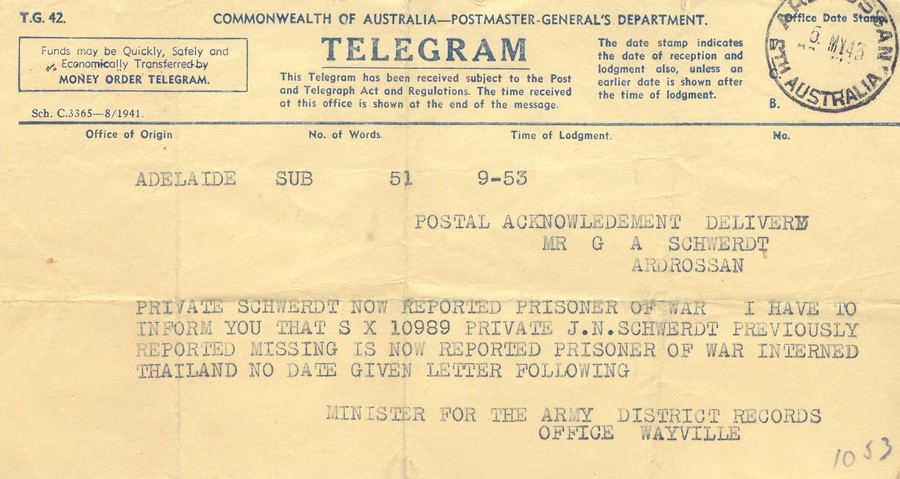
Private Schwerdt posted his final telegram to Australia on May 27, 1945. In it, he said his health was “fair” and that he was hoping to see his family again soon.
He was cremated and his remains brought back to Australia on a hospital ship on October 16, 1945.
His ashes were interred in the Sydney War Cemetery two days later.
Of the 736 soldiers whose remains are at the cemetery, Private Schwerdt is believed to be the only Australian soldier who died as a PoW in Japan to have a headstone at the cemetery.
The information came to be discovered after a series of letters from Private Schwerdt addressed to his sister Edna were handed over to the Gawler RSL sub-branch.
Nineteen letters from Private Schwerdt spanning from his training in Alice Springs in 1940 to his final telegram from Japan in 1945, and a handful of telegrams addressed to his parents after his announcement was discovered on the radio, were discovered on the side of the road between Port Wakefield and Virginia.
The documents were first handed in to the police before being turned over to the RSL because of it containing military matters.
Gawler RSL public officer Wayne Clarke said that it was a “unique situation”.
“There just isn’t any other like that…a Prisoner of War that died in Japan and having a memorial in Australia, that just doesn’t happen,” he said.
“We have checked with the Commonwealth War Graves and they don’t know of any other.”
Mr Clarke said he was hoping to reconnect the documents with the descendants of Private Schwerdt.
Submitted 9 June 2021 by N. Campbell
Biography contributed by Sharyn Roberts
Advice from the Office of Australian War Graves regarding the presence of a gravesite in Sydney
"You are correct in stating that it was not Government policy to repatriate remains of casualties of the First and Second World Wars.
We can only speculate that perhaps one of his fellow prisoners of war was able to obtain his ashes and bring them back to Australia upon his return.
Office of Australian War Graves (OAWG) records confirm that Jasper Scherdt’s ashes were received from Hospital Ship, Pjigjalengka on 16 October 1945 and were interred in the Sydney War Cemetery on 18 October 1945. No other details are recorded. The grave registration card for Jasper states his next of kin at the time was his father, Mr G.A. Schwerdt.
The OAWG is unaware of any other cases similar to that of Jasper Schwerdt."
Biography contributed by St Ignatius' College
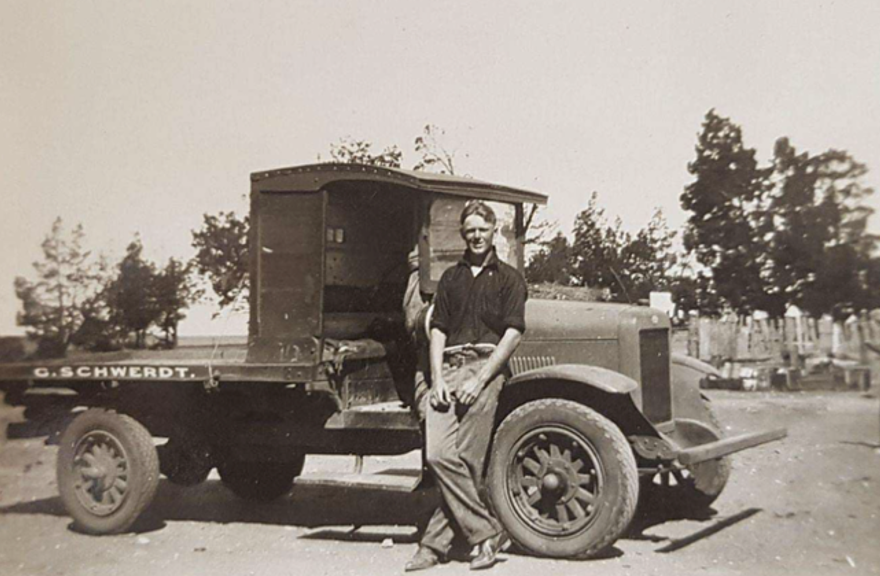
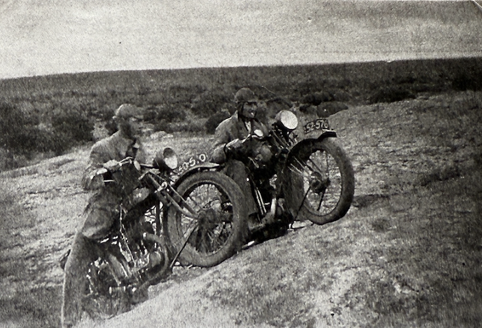
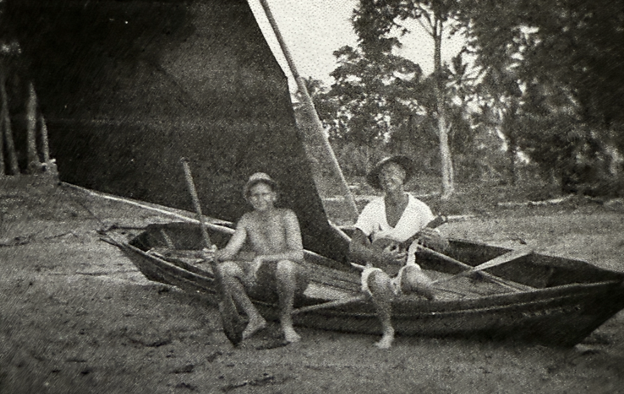
Jasper Nelson Schwerdt was born on the 5th of February 1907 on a small rural property near Kapunda in Ford’s, South Australia. He was the son of Gustav Schwerdt, a skilled blacksmith and farmer, and Anna Louise Schwerdt, née Peters. Both were of Prussian descent. Jasper grew up alongside his four sisters, Irene Norma, Pearl Gladys, Ruby Edna and Maxine Betty. The family moved frequently in search of resourceful farmland. At the age of two, Jasper’s family relocated to Port Lincoln, sailing with their possessions, 25 horses, and cattle on the Rupara, accompanied by his uncle Harry. At Port Lincoln, their first home consisted of an iron shed with a tarred floor, reflecting the challenges encountered by the hardships of rural farming life in the early 20th century. The family moved frequently to places including Pearlah, Charlton, and later Wanilla on the Eyre Peninsula. Harsh weather, unfertilised soil, and the extreme physical demands of establishing a profitable farm were consistently experienced. Gustav supplemented his low income during off seasons with blacksmithing, horseshoeing, and carting work. From a young age, Jasper assisted his father in these practices, gaining valuable skills in farming, mechanics, and smithing, which he would carry into adulthood. Music was additionally an important part of his family life. Jasper learned the guitar while performing in a family band with his sisters, who played on the fiddle and squeeze box. The struggles Jasper encountered during his adolescence, enabled him to develop a strong work ethic and independence. At 28, he moved to Taplan to establish his own business, J.N. Schwerdt Motor Repairs and Blacksmith. He remained single, practising the Church of England faith and devoting himself to his trade. His occupation further allowed him to combine his passion for mechanics with his practical abilities, enabling him to complete projects from repairing vehicles to forging tools and equipment.
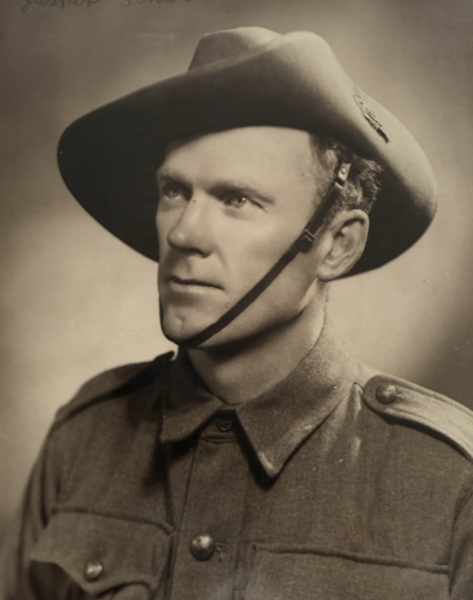
Jasper’s lifestyle before World War II had already allowed him to ascertain qualities that would later define his military service. Running his motor repairs and blacksmithing business required leadership, responsibility, and practical problem solving. The frequent collaboration with farmers in local communities to aid with machinery, the construction of tools, and maintenance of vehicles, was a skill set directly transferable to the transport and logistics work he would later perform in the Australian Imperial Force (AIF). His mechanical expertise and resourcefulness swiftly became evident and established him as a capable tradesman when he enlisted to the 2/48th Battalion of the AIF on the 8th of March 1939. During basic training, Jasper learned a range of essential military skills, including marching, bayonet, rifle cleaning and firing, saluting and gas procedures. By October, he regularly attended the Port Adelaide rifle ranges to refine his shooting and conduct in the field. On the 30th of October 1939, he participated in Ordnance Workshops under the Director of Ordinance Mechanical Forces, where he applied his acquired mechanical knowledge to the maintenance and repair of weapons, vehicles and other equipment. On the 2nd of November 1940, Jasper was graded as Group II tradesman, distinguishing him from other recruits, and recognising his skills in mechanics, driving and repair. This transitioned him from infantry duties to a technical, specialist role. Between October 1940 and January 1941, he performed standard duties in Alice Springs, maintaining army trucks, cars, and potentially weaponry while living in basic military camp conditions, enduring the desert environment. A letter from Jasper to his sister Ruby Edna reflected his positive outlook during this period, stating he was having “a very nice time.” On the 15th of January 1941, he transferred back to the Recruit Reception Depot in Adelaide in preparation for assignment to the Mechanical Transport Reserve in South Australia, which would be the final stage of his training before completing service abroad in World War II.
After a long journey aboard the HMT Queen Mary, Jasper began active service with the AIF on the 16th of November 1941, assigned to the Motor Transport Company in Singapore. He was involved in logistics operations, including the transport of ammunition, explosives, and concertina wire. He was also responsible for clearing and preparing roads for military operations and travel. His skill as a driver and mechanic were immediately evident, with him being dispatched for numerous duties across the Malayan Peninsula. Jasper and his unit played a vital role in moving personnel and equipment to positions and supplying and mobilising battalions. During this time, the AIF soldiers were additionally trained in camouflage, battlefield reaction techniques, and anti-gas procedures in preparation for potential chemical warfare threats. This demonstrates the extensive training in readiness and combat that Jasper and his unit learnt, valued and maintained throughout his service.
By January of 1942, Jasper’s unit faced the harsh realities of war directly. After digging slit trenches, preparing defensive positions, and experiencing bombing raids, such as the attack on Tenang railway station, Jasper’s unit faced the beginning of sustained Japanese offensive operations in the region. Jasper crucially transported battalions across challenging terrain in heavy rain and difficult conditions, often working long hours to ensure supplies reached their destinations and the survival of fellow soldiers. Through these tasks, his mechanical and logistical abilities prevailed, ensuring the operational effectiveness of the involved Australian units, whilst also protecting the lives of countless comrades.
A fortnight before the fall of Singapore, on the 7th of February 1942, Jasper was captured and became a prisoner of war (POW) under Japanese control. Initially stationed in Changi POW camp, he endured harsh conditions. Extreme perseverance and determination were sole factors in enabling him to survive amid the unsanitary shelter and minimal food. Later, he was instructed to work on the construction of the Thai-Burma railway, a project notorious for its brutal working conditions. Soldiers were crammed shoulder to shoulder in trucks, previously used for cattle and due for transport north to Ban Pong. The journey, offering little water, low sanitation and minimal food, fostered an environment for widespread cases of dysentery, malaria and malnutrition. Jasper would have faced extreme physical and psychological strain during the gruelling 10 to 12 hour workdays of clearing jungle, laying sleeper supports, and constructing the rail itself. He lived in overcrowded bamboo huts with poor ventilation and no bedding, struggling through both the heat of the dry season, and the heavy rain of the monsoon. Food rations were scarce, consisting mainly of rice and occasionally diluted vegetable stew, a diet unsustainable and containing a significant lack of nutrients. Despite these conditions, Jasper demonstrated remarkable perseverance and mateship, sharing resources and supporting fellow prisoners, notably saving the life of his friend and comrade Syd, when he fell ill with pneumonia.
In September 1944, Jasper was among the prisoners boarded onto the Rakuyo Maru, bound for Japan to support the Japanese war effort. The voyage on this “hell ship” was horrendous, with people crammed into cargo holds with no ventilation, minimal water, and inadequate food. On the 12th of September, the convoy was attacked by American submarines, and the Rakuyo Maru sank. Prisoners scrambled to escape, but most perished in the sea from drowning, or shark attacks. Jasper survived this suffering, only to be picked up by other Japanese transports, in his severely weakened state from malnutrition and illness.
Upon arrival to Japan, he was sent to Sendai Camp 9B in the Yamagata Prefecture of Honshu, where conditions remained brutal. The buildings were again poorly insulated against the freezing winters. Diets and rations were minimal, with little carbohydrates, protein or fats. Medical care was essentially non-existent. Prisoners were forced into daily labour under harsh supervision, yet Jasper maintained his resilience and cared for his fellow prisoners whenever possible, despite the maltreatment. He continued to write to his family, assuring them of his health, even as he became weakened with chronic malnutrition. He ultimately passed away in early June 1945, at the age of 38. Official Japanese records listed his death as acute cardiac beriberi, although accounts from fellow prisoner, Edward Anderson, suggest pneumonia and neglect were the true causes. Unusually, his ashes were repatriated to Australia after the war, a rare honour for a prisoner of war who died in Japan. It was speculated by the Office of Australian War Graves that perhaps one of his fellow prisoners of war was able to obtain his ashes and bring them back to Australia on the hospital ship Tjitjalengka in October 1945. Jasper was buried at the Sydney War Cemetery in the following days.
Reference List:
Books:
Adam-Smith, P 1991, Prisoners of War: From Gallipoli to Korea, Penguin Books.
Beaumont, J 1996, Australia’s War, 1939-1945, Allen & Unwin, Sydney.
Ewer, P 2006, Storm Over Singapore: The Australian Defence of Malaya and Singapore, 1941-42 , Allen & Unwin, Sydney.
Giese, D 2003, Beyond the Burma Road: The Memoirs of an Australian POW, ABC Books, Sydney.
Horner, D 2010, The Second World War: To Benghazi, vol. 1, Australian War Memorial, Canberra.
Nelson, H 2007, Changi: A History of the Most Infamous Prisoner of War Camp of World War II, Allen Lane, London.
Wigmore, L 1968, The Japanese Thrust, vol. 4, Australian War Memorial, Canberra.
Williams, M 2012, The Burma Railway: How the Allied POWs Survived My Father’s Story, Allen & Unwin, Sydney.
Newspaper Articles:
The Adelaide Chronicle 1944, ‘Births, Marriages and Deaths’, 21 September, p. 14, viewed 28 July 2025, <https://trove.nla.gov.au/newspaper/article/92808505>.
The Advertiser 1943, ‘Private Casualty Advice’ - The Advertiser (Adelaide, SA : 1931 - 1954) - 11 May 1943’, Trove, 11 May, Advertiser Newspapers Ltd., p. 65, viewed 2 August 2025, <https://trove.nla.gov.au/newspaper/article/48912156>.
The Advertiser 1932, ‘Reports from Rural Centres’, 14 October, p. 17, viewed 3 August 2025, <https://trove.nla.gov.au/newspaper/article/73993968>.
The Tweed Daily 1945, ‘Delaying Return of War Prisoners’, 2 November, p. 5, viewed 10 August 2025, <https://trove.nla.gov.au/newspaper/article/194383163/>.
West Coast Recorder 1935, ‘Kyancutta’, 20 June, p. 293, viewed 11 August 2025, <https://trove.nla.gov.au/newspaper/article/261300684>.
Websites:
FamilySearch.org 2015, Familysearch.org, viewed 10 August 2025, <https://ancestors.familysearch.org/en/LCZX-KDX/maximilian-heinrich-ewald-schwerdt-1795>.
Genge 2015, DVA’s Nominal Rolls, Dva.gov.au, viewed 12 August 2025, <https://nominal-rolls.dva.gov.au/veteran?id=674409&c=WW2#R>.
Gustav Adolf Schwerdt 2025, The Scholz Family of Australia, viewed 13 August 2025, <https://www.whosyerdad-e.com/families-stu/tree/scholz.ged/individual/I1131/Gustav-Adolph-Schwerdt#>.
J N Schwerdt 2025, Awm.gov.au, viewed 14 August 2025, <https://www.awm.gov.au/collection/R1469226>.
Jasper Nelson Schwerdt 2025, Awm.gov.au, viewed 18 August 2025, <https://www.awm.gov.au/collection/R1697232>.
Radio Message from Jasper Nelson Schwerdt 1944, viewed 18 August 2025, <https://digitize-vwma.s3.amazonaws.com/I/documents/9531/file/SKM_C36821011814370.pdf>.
Robert Heinrich Ewald Schwerdt 2025, Whosyerdad-e.com, viewed 18 August 2025, <https://www.whosyerdad-e.com/families-stu/tree/scholz.ged/individual/I1125/Robert-Heinrich-Ewald-Schwerdt>.
Schwerdt, JN n.d., Letters to Ruby Edna Schwerdt, Trove, viewed 19 August 2025, <https://trove.nla.gov.au/newspaper/article/48912156>.
Terrace, V 2025, Jasper Nelson Schwedt Service Record, Naa.gov.au, viewed 20 August 2025, <https://recordsearch.naa.gov.au/SearchNRetrieve/Interface/ViewImage.aspx?B=6394674>.
The Advertiser 1946, Family Notices, Trove, viewed 23 August 2025, <https://trove.nla.gov.au/newspaper/article/35699168>.
The Scholz Family of Australia, 2025, viewed 25 August 2025, <https://www.whosyerdad-e.com/families-stu/tree/scholz.ged/individual/I1145/Jasper-Nelson-Schwerdt>.





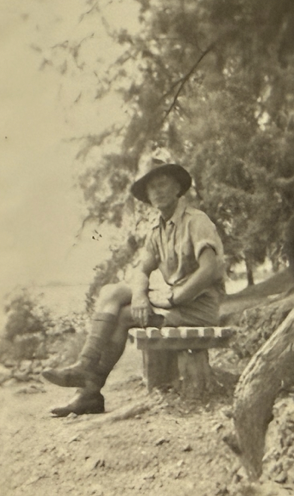
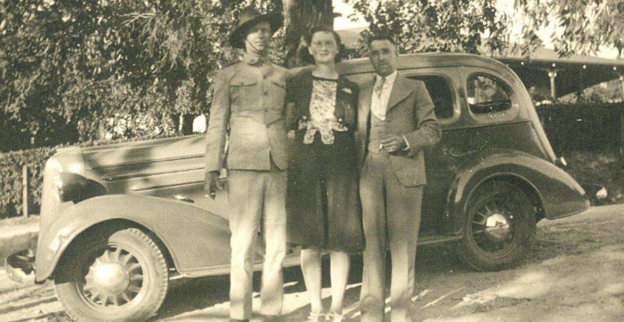
Click images to start slideshow.