





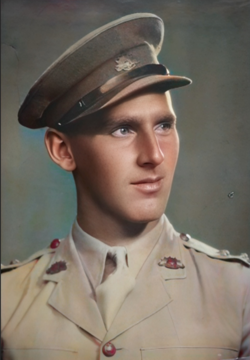
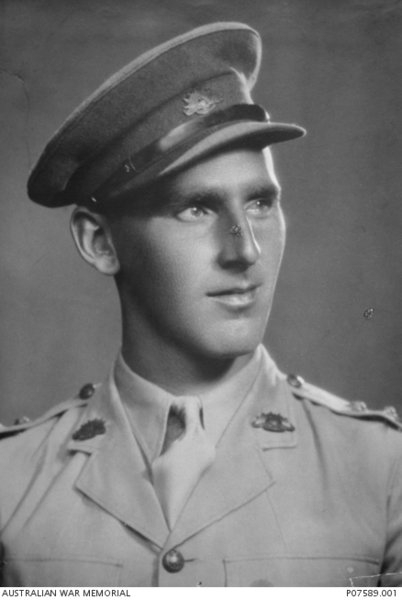
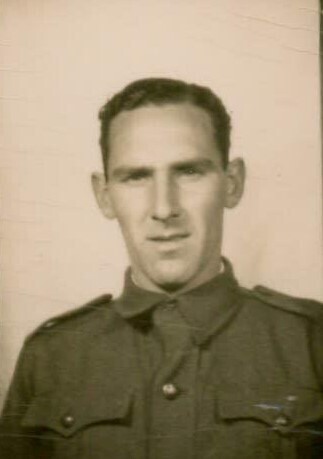
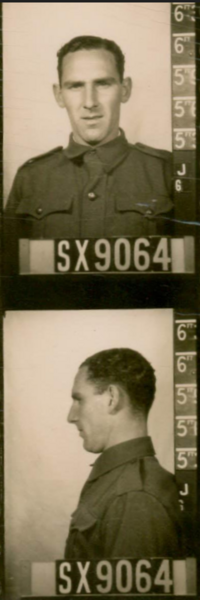
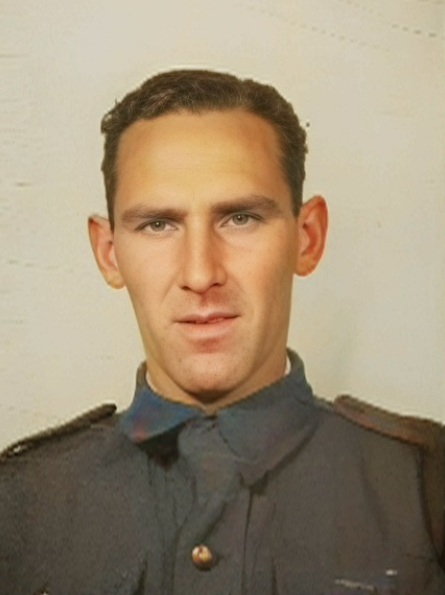
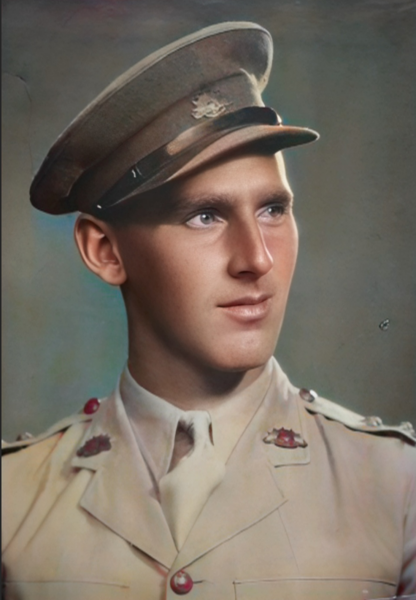
TRELOAR, Hugh Francis
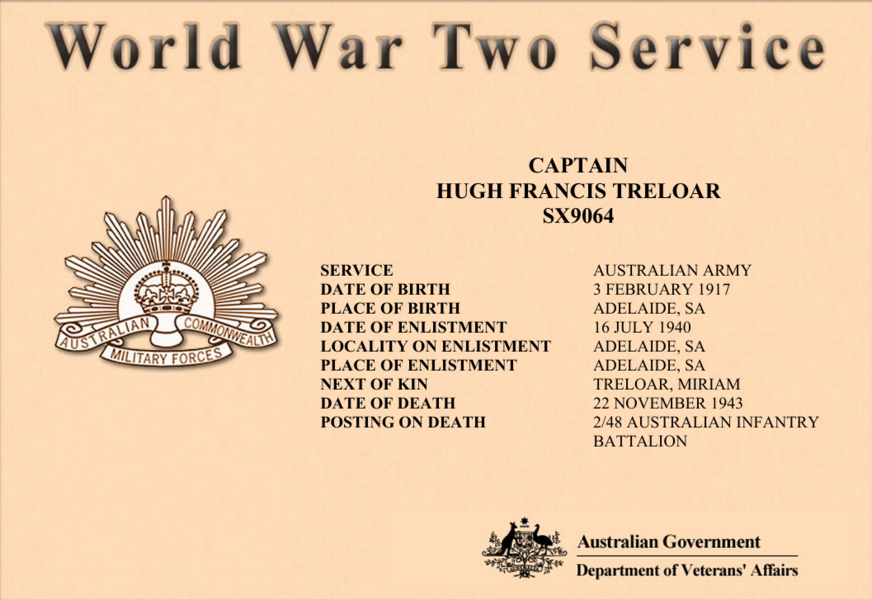
| Service Number: | SX9064 |
|---|---|
| Enlisted: | 16 July 1940, Adelaide, SA |
| Last Rank: | Captain |
| Last Unit: | 2nd/48th Infantry Battalion |
| Born: | Adelaide, South Australia, Australia, 2 February 1917 |
| Home Town: | Adelaide, South Australia |
| Schooling: | St Peters College, Adelaide, South Australia |
| Occupation: | Wool Appraiser |
| Died: | Died of wounds, New Guinea, 22 November 1943, aged 26 years |
| Cemetery: |
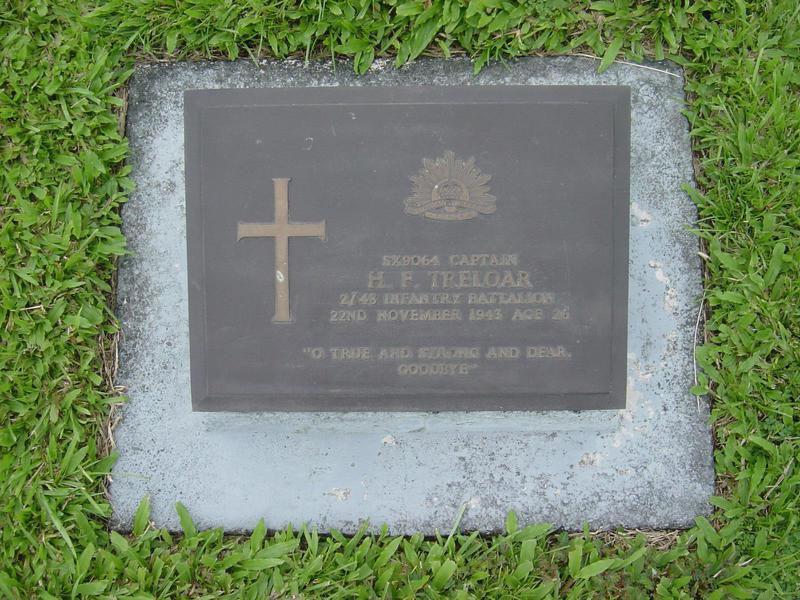
Lae War Cemetery CWGC Grave Reference: Plot AA, Row B, Grave 12. Inscription: "O true and strong and dear, goodbye." |
| Memorials: | Adelaide WW2 Wall of Remembrance, Australian War Memorial Roll of Honour, St Peters - St Peter's College WW2 Honour Roll |
World War 2 Service
| 16 Jul 1940: | Involvement Captain, SX9064 | |
|---|---|---|
| 16 Jul 1940: | Enlisted Adelaide, SA | |
| 16 Jul 1940: | Enlisted SX9064, 2nd/48th Infantry Battalion |
Posthumously Mentioned in Despatches.
Hugh was born in Adelaide to Charles Hextal and his second wife, Maud Louise Treloar on the 2nd February 1917. Hugh had barely turned one when the family grieved the loss of his young sister, seven-year-old Barbara Joan who died in May 1918.
Initially Hugh was educated at the Tranmere School where, as a seven-year-old he was named as having the second highest marks in his grade. That year his mother was instrumental in organising a children's sports competition to raise money toward defraying the cost of preparing and laying the lawns for the Tranmere Bowling, Tenis and Croquet Club. (Hugh’s father, Charles, later became one of the trustees.) Hugh represented the sport of boxing, while other children represented bowls, tennis, croquet, football and racing. It was also a special year with Hugh attending his older brother’s wedding in July. For his senior education, Hugh attended St Peter’s College on Hackney Road.
Post school Hugh became a Wool Appraiser, assessing the value of fleeces for prospective buyers. He enjoyed a very social life, including celebrating the New Year of ‘36 with friends at Brighton. In an era before compulsory seatbelts, all twelve piled into a guest’s car to the jetty to hear the first minutes of 1936 officially announced. They then gathered under the Arch of Remembrance to sing 'Auld Lang Syne’ before visiting the sideshows, and then, ladened with chocolates, returned home to finish up with songs. It was a night of fun and enjoyed thoroughly.
Hugh joined the 18/22 Light Horse, serving for over three years. During this time, he was unfortunate to be caught at midnight in November ’38 attempting to obtain liquor, from the Cumberland Arms Hotel. It was a costly exercise as he was fined £5. with 10/ costs. The following year in December Hugh announced his engagement to Miriam Adelaide Hanson, a talented ex-student who had attended Loreto Convent. They married in an evening service in June ’40 with Miriam’s photo appearing in the Adelaide News that day.
Just over eighteen months later, 23-year-old Hugh enlisted to serve in WWII on the 16th July 1940. He was allocated the number SX9064 and placed in the 2/48th Battalion. It was a challenging time as Hugh’s 72-year-old father, Charles died on the 10th October. Within weeks, Hugh boarded the Stratheden on the 17th November, arriving in the Middle East in December. He was to become one of the highly regarded and decorated Rats of Tobruk, an unofficial term owned with pride.
By June ’41 Hugh was promoted to Lieutenant, then on the 24th June, Hugh and SX8325 Jim Smith both received their Sergeant commissions in the field. (Interestingly, for the men in their battalion, it was also a welcome time when they were able to be taken to the sea to bathe and wash their clothes.) The following month, back home, Miriam welcomed their daughter at the Toorak Hospital.
Over the ensuing months Hugh attended Officers’ Regimental School and Weapons Training School before returning to his battalion. He experienced several infections including malaria, jaundice and an extremely high temperature (Pyrexia of Unknown Origin).
At the end of October ’42 Hugh was involved in the fierce assault on the railway line at the Blockhouse. Little did he or the men of the 2/48th know that only forty-one weary troops would remain in the field. John Glenn in Tobruk to Tarakan poignantly wrote ‘We thought of ourselves as few enough then. But surely even the bravest among us would have shuddered if they could have known what a weary handful we would be reduced by morning…’ The battle took a huge toll in officers and N.C.O.s. From Hugh’s D Company, both Captain P Robbins and Sergeant W Kibby were killed. Hugh and Lieut T W Farrell were both wounded in action and evacuated. Hugh sustained a gunshot wound in his back and thigh. Glenn summarised that “truly it can be said of these men, They fought themselves and their enemy to a standstill until flesh and blood could stand no more, then they went on fighting.” This was the 2/48th Battalion.
Hugh continued to undertake courses, including in Administration and Grenade until finally the battalion returned home via Melbourne in February ’43. On that voyage, he was hospitalised with malaria. Hugh was one of the 600 honoured guests from the 9th Division to attend Government House and meet Sir Malcolm and Lady Barclay-Harvey in March.
Training in the tropical conditions of Queensland followed as the battalion prepared to meet a very different enemy in the humidity and jungles of New Guinea.
By September ’43, Hugh was promoted to Temporary Captain. John Glenn described the chaotic conditions at Sattelberg with the attempt to capture Coconut Ridge. Dawn patrols were moving through thick bamboo, which meant that fighting was forced to be close combat without the use of mortars or artillery. There was the constant concern about enemy snipers. Two days previously two soldiers from the 2/48th Battalion had been killed in this manner. Enemy casualties were one hundred. Glenn recorded that ‘an interesting sidelight of this action was provided by the capture of a Jap soldier’s diary which read, ‘We have found out the enemy is the finest Australian picked division (9th). They have fought against Germans and Italians. They are very good fighters.’
Glenn recorded that ‘The 22nd November ’43 was the day “on which the enemy was most active with his shelling. A considerable number of shells had landed in the vicinity of the jeep-head at Jivevaneng, and further along the road, the intention probably being to deny us full use of the track. With parts of the road continually under observation from Sattelberg, the Japanese must have been aware of the amount of jeep traffic taking up supplies to forward troops. Whether they were firing at random will never be known but, nevertheless one shell made a direct hit on a tree above battalion headquarters, spraying the whole area with shell fragments, and inflicting a number of casualties. Major Reg Batten, the battalion second-in-command, Captain Hugh Treloar, the adjutant and Lieutenant G.J. Butler, the pioneer officer, were all badly wounded, and all died within twelve hours. Sergeant Lane, who was in a nearby trench, was killed instantly. The regimental medical officer, Captain Yeatman was wounded and sent to hospital. Others who died of wounds on the 22nd November were K.S. Kelly, L.M. Semmens and A.R.J. Lindsay. Casualties were mounting fast.”
In that action, Hugh’s D Company had swung to the north to avoid a minefield, fighting a lone battle to the base of the Ring Contour 25 feature, while A,B and C Companies were to the south of the Mantruh Road. Hugh had suffered a severe injury from machine gun fire. An article featured in the March ’44 edition of the Advertiser sharing the exceptional work undertaken by skilled doctors under extreme conditions. It described conditions at Satelberg where one shell landed a few yards from the RAP, killing Maj. R. Batten and Capt. Hugh Treloar, of SA. and wounding the SA medical officer. But the latter, despite his wound, carried on.
Back home, the Advertiser of December 6th ’43 carried the news of Hugh’s death. ‘Mrs. H. Treloar, of Hanson avenue, Heathpool, has been notified that her husband, Capt. Hugh Treloar, died of wounds on November 22. He was the youngest son of Mrs. C. H. Treloar, of Rose Park, and the late Mr. Treloar. He has left a small daughter.
Hugh was 26 when died of his wounds. He was initially buried at Satelberg then the Finschhafen War Cemetery before finally being reburied in May ‘46 in the Lae War Cemetery Commonwealth War Graves in Plot AA, Row B Grave 12. He is surrounded by others from his sister battalion, the 2/43rd and from the 2/14th and 2/23rd. Nearby are young men from his own 2/48th Battalion, 29 year old SX29019 Private Archibald R.J. Lindsay, 23 year old QX35719 Sergeant Leslie D. Lane and 22-year-old VX82396 Private Lindsay T. Dixon. Hugh’s family chose the poignant tribute ‘O True and Strong and Dear, Goodbye.’ For his headstone.
Posthumously, on the 15th March ‘45 Lieutenant (Temporary Captain), Hugh Francis Treloar, SX9064 was Mentioned in Despatches for his distinguished service in New Guinea. He is also remembered at his Alma Mater, St Peter’s College.
Researched and written by Kaye Lee, daughter of Bryan Holmes SX8133, 2/48th Battalion.
Submitted 3 December 2025 by Kaye Lee
Click images to start slideshow.