







POND, George
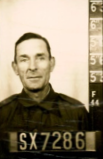
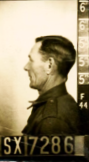
| Service Number: | SX7286 |
|---|---|
| Enlisted: | 1 July 1940, Adelaide, SA |
| Last Rank: | Private |
| Last Unit: | 2nd/48th Infantry Battalion |
| Born: | London, England, 5 July 1901 |
| Home Town: | Unley, Unley, South Australia |
| Schooling: | Not yet discovered |
| Occupation: | Trimmer |
| Died: | 4 January 1970, aged 68 years, cause of death not yet discovered, place of death not yet discovered |
| Cemetery: |
Centennial Park Cemetery, South Australia Derrick Gardens, Path 14, Grave 811A |
| Memorials: |
World War 2 Service
| 1 Jul 1940: | Involvement Private, SX7286 | |
|---|---|---|
| 1 Jul 1940: | Enlisted Adelaide, SA | |
| 1 Jul 1940: | Enlisted Australian Military Forces (WW2) , Private, SX7286 | |
| 1 Jul 1940: | Enlisted Australian Military Forces (WW2) , 2nd/48th Infantry Battalion | |
| 23 Nov 1945: | Discharged | |
| 23 Nov 1945: | Discharged Australian Military Forces (WW2) , Private, SX7286 |
Trimmer to Tobruk.
George was London born on the 5th July 1901, but little is known of his family, apart from his sister, Daisy Muir, who remained in London when George came to Australia. George lived in the suburb of Unley and worked as a trimmer. This involved installing, repairing and replacing interior trims of various fabrics, including leather and vinyl in cars.
However, with the outbreak of WWII, 39-year-old George, unmarried, enlisted on the 1st July ’40 at Adelaide and was allocated the number SX7286 in the newly formed 2/48th Battalion. His early days were spent in the pavilions at the now Royal Adelaide Showground, before heading to Woodside in the Adelaide hills for intensive training.
Early in August that year, George was graded as a Group II Cook. Following pre-embarkation leave, George boarded the Stratheden on the 7th November, arriving in the Middle East on the 17th December.
Within a month, George did some unofficial sight seeing in Dimra and was fined a day’s pay plus confined to barracks for a week. By March he had joined the Infantry Special group. Unfortunately, the harsh desert conditions contributed to George contracting dermatitis, followed by a further skin infection, folliculitis and having several days of recovery in hospital.
He was to become one of the highly respected Rats of Tobruk, an unofficial title designed to demoralise the troops, who were living in fly and rat infected sandy dugouts. The taunt of living like rats had the opposite effect and became one owned with pride by the men.
By August ‘41, George was promoted to Acting Corporal before undertaking the role of Security Battalion. With this promotion, George relinquished his Group II Cook status. However, while on leave on the 15th October, he was involved in fracas with fellow 2/48th Battalion soldier, Irishman SX7748 SX7748Richard Stewart. The basis of their argument was never documented. The outcome was that the Irishman was hospitalised in Jerusalem with concussion and a fractured left maxilla the day at Haifa. Being off-duty, the two had been drinking when an argument erupted with George forcibly striking Richard. The severity of the blow meant the Irishman was hospitalised for two months. Inevitably, a Court of Inquiry was held at Mughazi in December. The injury was declared unlikely to affect Richard’s future military efficiency – but apart from these general facts, no mention was made of action taken, fines issued or the details added to George’s military records.
By July ’42, George was himself hospitalised without pay for self-inflicted infection. He lost his promotional status until he returned to the Guard Battalion. Soon after, he was reprimanded for not upholding ‘good order and military discipline’.
Fortunately, by February ’43 George returned to Australia via Sydney. An indication of his deteriorating health came with a diagnosis that he was temporarily medically unfit in June ’43 and not unexpectedly was described as in an Anxiety State (now more accurately described as Post Traumatic Stress Disorder) and placed in Kapara for two months to recover. This hostel at Glenelg provided a peaceful haven for men and was supported by the Red Cross. While there George underwent a hospital tonsillectomy. Not unexpectedly, George chose to take an unofficial day’s leave in September, receiving both a two-day fine and being reprimanded.
George then reverted to the rank of Private, transferring permanently to the 4th Garrison Battalion and was graded as a Group II Cook. Early in ’44 George again spent time in Kapara and underwent a further operation later gaining his qualifications as a Group III Cook. By May that year George again went Absent for 90 minutes and received a seemingly harsh punishment of being confined to barracks for seven days. A series of minor illnesses followed, as did an admonishment for disobeying Camp orders. War conditions, carrying bulky equipment and George’s age all eventually contributed to a chronic muscle inflammation (Lumbar myositis) and on-going chronic backache.
Aged 44, George was finally discharged on the 23rd November ’45. Army recreational habits stayed with him (but were illegal in the community) and proved to be expensive. While working as a mail officer, George had a small ‘on the side’ interest of illegal bookmaking. He and his fellow entrepreneur faced the Adelaide Police Court where George was fined £50 with 7/6 costs.
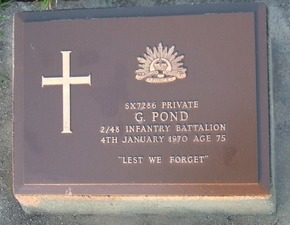
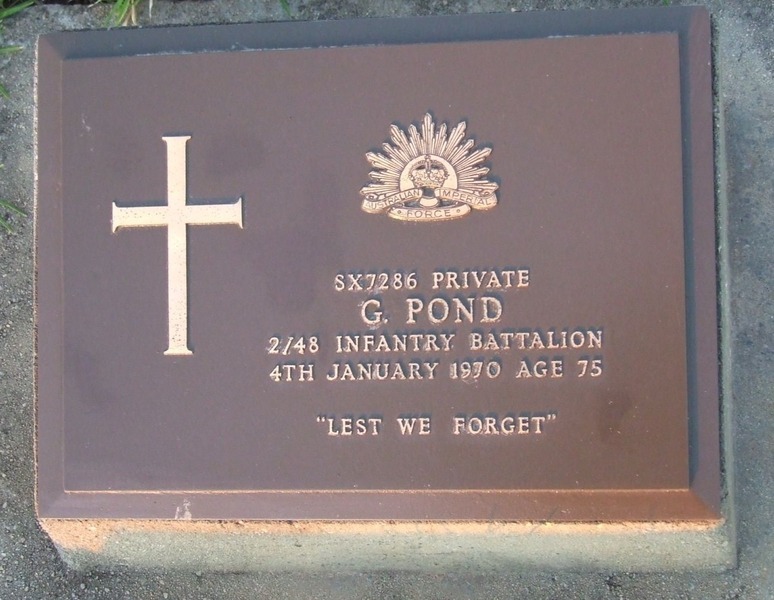
George lived to be 75 and died on the 4th January 1970 He now rests at Centennial Park Cemetery in the Derrick Gardens, Path 14, Grave 811A
Researched and written by Kaye Lee daughter of Bryan Holmes, SX8133, 2/48th Battalion.
Submitted 4 June 2026 by Kaye Lee
Click images to start slideshow.