



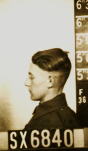
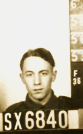
DIXON, John Frederick Robert
| Service Number: | SX6840 |
|---|---|
| Enlisted: | 29 June 1940, Adelaide, SA |
| Last Rank: | Private |
| Last Unit: | 2nd/48th Infantry Battalion |
| Born: | London, England, 5 November 1919 |
| Home Town: | Adelaide, South Australia |
| Schooling: | Rose Park Public School, South Australia |
| Occupation: | Motor Trimmer |
| Died: | Campbelltown, South Australia, 30 March 1979, aged 59 years, cause of death not yet discovered |
| Cemetery: |
Enfield Memorial Park, South Australia Plot Second Crescent 268. |
| Memorials: |
World War 2 Service
| 29 Jun 1940: | Involvement Private, SX6840 | |
|---|---|---|
| 29 Jun 1940: | Enlisted Adelaide, SA | |
| 29 Jun 1940: | Enlisted Australian Military Forces (WW2) , Private, SX6840 | |
| 29 Jun 1940: | Enlisted Australian Military Forces (WW2) , 2nd/48th Infantry Battalion | |
| 26 Jul 1943: | Discharged | |
| 26 Jul 1943: | Discharged Australian Military Forces (WW2) , Private, SX6840 |
Help us honour John Frederick Robert Dixon's service by contributing information, stories, and images so that they can be preserved for future generations.
Add my storyBiography contributed by Faithe Jones
John resided at 50 Hutt Street, Adelaide and was fond of and interested in boxing. In civil life he wa a motor trimmer at Richards Motor Works. He was very popular with his comrades and had an obliging nature.
Biography contributed by Kaye Lee
Seriously Wounded
John and his brother Albert George were both born in London, John on the 5th November 1919 and his younger brother Albert on the 15th December ’21. Their father, John Snr was born in Chesire and had previously served in WWI, including being part of the crew of ‘Prince George’ at Gallipoli, before returning to the workforce in 1919 and marrying Ethel Mahala in January. John Frederick Robert arrived in November, the first of eight children. The family came to Australia in ’25, moving to Adelaide, South Australia and lived in Hutt Street, then Colby Place. The children attended the popular Rose Park Public School where days, including Arbour Day were celebrated. John also developed an interest in boxing as a fitness regime.
Post school, John worked for Richard’s Motor Body Works as a motor trimmer. The company was aware of the importance of ‘team spirit’ and included such activities as a football competition in the South Parklands between their workers to raise money for a Blanket Fund. In the good-natured encounter, various workers were ‘fined’ for outrageous acts including being the father of twins, not barracking enough, barracking too much, coming late, leaving the wife in the car alone, comparing Melbourne with Adelaide, walking on to the ground, and worrying too much over Sturt's defeats. These good humoured ‘fines’ were a novel way to raise funds.
This large company was affected by many of its young workforce enlisting to serve in WWII. Besides John, who enlisted just prior to his 20th birthday on the 29th June 1940 other fellow workers who enlisted at a similar time and were also placed in the 2/48th Battalion, included Scottish-born SX7260 Sgt Charles Fraser who was killed in action after serving in Syria, Libya and Tobruk. John Junior was given the number SX6840 and placed in the newly formed 2/48th Battalion.
At the time of his enlistment, John stated he was married to Phyllis Jean. John Jnr’s early training was in the Adelaide Hills town of Woodside before enjoying pre-embarkation leave. Unfortunately, he was several hours late returning and was heavily punished, being confined to barracks for three days. By the 7th November he boarded the Stratheden, arriving in the Middle East on the 17th December. He was to become one of the highly regarded Rats of Tobruk. The term, designed to destroy morale, had the opposite effect and was seized on as an unofficial badge of honour.
A year after John’s enlistment, John’s younger brother, 19-year-old labourer Albert George enlisted on the 30th June ’41. He was initially placed in the 2/10th reinforcements but was quickly placed in the sister battalion to John, the 2/43rd in May ’43. Albert also served in the Middle East.
John’s 48-year-old father, John William enlisted five months later in November ’41, serving with the 4th Garrison Battalion as S1688 until his discharge in 1943. His role included guarding internees and prisoners of war and predominantly guarding Adelaide assests.
Within twelve months of arriving in the Middle East, John had fractured his left fibula in October ‘41 and was transferred to a field ambulance before being able to return to the 2/48th in October.
John was again wounded in action early in July ’42 with a gunshot wound to his left hip and shell fragments to his left buttock, causing him to be evacuated to a British General hospital. Back home, The Chronicle was one of the newspapers to carry a list of those wounded in action. Those from his 2/48th Battalion, included SX7512 L-Sgt Albert R. Cross, Wallaroo Mines; SX6840 Pte. John F. R. Dixon, Adelaide; SX6969 Pte. Robert M. Harper, Evandale; SX8060 Pte. Archibald J. McFarlane, Cobdogla; SX13O19 A-Sgt. John Murray, Adelaide and SX8039 Pte. Donald F. Priester, Renmark and SX8182 Pte. Maxwell S. Wolter, Renmark.
At the time, Lieut-Colonel Hammer received orders to capture West Point 24 of Tel El Eisa in a dawn attack. John Glenn in Tobruk to Tarakan describes how ‘Before dawn the next morning the silence of the night was shattered by the wicked bark of the 25 pounders, and pin-points of flame danced across the desert.’ This was to be a daylight show and the troops did not like it.‘ When the troops were well forward of the start line, they came under terrific fire from shells and mortars from the front and left and suffered heavy casualties.’ There was a constant call for stretcher bearers.
According to SX8039 Pte. Don Priester, their injuries were sustained during the fierce attack on Tel El Eisa when the carriers were ordered out to take some of the fire. Unfortunately, in doing so, they were forced on to a German minefield by the intense anti-tank fire, resulting in casualties. In a letter headlined as Buried by a Bomb Burst published in the Murray Pioneer of June 1943, Don was quite graphic in his recount. "When Wavell's forces were coming back to go to Greece, we advanced and re-entered Tobruk. On January 1 Jerry attacked and broke in through the perimeter. He broke in with infantry, tanks and artillery. He held the salient he had won. We attacked him with the bayonet and had casualties. I remember Cpl. H. Lock (now a sergeant) being there in the attack. Jerry came in a blinding dust storm, and we could not see more than about 10 yards. It was here that Pte. Brown, of Barmera, was shot through the head. Lt. Larkin was hit twice through the arm and once in the shoulder. It was a hard fight but we pinned them to what they had taken."
Back home, The July ’42 issue of the Advertiser reported ‘Mrs. J. F. R. Dixon, of Hutt street, city, has been notified that her husband, Pte. J. F. R. Dixon, has been wounded in action in the Middle East. Before enlisting in 1940, Pte. Dixon, whose father is Pte. J. W. Dixon, of the Garrison Battalion, was employed by Richards Industries Limited. A similar report followed the next day, referencing John Snr’s involvement ‘WOUNDED IN EGYPT Advice has been received by Private J. W. Dixon, of the 4th Garrison Battalion, and Mrs Dixon, of Colbey place, Adelaide that their eldest son, Private John Frederick Robert Dixon, has been wounded in action in Egypt. Pte. J. F. R. Dixon enlisted in 1940 and left for overseas the same year. He served, at Tobruk for eight months. He was formerly employed at Richard's. ' He has a younger brother with the A.I.F. in the Middle East.
For a young city boy, the trauma of war and the horrific conditions in which John Jnr. was living caused him to sustain a blast wound to his right foot, rendering him unable to march. A Court of Inquiry investigated if this was self-inflicted before he was able to return in mid December to his 2/48th Battalion.
John developed a form of eczema on both his hands and feet (often associated with stress and allergies.) He returned to Australia on a hospital ship, being placed on the dangerously ill list with constant vomiting of blood from his upper gastro tract, (hematemesis) on returning to SA. His prognosis ranged from dangerously to seriously ill listing.
Less than four months later, further distressing news was received that John’s younger brother Albert George was also wounded in action ‘DESERT FIGHT CASUALTIES Private Advices Mrs. J. W. Dixon. of Colbey place, City, has been notified that her younger son, Pte. A. G. Dixon, has been wounded in action in Egypt. Pte. Dixon, who is 20, joined the A.I.F. in June, 1941, and went overseas in September of that year. Educated at Rose Park School. he was a keen skater before his enlistment. An elder brother, Pte. J. F. R. Dixon, who served for several months in Tobruk, was also wounded in this desert campaign, and is still in hospital. Their father is a member of the Fourth Garrison Battalion. (Photo). Albert’s wound was serious – a ‘sucking wound’ in his chest, sternum and fractured right humerus. He returned to Australia on a medical ship, eventually being discharged at the end of January ‘44
Of continuing concern was John’s slow recovery with him being placed on the Seriously ill list in March ’43, but by the following month removed from all lists. He was eventually discharged as medically unfit for service on the 26th July.
Aged 59, John died on the 30th March ’79 at Campbelltown. He was buried in the Enfield Memorial Park Cemetery, Plot Second Crescent 268. His wife, Phyllis Jean lived a further two decades to be 83. She died on the 14th December 2002.
Researched and written by Kaye Lee daughter of Bryan Holmes, SX8133, 2/48th Battalion.


Click images to start slideshow.