







THREDGOLD, Roy Thomas
| Service Number: | SX5165 |
|---|---|
| Enlisted: | 12 June 1940, Adelaide, SA |
| Last Rank: | Sergeant |
| Last Unit: | 2nd/27th Infantry Battalion |
| Born: | Crystal Brook, SA, 19 January 1917 |
| Home Town: | Narridy, Northern Areas, South Australia |
| Schooling: | Not yet discovered |
| Occupation: | Tractor Driver |
| Died: | 28 September 2009, aged 92 years, cause of death not yet discovered, place of death not yet discovered |
| Cemetery: |
Centennial Park Cemetery, South Australia |
| Memorials: | City of West Torrens WW2 Boulevard of Honour, Crystal Brook District WW2 Roll of Honour |
World War 2 Service
| 12 Jun 1940: | Enlisted Australian Military Forces (WW2) , Private, SX5165, 2nd/27th Infantry Battalion, Adelaide, SA | |
|---|---|---|
| 7 Jun 1941: | Involvement Australian Military Forces (WW2) , Private, SX5165, 2nd/27th Infantry Battalion, Syria - Operation Exporter | |
| 15 Aug 1942: | Involvement Australian Military Forces (WW2) , Corporal, SX5165, 2nd/27th Infantry Battalion, Kokoda - Papua | |
| 20 Jul 1945: | Involvement Australian Military Forces (WW2) , Sergeant, SX5165, 2nd/27th Infantry Battalion, Borneo - Operation Oboe May - August 1945 | |
| 5 Dec 1945: | Discharged Australian Military Forces (WW2) , Sergeant, SX5165, 2nd/27th Infantry Battalion |
Help us honour Roy Thomas Thredgold's service by contributing information, stories, and images so that they can be preserved for future generations.
Add my storyBiography contributed by Playford International College
Roy Thomas Thredgold was born on 19 January 1917 in the small country town of Crystal Brook, South Australia. Crystal Brook was, and still is, known for its farming community and its connection to the railways. His parents were Hubert John Thredgold and Catherine Rose Moore.
When World War II broke out, Roy enlisted in the Second Australian Imperial Force. He was assigned to D Company of the 2/27th Australian Infantry Battalion, part of the 21st Brigade in the 7th Australian Division.
The 2/27th Battalion first served in the Middle East, but it was in the jungles of Papua New Guinea that Roy faced some of the most gruelling conditions. As a Sergeant, he had leadership responsibilities, which meant he was responsible not only for his own safety but also for the wellbeing and performance of the men under his command.
One of the most significant periods of his service was during the New Guinea campaign in late 1942, particularly at Gona and Buna. These battles were notorious for their intense fighting and the deadly environment. The thick jungle, sweltering heat, constant rain, and deep mud made movement almost impossible. Supplies were limited, and soldiers faced diseases such as malaria and dysentery, as well as well-entrenched Japanese forces who fought fiercely to hold their ground.
In a 1994 interview for the Australian War Memorial, Roy spoke about the realities of jungle warfare. He recalled the oppressive humidity, the sound of enemy fire, and the sight of mates risking everything to help one another. He described how the terrain and weather were as dangerous as the enemy, and how the courage of the Australian soldiers was tested daily.
Despite the hardships, Roy survived the war. In 1942 during leave he married Glend.
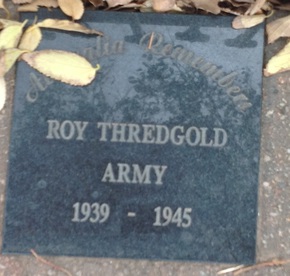
Roy lived a long life, passing away at the age of 92 on 28 September 2009 in Adelaide. He was buried at Centennial Park Cemetery, a resting place for many veterans, where his service is remembered and honoured.


Click images to start slideshow.