



ROGERS, George William
| Service Number: | SX4006 |
|---|---|
| Enlisted: | 30 May 1940, Adelaide, SA |
| Last Rank: | Private |
| Last Unit: | 2nd/48th Infantry Battalion |
| Born: | Broken Hill, New South Wales, Australia, 29 January 1913 |
| Home Town: | Pinnaroo, South Australia |
| Schooling: | Broken Hill Junior Technical School, New South Wales, Australia |
| Occupation: | Motor Driver |
| Died: | 28 October 1971, aged 58 years, cause of death not yet discovered, place of death not yet discovered |
| Cemetery: |
Enfield Memorial Park, South Australia Eastern Niche Wall Number 1 GA-GU 16 – 1 |
| Memorials: |
World War 2 Service
| 30 May 1940: | Involvement Private, SX4006 | |
|---|---|---|
| 30 May 1940: | Enlisted Adelaide, SA | |
| 30 May 1940: | Enlisted Australian Military Forces (WW2) , Private, SX4006 | |
| 30 May 1940: | Enlisted Australian Military Forces (WW2) , 2nd/48th Infantry Battalion | |
| 22 Jan 1942: | Discharged | |
| 22 Jan 1942: | Discharged Australian Military Forces (WW2) , Private, SX4006 |
A Challenging Life.
George’s family of five lived in Broken Hill with parents Robert James (known as ‘Dodger’) and May Helena. His siblings included Cyril James, Gladys May, Doris and Harry. In a cruel twist, May died in childbirth when George was born on the 29th January 1913. In that era most births were home births. Her funeral therefore left from their residence on the corner of Blende and Gossan streets for interment in the Anglican Cemetery at Broken Hill. Robert re-married in 1915 with his second wife, named May Lucinda having a son, Clarence Lindsay ‘Tubby’.
George’s father Robert had come from Tasmania to Broken Hill as a miner in 1902, marrying May in 1904. He began his working career on the Proprietary mine then worked in practically every mine along the line of lode before retiring on compensation in ’28 (when George was 15.) He was heavily involved in many clubs including the Worker’s Union, Democratic Club, Compensation Association and the R.A.O.B. lodge and served on a jury when a fatal accident occurred in July ’15. Conditions for miners at the time were basic and earth falls not uncommon. However, the effects were often fatal. The miner had suffered a severe compound leg fracture, chest bruises, scalp wounds, severe, internal head injuries and shock. Onus was put on workers, rather than the Corporation to ensure their working conditions were safe.
The children attended the local Junior Technical School and were successful in their exams.
George had just turned 17 when his 64-year-old father died in June ’30. The following year, George, living and working at Glossop, received horrific news. His oldest brother, unemployed labourer, 28-year-old Cyril James committed suicide in a shed. In those days, newspapers printed every detail of the injury, means of death and content of the cards left by Cyril.
Aged 27 George enlisted on the 23rd May, 1940 whist living in Pinnaroo and was working as a motor driver. He was allocated the number SX4066 nominating his brother, Harry as his next of kin. The following year Harry, who had been unemployed and anxious to receive his call-up papers, also enlisted on the 14th January as 28344 in the Airforce. He served in the Middle East and England, rising to the rank of Sergeant.
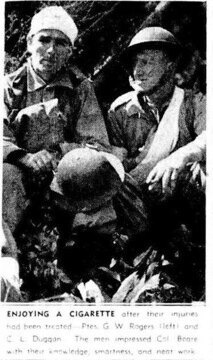
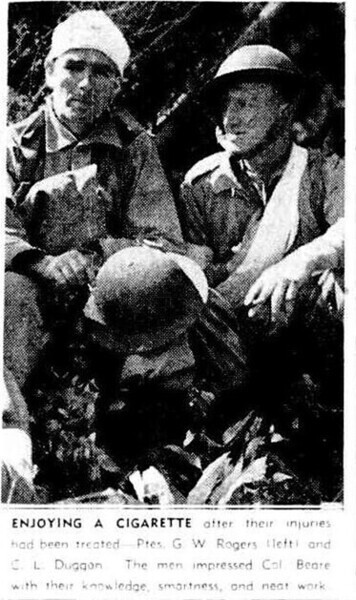
George and his fellow new enlistees trained at Woodside in the Adelaide Hills where part of their training included realistic practices for emergencies they would possibly face. This was also an event that would give good exposure to potential recruits, so was well covered by the media, including The September issue of The News. Reporters travelled to the ‘Bird in Hand’ mine near the army training centre at Woodside. The realistic manoeuvres were undertaken under active service conditions with the ‘injured’ patients placed on stretchers and gas masks in use. The latter was as a response to the use of gas in WWI. George was one of the ‘injured’ as was fellow enlistee SX4007 Clarence Duggan from Hallett (who later served with the 2/6th Field Ambulance).
George spent his pre-embarkation leave in Pinnaroo in August, then just days after Christmas, on the 29th, he embarked for the Middle East, arriving on the 31st January. He was initially with the 2/6th Field Ambulance but by March he had transferred to the 2/48th Battalion. He was to become one of the highly regarded Rats of Tobruk. Ironically the taunt of ‘living like rats’ was designed to destroy morale but it had the opposite effect and was seized upon as an unofficial badge of honour. In an accident that could have been fatal, during the Siege of Tobruk, George received an accidental bullet wound to his head on the 21st April.
Initially on the 8th May ’41, back home newspapers reported that George was listed as wounded in action with Pte Thomas Wright SX6519 from Broken Hill. This was corrected a week later with the announcement that George was accidentally wounded.
George was evacuated to hospital with his record corrected to read a ‘gunshot wound to his neck’. Regardless, by the end of August, the Medical Board classified him as Permanently Unfit for Service’ and he was discharged from hospital to sail home on the 21st November ’41 arriving less than a year after he departed. The December issue of The Advertiser published many stories from the Tobruk men on the vessel. These included attacks on Red Cross Hospitals, including being bombed by Italian planes. The men reported that the Australian troops were ‘in great heart and were always eager to be in the thick of the fighting.’ George was one of more than 50 South Australians in the return party, which included several officers.
Close inspection of his injury back in South Australia indicated his wound was to the 3rd vertebrae. The proximity to the spinal cord carried a real risk of brain injury and to movement. Perhaps not unexpectedly while being treated, George chose about 90 minutes of freedom from hospital and chose not to follow a Hospital order which cost him £2.
George was eventually discharged on the 22nd January ’42. He married a widow, Lorna Rose in ’47 who had a daughter whom George treated as his own.
Aged 58, George died at Woodville Gardens on the 28th October ’71. He was buried in the Enfield Memorial Park Cemetery Eastern Niche Wall Number 1 GA-GU 16 – 1
Researched and written by Kaye Lee, daughter of Bryan Holmes SX8133, 2/48th Battalion.
Submitted 7 May 2026 by Kaye Lee
Click images to start slideshow.