








JACKSON, John Francis
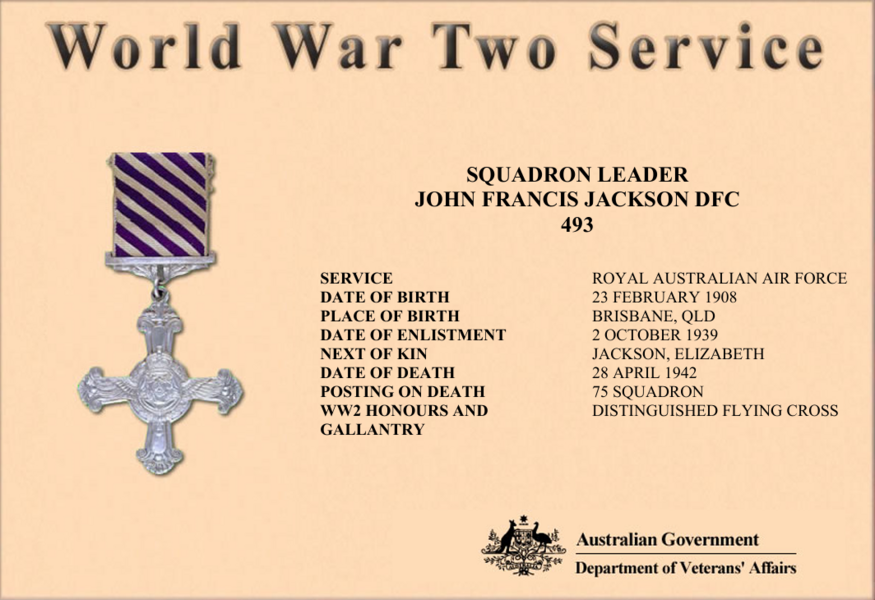
| Service Number: | 493 |
|---|---|
| Enlisted: | 2 October 1939 |
| Last Rank: | Squadron Leader |
| Last Unit: | No. 75 Squadron (RAAF) |
| Born: | Brisbane, Queensland, Australia , 23 February 1908 |
| Home Town: | Saint George, Balonne Shire, Queensland |
| Schooling: | The Scots College, Warwick |
| Occupation: | Stock and Station Agent |
| Died: | Flying Battle, New Guinea, 28 April 1942, aged 34 years |
| Cemetery: |
Port Moresby (Bomana) War Cemetery, Papua New Guinea CWGC Grave No: Section B. Plot 2. Row C. Grave 17. Inscription: "LIFE IS ETERNAL". |
| Memorials: | Australian War Memorial Roll of Honour, Spring Hill Brisbane Grammar School WW2 Great Hall Honour Board, St George Memorial Wall - We Remember Their Sacrifice, St George The Pilots Memorial |
World War 2 Service
| 3 Sep 1939: | Involvement Squadron Leader, 493 | |
|---|---|---|
| 2 Oct 1939: | Enlisted Royal Australian Air Force, Pilot Officer, 493, No. 23 Squadron (RAAF), Previously Air Force reserve 1936-39 | |
| 2 Oct 1939: | Enlisted Royal Australian Air Force, Squadron Leader, 493, No. 75 Squadron (RAAF) | |
| 30 Apr 1940: | Promoted Royal Australian Air Force, Flying Officer | |
| 19 Oct 1940: | Embarked Royal Australian Air Force, Flying Officer, 493, No. 3 Squadron (RAAF), Emb. Sydney for Middle East | |
| 26 Nov 1940: | Involvement Royal Australian Air Force, Flying Officer, 493, No. 3 Squadron (RAAF), Middle East / Mediterranean Theatre | |
| 1 Jul 1941: | Promoted Royal Australian Air Force, Flight Lieutenant, No. 3 Squadron (RAAF) | |
| 1 Jan 1942: | Honoured Mention in Dispatches | |
| 19 Mar 1942: | Involvement Royal Australian Air Force, Squadron Leader, 493, No. 75 Squadron (RAAF), Air War SW Pacific 1941-45 | |
| 19 Mar 1942: | Promoted Royal Australian Air Force, Squadron Leader, No. 75 Squadron (RAAF), Commanding Officer | |
| 7 Apr 1942: | Honoured Distinguished Flying Cross |
Help us honour John Francis Jackson's service by contributing information, stories, and images so that they can be preserved for future generations.
Add my storyBiography contributed by Robert Johnson
Port Moresby International Airport, also known as Jacksons International Airport, is named after John. His story is told by his son, Arthur, to commemorate the 75th anniversary of John's death,
See Link to the left of this page.
Biography contributed by Rod Hutchings
He was not meant to be there.
John Francis Jackson was a grazier from Queensland, a man used to distance, responsibility, and making decisions on his own ground. Before the war he ran properties, managed business interests, and flew because it made sense to do so. Aircraft shortened the country. They made work possible. Flying, for him, began as practicality, not romance.
When war came in 1939, he joined the Royal Australian Air Force as a pilot. He was already older than many of the men around him. Already a husband. Already a father. He did not come into uniform as a boy looking for direction. He came in as a man who had one, and set it aside.
What drove him is there in fragments, mostly in his own words.
He had little patience for distance between decision and consequence. He wrote critically of headquarters, of delays, of what he saw as poor organisation. He argued with senior officers when he believed his pilots were being overworked. “I’m afraid I’m too critical,” he admitted after one such dispute, though the criticism itself never really softened.
That tells us something important. He was not a passive officer. He was a thinking one.
In the Middle East with No. 3 Squadron, he learned his trade the hard way. Early combat left its mark.
“Had my first stoush… about 12… round me like bees… only providence saved me.”
That is not bravado. It is a man describing what it felt like to be alone in the air with too many enemies and not enough margin. He survived crashes, mechanical failures, and engagements that could easily have ended his war then and there. He attributed some of that survival to providence, but there was also skill—quick judgement, aggression when needed, and the ability to stay alive long enough to learn.
He was awarded the Distinguished Flying Cross for that period, but the citation cannot show the accumulation of fatigue that sat behind it.
“We are all done in and dog-tired… nearly too tired to sleep.”
And more quietly:
“Strange how one’s courage wanes.”
That line matters. It cuts through the idea of constant bravery. Jackson understood that courage was not fixed. It rose and fell with exhaustion, fear, and repetition. Leadership, in that environment, meant carrying on regardless and expecting others to do the same.
He was also, unmistakably, human in the way he wrote. He joked about poor equipment, about the absurdities of military administration, about his own decisions. He managed an Italian prisoner of war, Giorgio Rizzo, as a batman, communicating through gestures, broken language, and “a few well-chosen Aussie swear words.”
There is no ideology in that moment. Just two men working out how to get through the day.
Behind all of this sat his family.
His letters show concern not just for himself, but for his wife and children in Australia as the war moved closer. He considered moving them, even sending them overseas if necessary, weighing risks in the same practical way he approached everything else. He was not abstract about war. It had already reached into his home.
When he returned to Australia, he was no longer simply a pilot. He was one of the few men with real combat experience. That mattered.
In March 1942, he was given command of No. 75 Squadron, a newly formed unit equipped with Kittyhawks and filled with young pilots, many with little or no combat experience. The situation in New Guinea was deteriorating quickly. Port Moresby was the last barrier before Australia itself.
Jackson’s task was to take that group and make it operational in days.
What did others think of him? They called him “Old John.” It was not a dismissal. It was recognition. He was older, more experienced, and, importantly, steady. In a squadron of young men, that steadiness mattered.
He taught them how to fight and how to survive. Formation discipline. Situational awareness. The importance of not being drawn into combat that favoured the enemy aircraft. His notes on air fighting show a methodical mind—see the enemy first, stay together, avoid being surprised. These were not abstract principles. They were survival rules.
He led from the front. That was both his strength and, ultimately, part of the cost.
In April 1942, he was shot down near Lae during a reconnaissance flight. He survived the crash, made it ashore, and began a difficult journey back through jungle and mountains with the help of local villagers. He arrived exhausted, injured, but alive.
“Providence alone has saved me… I could only just stagger…”
He resumed command almost immediately.
That decision tells its own story. He could have been evacuated. He could have stepped back. He did neither.
Within days, he was flying again.
The final action on 28 April 1942 came at a time when No. 75 Squadron was already worn down, aircraft lost, pilots killed, the margin for error narrowing. Jackson had taught his pilots to avoid turning engagements with the Japanese Zero, an aircraft superior in manoeuvrability.
There was pressure to prove otherwise.
He went up to show it could be done.
Caught at a disadvantage at altitude, his aircraft was engaged by Japanese fighters. In the ensuing combat, he was killed when his Kittyhawk went into a vertical dive and crashed.
He was thirty-four years old.
His death was not just the loss of a squadron commander. It was the removal of the one man in that unit who had already learned, at cost, how to survive and how to teach others to do the same.
For his family, it was something else entirely.
His children would grow up without him. One would later describe him simply as the father they never knew. That absence sits alongside every operational record, every citation, every victory.
There was no “after the war” for John Jackson.
But his influence carried forward. The squadron he led continued to fight. The defence of Port Moresby held. The airfield he helped protect would later bear his name, Jacksons.
What remains is not just the record of a fighter ace or a squadron leader. It is the picture of a man who brought civilian judgement into uniform, who questioned, who learned quickly, who led from the front, and who carried both professional responsibility and personal concern at the same time.
He had a lot to fight for.
That is what makes his story endure.
Rod Hutchings
Director, Virtual War Memorial Australia



Click images to start slideshow.