







WATSON, William Walker Russell
| Service Number: | Officer |
|---|---|
| Enlisted: | 17 August 1914 |
| Last Rank: | Colonel |
| Last Unit: | Headquarters 17th Brigade (AIF WW1) |
| Born: | Sydney, New South Wales, Australia, 19 May 1875 |
| Home Town: | Sydney, City of Sydney, New South Wales |
| Schooling: | Sydney High School , New South Wales, Australia |
| Occupation: | Gentleman |
| Died: | Septicaemia, Sydney, NSW, 30 June 1924, aged 49 years |
| Cemetery: |
South Head General Cemetery, Vaucluse, New South Wales Location: S-N-GE-398 |
| Memorials: |
Boer War Service
| 1 Oct 1899: | Involvement Captain, 1st New South Wales Mounted Rifles |
|---|
World War 1 Service
| 17 Aug 1914: | Enlisted AIF WW1, Lieutenant Colonel, Officer | |
|---|---|---|
| 18 Aug 1914: | Involvement AIF WW1, Lieutenant Colonel, Officer, Australian Naval and Military Expeditionary Force, German New Guinea, Appointed to command AN&ME from Sep 1914 to January 1915 | |
| 10 May 1915: | Embarked AIF WW1, Lieutenant Colonel, Officer, 24th Infantry Battalion, --- :embarkation_roll: roll_number: '14' embarkation_place: Melbourne embarkation_ship: HMAT Euripides embarkation_ship_number: A14 public_note: '' | |
| 10 May 1915: | Embarked AIF WW1, Lieutenant Colonel, Officer, 24th Infantry Battalion, HMAT Euripides, Melbourne | |
| 5 Nov 1916: | Involvement AIF WW1, Colonel, Officer, Headquarters Staff, Commanded AIF Infantry Training Depot UK | |
| 19 Jul 1917: | Involvement AIF WW1, Colonel, Officer, Headquarters 17th Brigade (AIF WW1), Formed in the UK on Salisbury Plain. Disbanded Sep 1917 | |
| 20 Jan 1920: | Discharged AIF WW1, Colonel, Officer |
Help us honour William Walker Russell Watson's service by contributing information, stories, and images so that they can be preserved for future generations.
Add my storyBiography contributed by Steve Larkins
Residential address on enlistment "Gattoma" Elizabeth Bay Sydney New South Wales.
Employment - "Independent" C/- S Hordern and Son Ltd., Brickfield Hill, Sydney, New South Wales
NoK - Mrs Minnie Sarah Russell Watson
Biography contributed by Trevor Watson
Watson, William Walker Russell (1875–1924)
William Walker Russell Watson (1875-1924), soldier, dentist and company director, was born on 19 May 1875 at Balmain, Sydney, son of native-born parents William George Watson, surgeon, and his wife Emily Jane, née Walker. Educated at Sydney Boys' High School (where he was a cadet bugler) and the University of Sydney, Watson entered the dental profession. He joined the New South Wales Scottish Rifles and in 1896 was commissioned second lieutenant in the 4th Infantry Regiment.
He served as a lieutenant, New South Wales Mounted Rifles, in the South African War. As a staff officer in the 2nd Imperial Mounted Infantry Corps, he was dispatched to demand the surrender of Pretoria; under heavy fire at Dainsfontein, he risked his life to rescue a wounded man. For his service in the Orange Free State, Cape Colony and the Transvaal, he was mentioned in dispatches and promoted captain. In 1902 he commanded the New South Wales detachment of the Australian Coronation Corps at the crowning of King Edward VII. Watson was promoted major in 1905 and lieutenant-colonel in 1912. On 9 November 1904, at St Mark's Church, Darling Point, Sydney, he had married Minnie Sarah, daughter of Samuel Hordern and sister of (Sir) Samuel Hordern; they were to remain childless.
Watson was appointed commanding officer of the infantry battalion of the Australian Naval and Military Expeditionary Force raised in August 1914 to seize German Pacific territories. Virtually unopposed, by December his troops had secured New Britain, New Guinea, New Ireland, Nauru, and the Admiralty and Solomon Islands. In January 1915 he returned to Australia with Colonel William Holmes; both gave evidence before a court of inquiry into looting by the A.N. & M.E.F.
On 16 March Watson took command of the 24th Battalion, Australian Imperial Force, and reached Gallipoli on 5 September. As his brigade commander Colonel Richard Linton had died at sea after a troopship had been torpedoed, Watson temporarily commanded the 6th Brigade for its landing. On the night of 10-11 September the 24th took over positions at Lone Pine. In addition to hardship caused by the onset of cold weather, they suffered casualties from suffocation in the shallow tunnels and dug-outs when the Turks bombarded them in November. During the evacuation of Gallipoli, Watson successfully commanded the 6th Brigade rear parties; for his service on the peninsula he was appointed C.B. and again mentioned in dispatches.
In March 1916 the 24th Battalion sailed for France and in April moved into the line at Fleurbaix. Near Albert, on the night of 7-8 August a shell burst in an old gun-pit occupied by battalion headquarters. Watson was the sole survivor. Admitted to hospital with shell-shock, he resumed command on 12 October. He took charge of the 2nd Division Training School in November. In May 1917 he resumed command of the 24th Battalion, but in July returned to England where he had charge of the 17th Brigade; in September he was appointed commandant of the Overseas Training Depot near Warminster. He immediately convened a court martial to deal with outstanding cases, re-wrote standing orders and introduced more effective training programmes. He was promoted colonel on 1 June 1918. Desertion by Australian troops on leave in England had increased. On one occasion, when a draft paraded before returning to France, a soldier protested that he would not go unless he were carried. Watson had him tied to an ambulance and dragged with the draft until he begged to be released. In December Watson was appointed C.M.G.; in January 1919 he became commander of the A.I.F. depot at Sutton Veny.
From April until July Watson took special leave to participate in the A.I.F. non-military employment scheme and was involved in the manufacture of cardboard at Anthony Hordern & Sons in London. He embarked for Australia in September and was awarded the Légion d'honneur in December. After demobilisation he became chairman of directors of Cumberland Paper Board Mills Ltd, a member of the New South Wales Club and the National Club, and an adherent of the National Party.
Allegedly as the result of a chill caught at the funeral of Brigadier General Henry Finn, Watson died in Sydney of septicaemia on 30 June 1924 and was buried with Anglican rites in South Head cemetery. He was survived by his wife. Typical of the better A.I.F. commanders, he was respected by his troops; he was intensely loyal to them, but would not tolerate those who sought to evade their responsibilities.
Australian Dictionary of Biography entry.

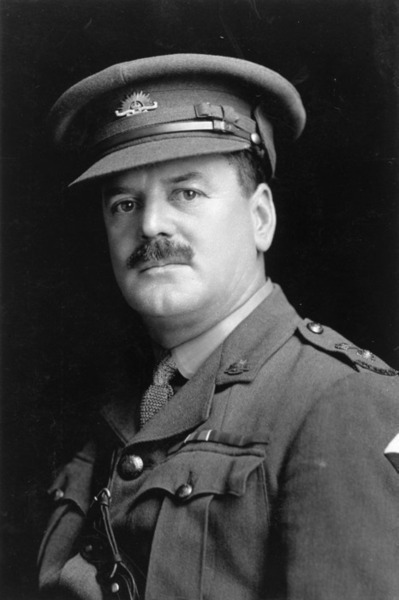

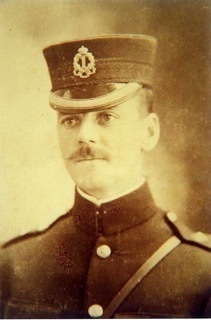
Click images to start slideshow.