








S5253
CARR, Gabriel
| Service Number: | 4516 |
|---|---|
| Enlisted: | 3 November 1916 |
| Last Rank: | Corporal |
| Last Unit: | 43rd Infantry Battalion |
| Born: | Port Lincoln, SA, 19 February 1886 |
| Home Town: | Tumby Bay, Tumby Bay, South Australia |
| Schooling: | Wadella School (near Yallunda Flat SA) |
| Occupation: | Farmer |
| Died: | Tumby Bay, 29 October 1961, aged 75 years, cause of death not yet discovered |
| Cemetery: |
Tumby Bay Cemetery |
| Memorials: | Tumby Bay Great War Honor Roll, Tumby Bay Great War Honor Roll, Tumby Bay RSL Portrait Memorials |
World War 1 Service
| 3 Nov 1916: | Enlisted AIF WW1, Private, 4516, 2nd Depot Battalion | |
|---|---|---|
| 16 Dec 1916: | Involvement AIF WW1, Private, 4516, 32nd Infantry Battalion, --- :embarkation_roll: roll_number: '17' embarkation_place: Adelaide embarkation_ship: HMAT Berrima embarkation_ship_number: A35 public_note: '' | |
| 16 Dec 1916: | Embarked AIF WW1, Private, 4516, 32nd Infantry Battalion, HMAT Berrima, Adelaide | |
| 11 Nov 1918: | Involvement AIF WW1, Corporal, 4516, 43rd Infantry Battalion | |
| 20 Nov 1919: | Discharged AIF WW1, Corporal, 4516, 43rd Infantry Battalion |
Help us honour Gabriel Carr's service by contributing information, stories, and images so that they can be preserved for future generations.
Add my storyBiography contributed by St Ignatius' College
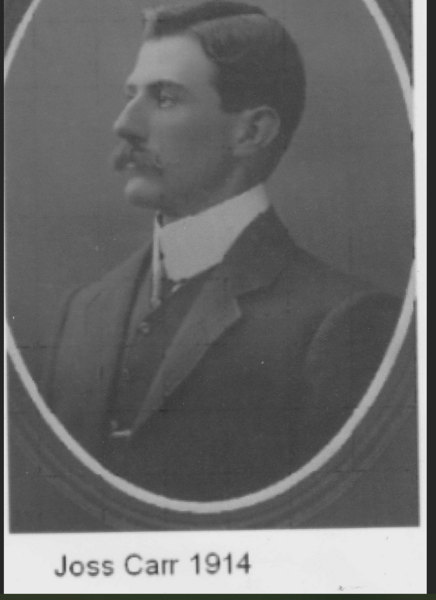
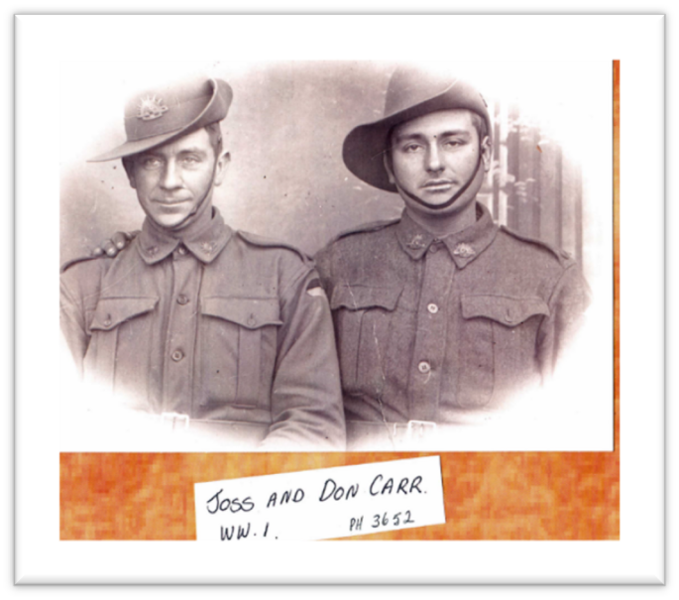
GaGabriel Carr, known as Joss, was born on February 19th 1886 in Port Lincoln, South Australia to Margaret Carr (nee McCallum) and George Carr. He was the eldest of 4 children: Donald, Horace and Edith (Ediee). Gabriel’s brother Donald Carr also served in World War One with the 27th infantry Battalion. Gabriel attended a school at Wadella located near Yallunda flat in South Australia. Upon enlistment Gabriel listed his occupation as a Farmer and his address as Tumby Bay. He married Lavinia on the 12th of December (4 days before embarkment) at the College Park Congregational Church, South Australia.
Gabriel enlisted for service in the war on the 3rd of November 1916, in Adelaide, South Australia. Gabriel enlisted for the war when he was 30 years of age.
Before embarkment from Australia, Gabriel trained at the Mitcham Army Camp. He embarked from Adelaide 16th of December 1916, aboard the HMAT A35 Berrima bound for the UK. Gabriel disembarked in Devonport, England on the 16th of February 1917.
In England he trained at the Australian Imperial Force (AIF) Fovant Hurdcott Camp and Fovant Parkhouse Camp located on the Salisbury Plains. It was recorded that he trained at those military camps during the early and late part of 1917. Gabriel was admitted to the military hospitals at Parkhouse and Hurdcott for influenza in March and Mumps disease in April. He trained with the 8th training battalion when at the Hurdcott military camp. He continued training as a reserve for the Bn (8th) from around March to October of 1917.
On the 25th of September 1917, Gabriel embarked overseas to France, Le Havre. He marched in 36th of September 1917 and was taken on strength with the 43rd Battalion 30th October.
In early 1918 the 43rd battalion was involved in the German Spring Offensive (GSF) which involved a series of German attacks on the Western front during late March, April and May. The 43rd Battalion spent most of its time fighting in the Somme Valley. As part of the GSF the 43rd battalion undertook defensive actions around Morlan court (in the Somme) late March.
On the 3rd of April 1918, Gabriel was promoted to Lance Corporal. He was then later promoted to Temporary Vice Corporal on the 13th of April.
In April Gabriel fought in the battle of Villers-Bretonneux (located in the Somme) late April 1918 where he helped stop the GSF. Gabriel (43rd Battalion) as part of the 11th Brigade was involved in Lieutenant General John Monash’s attack to capture the village of Hamel on the 4th of July. On the 26th of July Gabriel was demoted to Corporal.
In August the battalion was involved in the Hundred-Day Offensive. Gabriel helped drive the Germans back to the Hindenburg line on September 29th, 1918 with his unit (43rd Bn). Gabriel’s last action with the battalion was at the battle of Mont Saint Quentin where the 43rd joined the advance that followed the second divisions victory at Mont St Quentin which ultimately led to the Armistice.
The battalion was withdrawn from the front lines in October 1918, and Gabriel was promoted to Substantive Corporal.
He left Le Havre on March 11th 1919, and disembarked in South Hampton on March 12t,. He was given leave with pay from the 2nd of March through to the 11th of July 1919 to attend a stock breeding and farming course at the property of Brigadier Harrison Crawford at Dunlop House, Ayrshire.
Upon completion of the course, he embarked on the SS Ajana on the 19th of August 1919 to return to Australia. He disembarked in Sydney on the 9th of October 1919 and was discharged from the war on the 20th of November 1919.
After returning from the war, Gabriel reunited with his wife (Lavinia) and resumed working on his farm in Wadella. There, he raised his family of one girl and two boys: Phyllis Jean Carr, Reginald Carr and Ronald Maxwell Carr. Later in life he purchased a property of 2500 acres from Mr Michael Sheehan in 1925. His family moved onto this property located in Koppio in 1926, but Gabriel continued to work at his farm in Wadella.
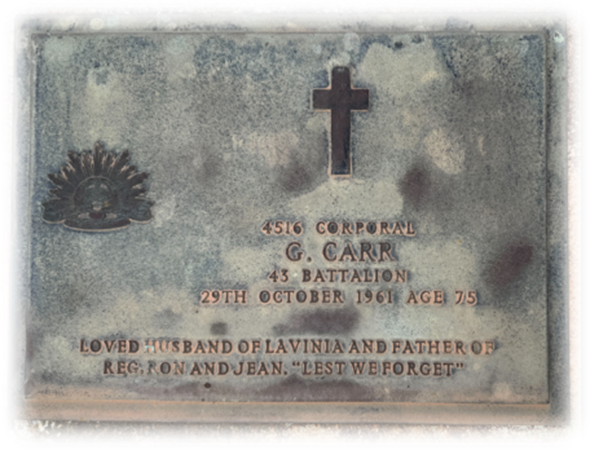
Gabriel and Lavinia later retired to Tumby Bay and his son took over the operation of the farm. Gabriel’s died on the 29th of October 1961, aged 75. His body was buried at the Tumby Bay Cemetery in Tumby Bay, South Australia. His wife Lavinia died in 1965 and was laid to rest next to her husband. His head stone reading: Loved Husband of Lavinia and Father of Reg, Ron, and Jean. “Lest We Forget.”



Click images to start slideshow.