






MCNEIL, William George
| Service Number: | 668 |
|---|---|
| Enlisted: | 27 August 1914, 2.5 years Senior Cadets |
| Last Rank: | Private |
| Last Unit: | 1st Machine Gun Battalion |
| Born: | Boggabri, New South Wales, Australia, 13 December 1892 |
| Home Town: | Waterfall, Sutherland Shire, New South Wales |
| Schooling: | Not yet discovered |
| Occupation: | Railway signalman |
| Died: | Brisbane Mental Hospital, Goodna, Queensland, Australia, 24 January 1952, aged 59 years, cause of death not yet discovered |
| Cemetery: |
Lutwyche Cemetery, Brisbane, Qld Anzac Portion 8 |
| Memorials: | Roseworthy Agricultural College Roll of Honour, Sutherland WW1 Memorial Wall, Waterfall Roll of Honor |
World War 1 Service
| 27 Aug 1914: | Enlisted AIF WW1, Private, 668, 4th Infantry Battalion, 2.5 years Senior Cadets | |
|---|---|---|
| 20 Oct 1914: | Involvement Private, 668, 4th Infantry Battalion, --- :embarkation_roll: roll_number: '8' embarkation_place: Sydney embarkation_ship: HMAT Euripides embarkation_ship_number: A14 public_note: '' | |
| 20 Oct 1914: | Embarked Private, 668, 4th Infantry Battalion, HMAT Euripides, Sydney | |
| 6 Apr 1916: | Honoured Mention in Dispatches, The August Offensive - Lone Pine, Suvla Bay, Sari Bair, The Nek and Hill 60 - Gallipoli, At Lone Pine, 6th August, volunteered for a storming party under Capt. Scott, 4th Bn., for the capture of an important link of enemy trench which was taken in the face of heavy bomb fire. This action was of great value to the defence in opening up communication with neighbouring units and keeping down hostile bomb fire. Awarded, and promulgated, 'London Gazette', Supplement No. 29455 (28 January 1916); 'Commonwealth Gazette' No. 44 (6 April 1916). | |
| 24 Mar 1920: | Discharged AIF WW1, Private, 668, 1st Machine Gun Battalion , 2nd MD |
Help us honour William George McNeil's service by contributing information, stories, and images so that they can be preserved for future generations.
Add my storyBiography contributed by Evan Evans
From Australian Remembrance Army
Over the past six years we have submitted the service records and causes of death of several hundred veterans to the Office of Australian War Graves for assessment for Official Commemoration. To date, more than 100 of these veterans interred at Lutwyche Cemetery have been accepted for Official Commemoration, and their graves are now being formally marked and will be maintained in perpetuity by the Office of Australian War Graves.
Australian World War One veteran Private William George McNeil MiD (Service No. 668) is one of the previously unmarked First World War veterans at Lutwyche Cemetery whose grave has now been accepted for Official Commemoration. He was Mentioned in Despatches (MiD) for his valuable actions at Gallipoli.
See Australian Remembrance Army Facebook page
Mention in Despatches:
“I have the honor to submit herewith the name of No. 668, Private W. G. McNeil, 4th Battalion, whose services I wish to bring to your Lordship's notice in connexion with the operations described in my despatch of 11th December, 1915.”
“Volunteered for a storming party under Capt. Scott, 4th Bn., for the capture of an important link of enemy trench which was taken in the face of heavy bomb fire. This action was of great value to the defence in opening up communication with neighbouring units and keeping down hostile bomb fire.”
OAWG Official Commemoration:
https://connect.dva.gov.au/.../viewCommemoration.html...
William George McNeil was born on 13 December 1892 at Boggabri, New South Wales, the son of James McNeil and Margaret McNeil (née Archibald). Before the outbreak of the First World War, he worked as a railway employee. On 27 August 1914, shortly after Australia entered the war, he enlisted in the Australian Imperial Force in Sydney. He embarked for overseas service in October 1914 aboard HMAT Euripides.
In July 1915 McNeil joined the 4th Battalion at Gallipoli. During the Battle of Lone Pine on 6 August 1915 he volunteered for a storming party led by Captain Scott tasked with capturing a key section of enemy trench. The position was taken under heavy bomb fire, and his actions were recorded as helping to maintain communications with neighbouring units and suppress hostile bombing. For his conduct during these operations, he was Mentioned in Despatches by General Sir Ian Hamilton on 11 December 1915. Around the same period McNeil was wounded, suffering a gunshot wound to the wrist, and was evacuated through Mudros before being transported to England for treatment.
After recovering, he spent much of the remainder of the war in Britain with Australian machine-gun training and depot units. His service record shows a number of hospital admissions for illness and injuries. In early 1918 he appeared before a medical board which diagnosed defective vision in his right eye, attributed to shell concussion during active service. The board assessed his disability at approximately 30 percent and declared him permanently unfit for general service, although still capable of limited duties. Despite this, he continued to serve in training and depot roles and at one stage held temporary promotion. Late in 1918 he briefly returned to France with the 1st Machine Gun Battalion but was soon hospitalised again with synovitis of the knee and returned to England. In November 1919 he sailed for Australia aboard the transport SS Ypiranga.
McNeil’s post-war life was marked by continuing health problems and financial difficulty. He suffered from chronic bronchial asthma and other lingering medical issues and spent periods in hospital. In the early 1940s he wrote to the Department of Repatriation seeking to have his invalid pension converted to a service pension, explaining that his condition was chronic and that he required access to medical treatment during severe attacks. Correspondence with the department shows that his case was considered, although officials noted that service pensions were separate from war pensions and did not automatically entitle a veteran to medical treatment unless a disability was clearly attributable to war service.
Private William George McNeil MiD died from a perforated gastric ulcer at Brisbane Mental Hospital, Goodna, on 24 January 1952, aged 59. William was buried the following day in Anzac Portion 8, Lutwyche Cemetery, Brisbane. His death certificate recorded his occupation as cane cutter, and that he was unmarried and had no known children.
In 2024, seventy-two years after his death, we received notification that the Office of Australian War Graves had accepted our application for Official War Graves commemoration.
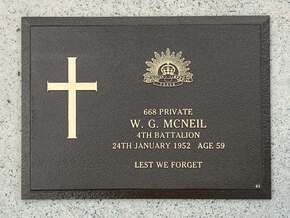
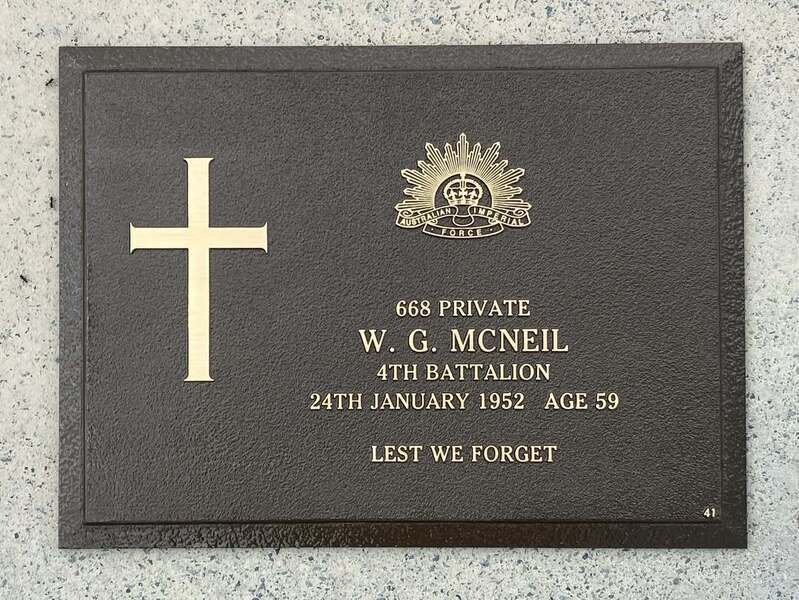
After decades in an unmarked grave, his final resting place now bears a plaque commemorating his service to Australia, ensuring his name endures among those remembered for their duty and sacrifice. His identity and dignity have now been restored.
Lest We Forget
Click images to start slideshow.