







EASTICK, Thomas Charles
| Service Numbers: | SX3295, 437351 |
|---|---|
| Enlisted: | 1 July 1918, Joined Senior Cadets 1/7/1914. Joined Citizen Forces 1/7/1918. |
| Last Rank: | Brigadier |
| Last Unit: | Headquarters 9 Australian Division |
| Born: | Hyde Park, South Australia, 3 May 1900 |
| Home Town: | Adelaide, South Australia |
| Schooling: | Goodwood Public School |
| Occupation: | Engineer |
| Died: | Natural causes, Somerton Park, South Australia, 16 December 1988, aged 88 years |
| Cemetery: |
West Terrace Cemetery (AIF Section) Cremated |
| Memorials: |
World War 1 Service
| 1 Jul 1918: | Enlisted Other Commonwealth Forces, Private, Joined Senior Cadets 1/7/1914. Joined Citizen Forces 1/7/1918. |
|---|
World War 2 Service
| 3 Sep 1939: | Enlisted Australian Military Forces (WW2) , Major, 13th Field Artillery Brigade | |
|---|---|---|
| 1 Oct 1939: | Promoted Australian Military Forces (WW2) , Lieutenant Colonel, 13th Field Artillery Brigade, Commanding Officer 13 Field Brigade (Militia) | |
| 10 Apr 1940: | Involvement Australian Military Forces (WW2) , Lieutenant Colonel, SX3295, 2nd/7th Field Regiment, Homeland Defence - Militia and non deployed forces, Appointed Commanding Officer | |
| 1 Jul 1942: | Involvement Australian Military Forces (WW2) , Lieutenant Colonel, SX3295, 2nd/7th Field Regiment, El Alamein | |
| 1 Jul 1943: | Promoted Australian Army (Post WW2), Brigadier, CRA 7 Australian Division. CRA 9 Australian division 31/7/1943 | |
| 4 Sep 1943: | Involvement Australian Military Forces (WW2) , Brigadier, SX3295, 7th Division Headquarters, New Guinea - Huon Peninsula / Markham and Ramu Valley /Finisterre Ranges Campaigns | |
| 1 Jun 1945: | Involvement Australian Military Forces (WW2) , Brigadier, SX3295, 9th Division Headquarters, Borneo - Operation Oboe May - August 1945, Commanded 9th Division Artillery from June 1944 Post War Commanded Kuching Force and administered Sarawak to Feb 46 | |
| 27 Feb 1946: | Discharged Colonel, SX3295, Headquarters (2nd AIF) | |
| 27 Feb 1946: | Discharged Australian Military Forces (WW2) , Colonel, 437351, Headquarters 9 Australian Division |
Non Warlike Service
| 28 Jan 1950: | Involvement Australian Army (Post WW2), Brigadier |
|---|
Help us honour Thomas Charles Eastick's service by contributing information, stories, and images so that they can be preserved for future generations.
Add my storyBiography contributed by Steve Larkins
Brigadier Sir Thomas Charles (Tom) Eastick, CMG, DSO, ED, MiD, JP (1900-1988)
Sir Thomas Charles (Tom) Eastick (1900-1988), engineer and army officer, was born on 3 May 1900 at Hyde Park, Adelaide, eldest of six children of Charles William Lone Eastick, plumber, and his wife Agnes Ann, née Scutt. Tom was educated at Goodwood Public School but left at the age of 12½ to look after his sick mother and his younger brothers and sisters while his father struggled to support the family. He became a junior purchasing officer with the hardware firm Colton, Palmer & Preston Ltd, where he developed the managerial skills which were a feature of his later life. He married Ruby Sybil Bruce, a saleswoman, on 31 October 1925 at the Baptist Church, Richmond, and they set up their home in the new suburb of Reade Park. He was a fair but firm father to his five sons, and a strict teetotaller who was never known to swear.
In 1927 Eastick was invited to manage temporarily an engineering company in Adelaide for twelve months. This career change was so successful that he co-founded a small engineering business, Angas Engineering Co. (Pty Ltd), with a friend who was a first-class mechanic. Business prospered until the Depression but thereafter times became progressively harder. During the night he would ride his bicycle to the factory to check on the case hardening of automotive components.
Having served four years in the senior cadets, Eastick had enlisted in the Australian Field Artillery, Militia, in 1918. Commissioned as a lieutenant in 1922, he set about his duties in the 13th Field Brigade with energy and efficiency and quickly developed a reputation as a sound trainer of men. He was given command of the 50th Battery in 1924 and promoted to captain in 1926. That year he demonstrated for the first time in Australia the use of survey procedures to predict gun data to engage targets without ranging. A second innovation with which he was associated was the control of artillery fire from aircraft: in 1927 a Royal Australian Air Force pilot adjusted the fire of Eastick’s battery during field firing. Eastick rose to major in 1930 and in 1938 his battery was awarded the Mount Schanck trophy for being the most efficient Militia field battery in Australia. In 1939 he was promoted to temporary lieutenant colonel and appointed commanding officer of the brigade.
Early in 1940, after the outbreak of World War II, Eastick embarked on a rigorous three-month training regime with his brigade. In April he was selected to raise and command the 2/7th Field Regiment, Australian Imperial Force, as a substantive lieutenant colonel. His unit was ultimately allotted to the 9th Division and embarked for the Middle East in November. Deployment on operations in North Africa followed from May to October 1941, after which the 2/7th became depot regiment at the British Army’s Middle East School of Artillery at Almaza near Cairo for three months. This honour was in recognition of the efficiency which Eastick had brought to his regiment and for which he was mentioned in despatches (1942). In February-June 1942 the regiment performed defensive duties in Syria and Lebanon.
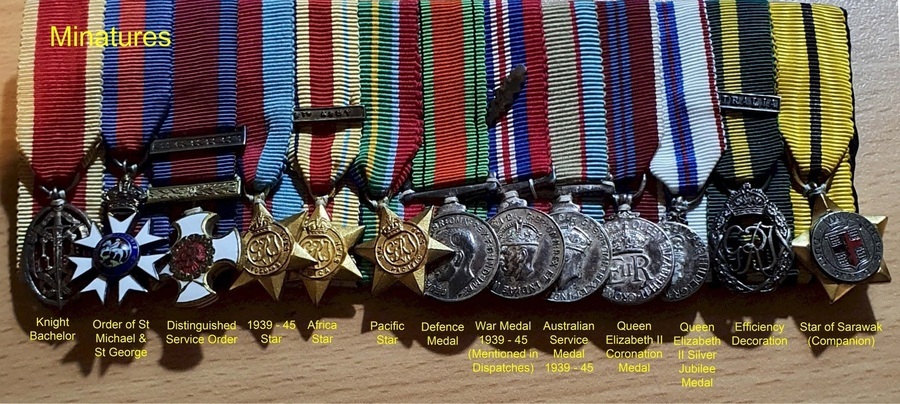
For the `forcefulness’ and `determination’ with which he commanded his regiment in Egypt, first at Tel el Eisa in July and then during the battle of El Alamein in October-November, Eastick was awarded the Distinguished Service Order. He returned to Australia in February 1943. In June he was promoted to temporary brigadier and posted as commander, Royal Australian Artillery, 7th Division. From August 1943 to April 1944 he served in Papua and New Guinea.
Appointed to command the 9th Division’s artillery in June 1944, Eastick served in Australia, Morotai and Borneo. During his command of Kuching Force (September-December 1945), he took the surrender of Japanese forces in southern Sarawak. He administered command of the 9th Division from December 1945 until February 1946. On 28 February he transferred to the Reserve of Officers with the honorary rank of brigadier. He was appointed a companion of the Order of the Star of Sarawak (1946).
Eastick resumed his civilian occupation and joined the Colonel Light Gardens sub-branch of the Returned Sailors’, Soldiers’ and Airmen’s Imperial League of Australia (Returned Services League from 1965); he was State president in 1950-54 and 1961-72. A Freemason, a justice of the peace and a leading participant in `A Call to the People of Australia’, he was also federal president of the Australia Day Council (1963-65, 1976-80). He served in an honorary capacity in some twenty-five other organisations, most of which were ex-service related.
On 28 January 1950 Eastick was recalled to the army as a brigadier and appointed commander, Headquarters Group, Central Command. Additionally, he was an honorary aide-de-camp to the governor-general Sir William McKell in 1950-53. He again transferred to the Reserve of Officers on 1 October 1953. From 1955 to 1960 he was a colonel commandant of the Royal Australian Artillery. Having been appointed CMG in 1953, he was knighted in 1970. He remained with Angas Engineering Pty Ltd until 1977.
Lady Eastick died suddenly in 1980. A few years later Sir Thomas moved to the Masonic Nursing Home at Somerton Park, where he died on 16 December 1988. Survived by his sons, he was cremated. His son Bruce was Speaker (1979-82) and leader of the Opposition (1972-75) in the South Australian parliament.
Integrity, professional competence, steadfastness, self-discipline and self-reliance had been instilled in Eastick at an early age. He inspired the officers and men he commanded with his proficiency and resolution. He was a valued and trusted businessman and servant of the many organisations with which he was involved. Despite the hardships of his early life and war service, he remained a kindly and charitable man who was tough and forceful when those attributes were required. He was not flamboyant, but a consistent performer who lived by the dictum with which he had been brought up—`near enough is never good enough’.
David N. Brook, 'Eastick, Sir Thomas Charles (Tom) (1900–1988)', Australian Dictionary of Biography, National Centre of Biography, Australian National University, https://adb.anu.edu.au/biography/eastick-sir-thomas-charles-tom-12451/text22393, published first in hardcopy 2007, accessed online 6 May 2026.
This article was published in hardcopy in Australian Dictionary of Biography, Volume 17, (Melbourne University Press), 2007
Biography contributed by Kathleen Bambridge
Brigadier Sir Thomas Charles Eastick C.M.G. D.S.O. E.D.
State President of RSL 1951-54 and 1962-1972. With his wife Lady Eastick who was also awarded a Life Membership for her work with the Women's Auxiliary, often undertaken with her husband. He recieved his accolade from her Majesty the Queen in Canberra during ANZAC week 1970.
His service to the RSL includes Vice-President national Executive. Member of the Defence Committee National Executive, RSL. Chairman of Trustees of Services Cemeteries, Poppy Day Trust and ANZAC Memorial Hall. Chairman Consultative Council of Ex-Serice Organisations of South Australia. Chairman of ANZAC DAY Committee. Chairman of the Women's Memorial Playing Fields Committee.Chairman Darby joan Cottages Scheme. Chairman of Girl in a Million. Chairman Defence and National Safety Committee, RSL. Chairman Land Settlement Committee Zone 5. Deputy Chairman World War 11 Services Welfare Fund. Chairman of the Violet Day Committee.
His work with Ex-servicemend Organisations includes Vice President El Alamein Group SA. Patron 2/7 Australian Field Regiment Unit.
his work in the broader community includes; Chairman of Marion Kindergarden Committee. Patron Holfast Bay Yacht Club. Member of Red Cross Society. Member Good Neighbour Council of SA. Member Committee Metal Industries Associatiton. Mtrember Charitable Purpose Committee of SA. . Member Betting Control Board. Federal President of Australia Day Council of Australia. State President Australia Day Council of S A. Honorary Commissioner Australia Forces Overseas Fund. Served for 31 years Justice of Peace.
**Joined the Senior Cadets 1/7/1914. Citizen Forces 1/7/1918. Promoted to Bombardier October 1918. Sergeant may 1920. Lt. April 1922. Captain 1926. Major 1930. Lt. Colonel 1939. Brigadier 1943.



Click images to start slideshow.